Nudged by Design: AI Features and Researcher Agency in Everyday Research Tools

Interface-level cues and automated behaviors that subtly steer user decisions in purposeful ways.

Borami Kang
Graduate student
MFA Candidate in Design Research and Development
The Department of Design
The Ohio State University

Artificial Intelligence (AI), particularly Large Language Models, is increasingly embedded as incremental features within familiar design research platforms such as Google, Miro, Notion, O’Reilly Media, and Zoom, rather than options. While promised as productivity enhancements, their effects on researcher attention, agency, and sense-making remain unexamined. Drawing on theories of behavioral nudging (Thaler &Sunstein), persuasive technology (Fogg), and human-centered AI (Shneiderman), this study examines these effects through the concept of AI nudges — interface-level cues and automated behaviors that subtly steer user decisions in purposeful ways. As AI becomes part of the background infrastructure of design research, understanding these micro-dynamics in different research activities is essential for both researchers managing their own practice and platform designers committed to responsible AI.

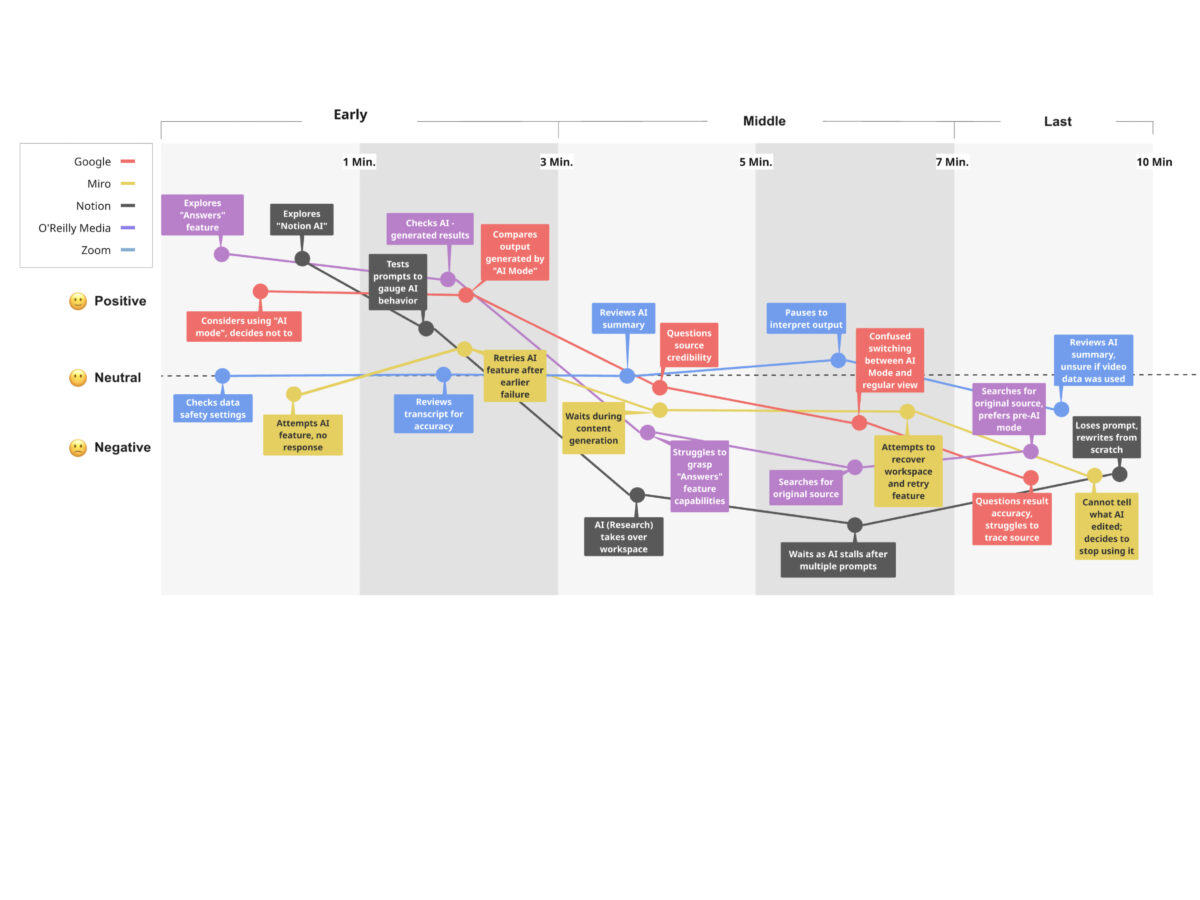
To study the micro-dynamics, the researcher conducted structured self-observation across five widely used platforms, performing core research tasks including literature search, synthesis, writing, reference review, and meeting documentation. Ten-minute sessions were recorded using screen capture, audio, and think-aloud protocols. Data were analyzed using Think-Feel-Say-Do (TFSD) empathy mapping at five time points per session and compared across platforms.

Across sessions, a consistent trajectory emerged: initial curiosity rapidly shifted to confusion, disorientation, and diminished control. Four themes were identified: (1) AI features appear as visual defaults rather than user-invoked options; (2) emotional states shift from engagement to fatigue as interventions accumulate; (3) automatic activation limits opportunities to pause or reverse actions; and (4) AI suggestions redirect inquiry away from original research intentions.

These findings suggest that current AI implementations reshape and frequently erode researcher agency not through explicit control, but through continuous, designed redirection. This paper contributes an analytical framework for examining AI-mediated research environments and proposes alignment between perceived and actual agency as a measurable criterion for responsible human-centered AI design.

This design research is presented at Design Incubation Colloquium 12.3: Virtual Summer on Friday, June 26, 2026.

Relational Construction in Graphic Design: ALT as Process-Driven Practice

Repetition, translation, sequencing, and restructuring.

Niharika Yellamraju
Adjunct Professor
Boston University
University of Connecticut

ALT began as a response to a recurring tension within graphic design practice: the expectation that every project must begin with a new idea. In many design environments, creativity is tied to the rapid generation of concepts, encouraging designers to prioritize novelty at the beginning of the process. This often creates a repetitive design process in which projects struggle to move beyond predictable visual patterns and familiar formal solutions.

ALT proposes an alternative approach through relational construction. Rather than beginning with a fixed concept, the work develops through the arrangement of elements and the relationships formed between them. Typography, images, sequence, scale, and structure are treated as active components that shape one another over time. The methodology operates through repetition, translation, sequencing, and restructuring, using constraint and variation to develop form across media.

The project takes form through books, typographic systems, websites, and serial print artifacts that move between print and digital contexts. Existing materials and visual structures are reorganized and recontextualized across formats, allowing the same content to shift through changes in scale, sequence, interaction, and reproduction. Printed pages may become scrolling surfaces, while production marks and repeated images are reused as structural and compositional elements. Through this process, ALT examines how graphic design can extend beyond static outcomes and operate as an evolving system across multiple contexts.

Situated within discussions of experimental publishing and process-driven design, ALT draws from traditions associated with figures such as Johanna Drucker, Ellen Lupton, and Massin. The project argues for a mode of practice in which meaning emerges through sustained formal relationships and the reorganization of existing structures rather than through idea-first authorship alone. 

This design research is presented at Design Incubation Colloquium 12.3: Virtual Summer on Friday, June 26, 2026.
A Global Approach to Typography: Introducing Multilingual Scripts in Beginning Design Courses

Foundational typography curricula.

Anna Jordan
Assistant Professor
Rochester Institute of Technology

Aisha Al Nouri, Jatin Joshi, Unika Dhakhwa
M.F.A. candidates
Rochester Institute of Technology

Design is a global language, yet beginning typography courses in the U.S. rarely teach beyond the Latin alphabet.

The topic of multilingual typography is largely confined to brief mentions in select textbooks, highly specialized design books, or rare elective courses available to very few students. Prior research underscores that awareness of the topic is essential for modern designers because visual communication operates across global contexts, yet it remains largely inaccessible to entry-level students. This study investigates whether short-format sprint workshops can effectively integrate multilingual scripts into foundational typography curricula.

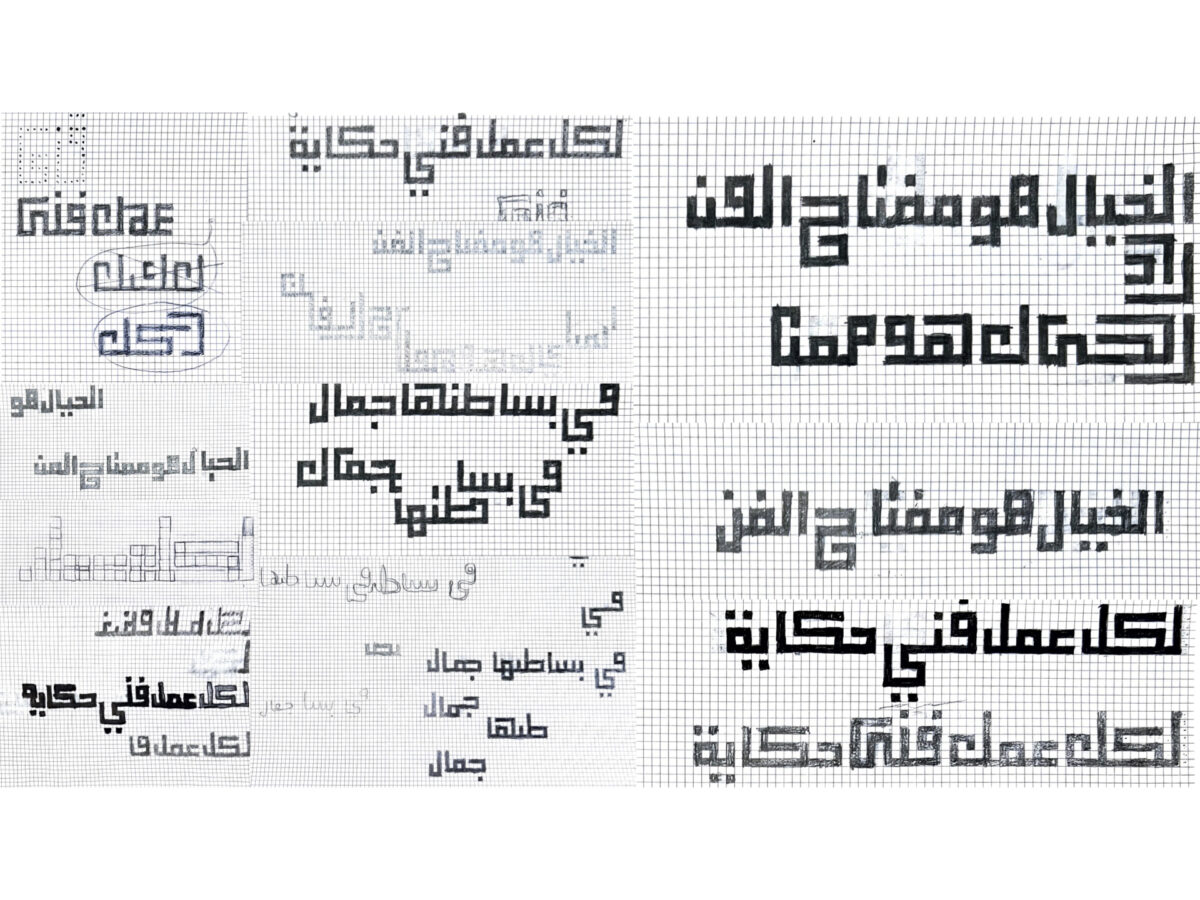
We found that multilingual scripts can be introduced into existing typography courses through short, structured workshops. We designed three single-class-session sprint workshops woven into a beginning typography course. Each workshop introduced a different script (Arabic, Hangeul, and Gujarati) and was led by graduate instructors with expertise in each script. The core approach was a “Learn-Play-Make” method that embraced the short format.

We focused on the visual and graphic qualities of the scripts rather than strict translation, while teaching foundational design skills applicable to typography across any language. The workshops produced distinct outcomes rooted in each script’s formal properties: connections in Arabic, geometry in Hangeul, and three-dimensional form in Gujarati. Students expanded their typographic visual vocabulary and grew more confident working with unfamiliar scripts.

Post-workshop surveys revealed four themes: students stepped outside Latin-centric thinking and recognized that design skills are not language-dependent; the sprint format reduced fear and made learning feel like play; even brief exposure sparked curiosity that extended beyond the classroom; and students grew more confident while expressing thoughtful ethical responsibility toward the cultures whose scripts they were working with. These findings demonstrate that multilingual typography can be effectively introduced within existing entry-level courses, offering a scalable way to prepare the next generation of typographers for the global design industry.

This design research is presented at Design Incubation Colloquium 12.3: Virtual Summer on Friday, June 26, 2026.
The Shift Deck: Pragmatic Design Pedagogy Interventions for Climate Resilience

Systems thinking, ethical responsibility, and resource stewardship.

Cindy Raspiller
Lecturer
San Jose State University

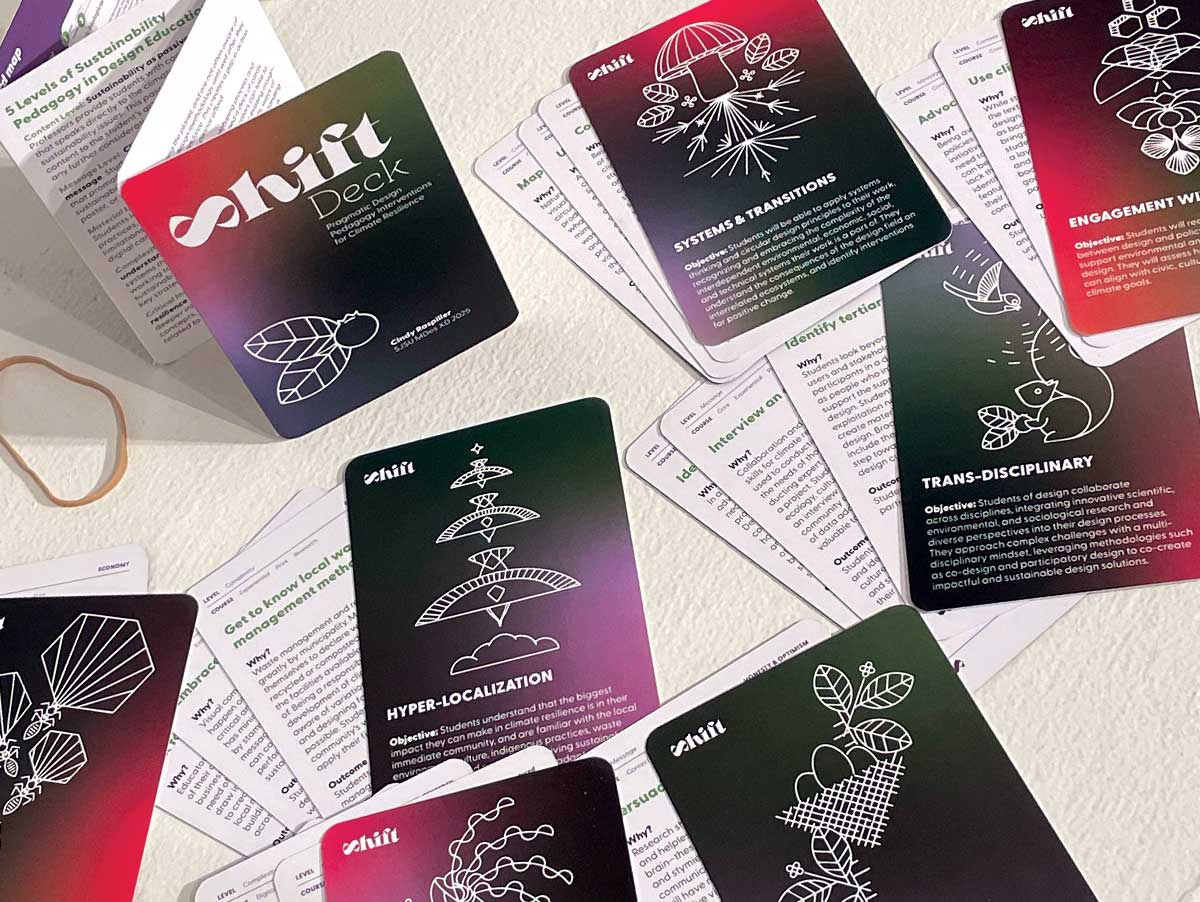
Climate resilience is rarely taught in visual communication design curricula, despite the growing recognition of design’s role in addressing environmental challenges. This research investigates why this gap persists and how climate resilience can be meaningfully integrated into design education. The Shift Deck is a pedagogical tool based on this research that empowers educators to introduce shifts toward climate resilient design into their teaching.

Analysis of the mixed-methods research approach–including literature reviews, curriculum analysis, survey data, and 24 semi-structured interviews–indicated that climate resilient design methodology is rarely taught in visual communication curricula because it is not physically substantial in nature, is considered academically separate from design, and professors feel unprepared to teach it.

These findings were synthesized into three interconnected frameworks that bridge theory, curriculum structure, and practical implementation. The 7 Mindsets of Climate Resilient Designers are student-facing learning objectives that define knowledge and practices necessary to build climate resilience, such as systems thinking, ethical responsibility, and resource stewardship. The 5 Levels of Sustainability Pedagogy in Design Education reflect degrees of student engagement with sustainable concepts and practices within the context of curriculum; from sustainability as passive content to sustainability as critical inquiry. Finally, the project’s design guidelines support instructors in practical application of the Shifts.

The frameworks informed the development of The Shift Deck: 27 small steps–or Shifts–educators can take to include climate resilient strategies in their assignments. Refined through interactive prototyping and student-centered co-design workshops, this bottom-up approach allows educators to advocate for climate resilient design practices without completely overhauling their pedagogy.

Built on prior work in sustainable design and pedagogy, including McDonough and Braungart’s Cradle to Cradle and David W. Orr’s Ecological Literacy, The Shift Deck offers conceptual frameworks and practical tools to position climate resilience as an accessible and actionable dimension of contemporary visual communication design education.

This design research is presented at Design Incubation Colloquium 12.3: Virtual Summer on Friday, June 26, 2026.
Designing Facilitated Experiences for Early Adolescents: Supporting Psychological Capital and Educational Access in Refugee Contexts

The Rohingya refugee crisis.

Hanna Ji
Graduate student
Master of Design Program
University of Arkansas

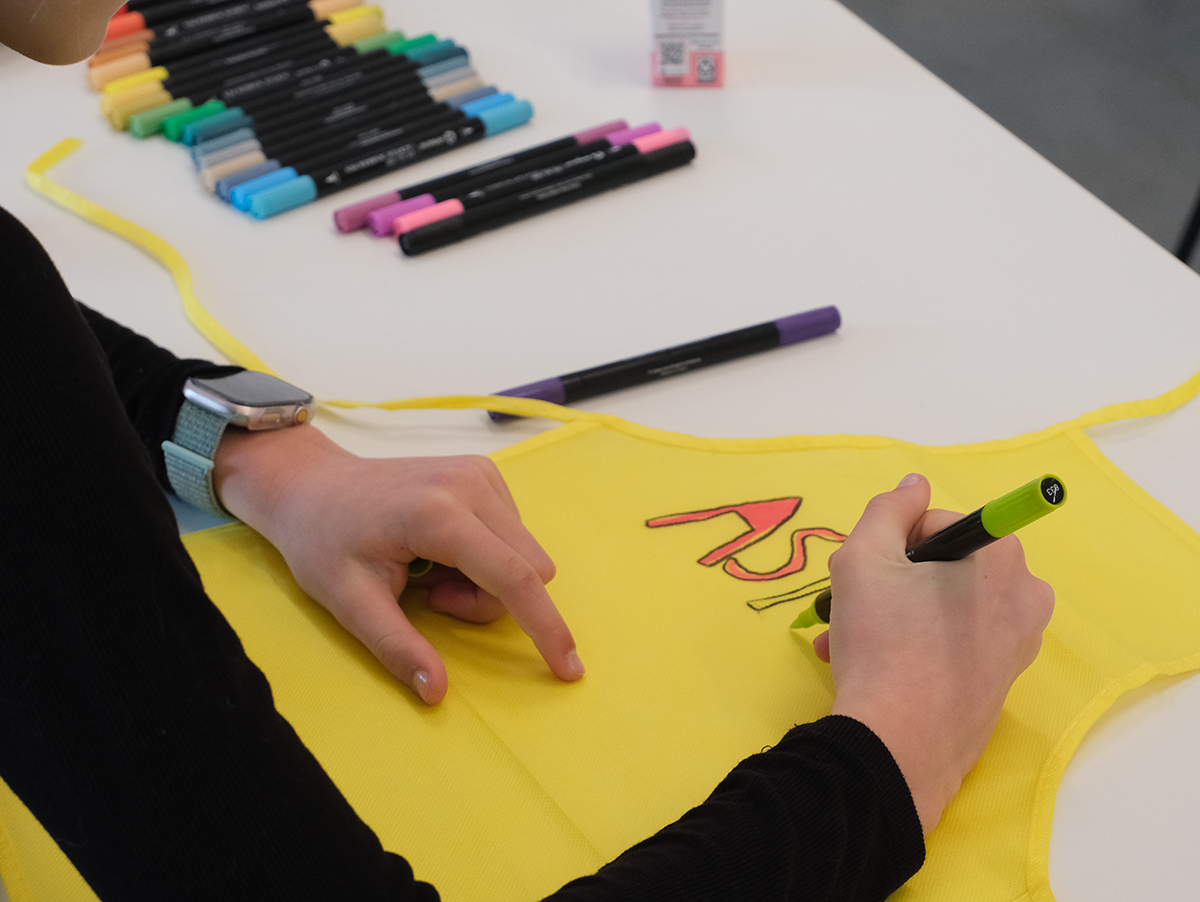
As global displacement reaches unprecedented levels, the need to support refugee populations has become increasingly urgent. As of 2024, 123.2 million people were forcibly displaced worldwide. Among the most complex protracted situations is the Rohingya refugee crisis. The Rohingya are the largest stateless population in the world. Over 1.15 million Rohingya refugees currently live in the Kutupalong-Balukhali refugee settlement in Cox’s Bazar, Bangladesh (“Bangladesh,” 2026). More than half a million children live in limbo, relying on humanitarian assistance with limited access to education. Adolescent girls are especially vulnerable due to the risks of sexual and gender-based violence and conservative gender norms that restrict their access to education. At the intersection of long-standing displacement, gender inequity, and limited educational opportunities, it is crucial to explore how these conditions can be addressed through thoughtful and contextually grounded approaches.

This research examines how facilitation of creative storytelling workshops can support early adolescent Rohingya girls by fostering hope through the development of agency and the visibility of educational pathways. Using a mixed-method qualitative approach, the study draws from secondary research, interviews with stakeholders, ethnographically informed fieldwork in Cox’s Bazar, and the design and facilitation of creative storytelling workshops with adolescent girls in collaboration with local partners in Bangladesh. Findings reveal that while educational access remains structurally constrained, storytelling-based participatory experiences can create space for self-expression, build confidence, and foster a sense of connection among participants. At the same time, the research underscores that cultivating hope requires not only strengthening individual agency but also making pathways toward education more visible and attainable.

The primary outcome of this research is a design framework for creating facilitated experiences for early adolescents that address key developmental needs as well as a multi-layered, storytelling-based initiative that operates across individual, community, institutional, and global systems. This approach proposes creative facilitation, mentorship, community engagement, and public-facing storytelling to support both individual development and broader shifts in perception. While design alone cannot resolve the complexities of forced displacement, this research demonstrates its potential to create conditions for agency, amplify marginalized voices, and contribute to expanding educational opportunities for Rohingya girls.

This design research is presented at Design Incubation Colloquium 12.3: Virtual Summer on Friday, June 26, 2026.
Fragment to Coherence: Designing Belonging through Position

A site-specific typographic installation in the lobby of the art school.

Narges Sedaghat
Graduate student
East Carolina University

This research-through-design project investigates belonging as a contingent condition within migratory contexts, framing it as positional rather than fixed, and dependent on cultural and spatial standpoints.

The theoretical framework draws on Homi Bhabha’s concept of the Third Space, which understands identity as produced in-between cultures through hybridity. This lens directly informs the installation’s spatial logic: meaning emerges only from a vantage point, fragmented elsewhere. Stuart Hall’s argument that identity is “not an essence but a positioning” is enacted materially, as the legibility of language depends on where the viewer stands. Jacques Derrida’s notion of the trace further frames the work, suggesting that each fragment carries residues of past identities while forming new ones. Together, these perspectives conceptualize belonging as dynamic, contingent, and perspectival.

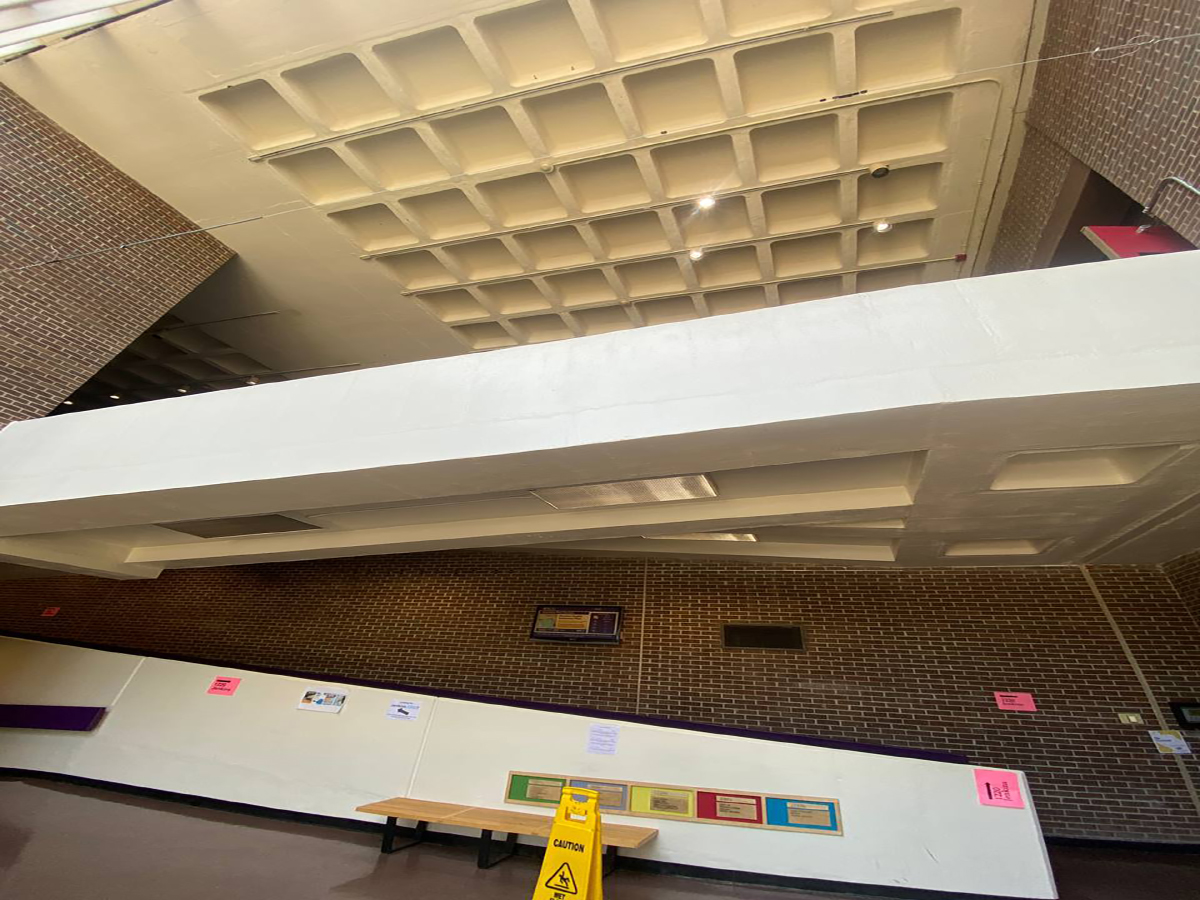
The project materializes these insights through a site-specific typographic installation in the lobby of the art school. Laser-cut plexiglass letters in English and Persian are suspended at varying heights. Installed at a zero-degree horizontal angle, they are unreadable from upper floors. Yet from the ground-floor lobby—by looking upward from below—the fragments align until they become legible as the full sentence “What does BELONG mean?” The work thereby demonstrates that belonging is always present but coherent only in relation to position and perspective.

A digital installation developed in p5.js is presented alongside the physical work. As the cursor moves from top to bottom of the screen, fragments shift from dispersed to legible, simulating the move from upper floors to the lobby. A QR code with the installation links viewers to this interactive version, accessible on devices.

The contribution is twofold: first, it materializes theories of hybridity, positioning, and trace through typographic and spatial practice; second, it advances communication design as a method for making the fluidity of identity in migration visible, participatory, and open to dialogue.

This design research is presented at Design Incubation Colloquium 12.3: Virtual Summer on Friday, June 26, 2026.

Illustrating Feminist and Queer ‘South Asian-ness’ in British Print Material from 1980s–90s

Periodicals, leaflets, and flyers to reach and engage with peers in the UK, USA, Canada, and South Asia.

Shreyas R. Krishnan
Assistant Professor
Washington University in St. Louis

In the 1970s and 80s, racial solidarity among African, Caribbean, and Asian immigrants in Britain was based on a shared history of colonial oppression. British South Asians — women and queer people in particular — found that a focus on cultural identity became necessary to identify and dismantle the specific kinds of structural violence they faced from within their communities. To organize themselves in the 1980s and 90s, South Asian women and queer groups produced periodicals, leaflets, and flyers to reach and engage their peers in the UK, USA, Canada, and South Asia.

Through culturally-specific illustrations of identity, struggles, and liberation, these printed materials helped visualize feminist and queer ‘South Asian-ness’, and contributed to creating domestic and cross-continental networks of care and advocacy for women and queer South Asians.

This research draws from a wide range of primary sources: leaflets, flyers, posters, council meeting records, and periodicals, including the feminist magazine ‘Mukti’ (published by Mukti Collective) and the queer newsletter ‘Shakti Khabar’ (published by Shakti, a South Asian lesbian and gay network). Situated across archives and special collections in London, UK, all of the material studied was produced either by or for South Asian groups between the 1980s and 90s. In this presentation, I will share a preliminary taxonomy for these illustrations to explore how they signalled cultural identity to women and queer South Asians. Through tracking recurring motifs, I will also examine how these illustrations of ‘South Asian-ness’ indicated either broader racial and queer solidarity or South Asian-specific solidarity.

This design research is presented at Design Incubation Colloquium 12.3: Virtual Summer on Friday, June 26, 2026.
Design Incubation Colloquium 12.3: Virtual Summer

Event date: Friday, June 26, 2026
Time: 1:00 pm – 3:30 pm EST
Format: Virtual/Online

Event date: Friday, June 26, 2026
Time: 1:00 pm – 3:30 pm EST
Format: Virtual/Online

Moderators

Cat Normoyle
Director of Peer Reviews, Design Incubation
Associate Professor
East Carolina University

Dina Benbrahim
Associate Professor of Graphic Design
University of Connecticut

Presentations

Design, Identity, and Social Contexts

This session brings together projects that explore how design engages with identity, lived experience, and social context. The work examines how design can support care, representation, and belonging, while addressing complex cultural, political, and community-based issues.

Care-Stories: Demystifying Women’s Reproductive Health

Holly Strickland
Assistant Professor
Middle Tennessee State University

Illustrating Feminist and Queer ‘South Asian-ness’ in British Print Material from 1980s–90s

Shreyas R. Krishnan
Assistant Professor
Washington University in St. Louis

Fragment to Coherence: Designing Belonging through Position

Narges Sedaghat
Graduate student
East Carolina University

Designing Facilitated Experiences for Early Adolescents: Supporting Psychological Capital and Educational Access in Refugee Contexts

Hanna Ji
Graduate student
Master of Design Program
University of Arkansas

Moderated Discussion

Design Pedagogy, Process, and Systems

This session focuses on how design is taught, structured, and practiced across different contexts. The presentations explore pedagogical approaches, process-driven methods, and emerging tools, highlighting how designers build frameworks that shape learning, research, and professional practice.

The Shift Deck: Pragmatic Design Pedagogy Interventions for Climate Resilience

Cindy Raspiller
Lecturer
San Jose State University

A Global Approach to Typography: Introducing Multilingual Scripts in Beginning Design Courses

Anna Jordan
Assistant Professor
Rochester Institute of Technology

Aisha Al Nouri, Jatin Joshi, Unika Dhakhwa
M.F.A. candidates

Rochester Institute of Technology

Relational Construction in Graphic Design: ALT as Process-Driven Practice

Niharika Yellamraju
Adjunct Professor
Boston University
University of Connecticut

Nudged by Design: AI Features and Researcher Agency in Everyday Research Tools

Borami Kang
Graduate student
MFA Candidate in Design Research and Development
The Department of Design
The Ohio State University

Moderated Discussion

Round Table Discussion

Closing Remarks

Call for Submissions, Colloquium 12.3: Virtual Summer Graduate Panel

Call for graduate design research abstracts. Deadline: Monday, March 30, 2026.


Submission Deadline: 
Monday, March 30, 2026.

Event date: Friday, June 26, 2026
Format: Virtual/Online
Location: ZOOM

We invite current and recent communication design graduate students to submit abstracts of their design research, creative investigations, and productions. The work can cover a broad range of topics, including but not limited to graphic design, typography, branding, illustration, photography, videos, motion graphics, advertising campaigns, websites, UX/UI designs, animations, and other visually communicated design products and solutions. The work should have been completed within the past 3 years. This is a virtual online event format. Abstracts can be submitted online now for peer review.

Abstract submissions are double-blind peer-reviewed. Accepted abstracts will be published online. Please review the articles, Quick Start Guide for Writing Abstracts and Writing an Academic Research Abstract: For Communication Design Scholars before submitting.

There is a $10 conference fee required per research abstract submission for non-members. Please submit only one abstract per colloquia. The conference fee is waived for active annual members. Find out more about our annual memberships.

Researchers will videotape their 6-minute presentations which will published online in advance of the colloquium. The video recording is due by Friday, May 22, 2026. We encourage all attendees to watch the videos in advance of the moderated discussion.

Presentation format is Pecha Kucha. For more details, see the colloquia details and description.

There is a moderated panel discussion following the research presentations.

Call for Submissions, Colloquium 12.3: Virtual Summer

Call for design research abstracts. Deadline: Monday, March 30, 2026.

Submission Deadline: Monday, March 30, 2026.

Event date: Friday, June 26, 2026
Format: Virtual/Online
Location: ZOOM

We invite designers—practitioners, creators, and educators—to submit abstracts of design research, creative investigations, and productions. This is a virtual online event format. Abstracts can be submitted online now for peer review.

Abstract submissions are double-blind peer-reviewed. Accepted abstracts will be published online. Please review the articles, Quick Start Guide for Writing Abstracts and Writing an Academic Research Abstract: For Communication Design Scholars before submitting.

There is a $10 conference fee required per research abstract submission for non-members. Please submit only one abstract per colloquia. The conference fee is waived for active annual members. Find out more about our annual memberships.

Researchers will videotape their 6-minute presentations which will published online in advance of the colloquium. The video recording is due by Friday, May 22, 2026. We encourage all attendees to watch the videos in advance of the moderated discussion.

Presentation format is Pecha Kucha. For more details, see the colloquia details and description.

There is a moderated panel discussion following the research presentations.