
Borami Kang
Graduate student
MFA Candidate in Design Research and Development
The Department of Design
The Ohio State University
Artificial Intelligence (AI), particularly Large Language Models, is increasingly embedded as incremental features within familiar design research platforms such as Google, Miro, Notion, O’Reilly Media, and Zoom, rather than options. While promised as productivity enhancements, their effects on researcher attention, agency, and sense-making remain unexamined. Drawing on theories of behavioral nudging (Thaler &Sunstein), persuasive technology (Fogg), and human-centered AI (Shneiderman), this study examines these effects through the concept of AI nudges — interface-level cues and automated behaviors that subtly steer user decisions in purposeful ways. As AI becomes part of the background infrastructure of design research, understanding these micro-dynamics in different research activities is essential for both researchers managing their own practice and platform designers committed to responsible AI.
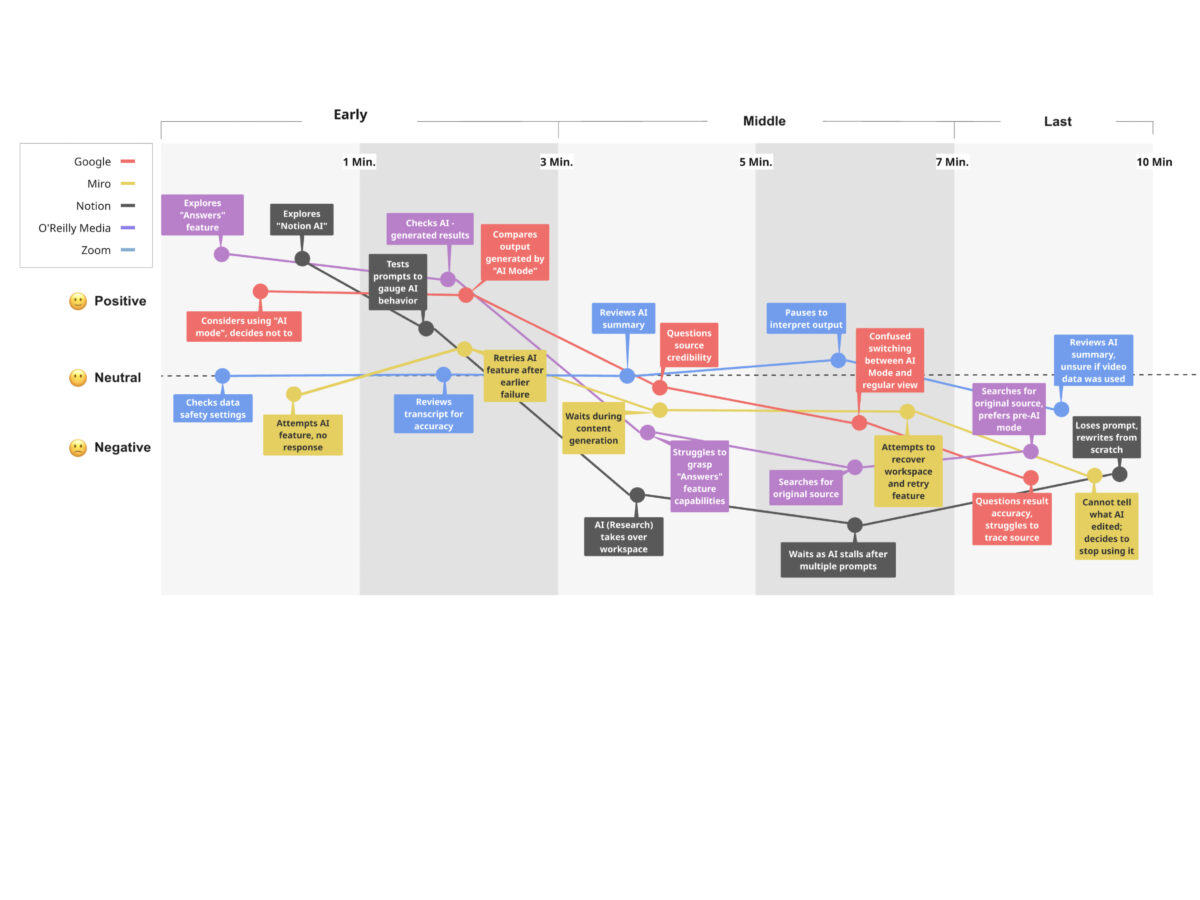
To study the micro-dynamics, the researcher conducted structured self-observation across five widely used platforms, performing core research tasks including literature search, synthesis, writing, reference review, and meeting documentation. Ten-minute sessions were recorded using screen capture, audio, and think-aloud protocols. Data were analyzed using Think-Feel-Say-Do (TFSD) empathy mapping at five time points per session and compared across platforms.
Across sessions, a consistent trajectory emerged: initial curiosity rapidly shifted to confusion, disorientation, and diminished control. Four themes were identified: (1) AI features appear as visual defaults rather than user-invoked options; (2) emotional states shift from engagement to fatigue as interventions accumulate; (3) automatic activation limits opportunities to pause or reverse actions; and (4) AI suggestions redirect inquiry away from original research intentions.
These findings suggest that current AI implementations reshape and frequently erode researcher agency not through explicit control, but through continuous, designed redirection. This paper contributes an analytical framework for examining AI-mediated research environments and proposes alignment between perceived and actual agency as a measurable criterion for responsible human-centered AI design.
This design research is presented at Design Incubation Colloquium 12.3: Virtual Summer on Friday, June 26, 2026.