
Narges Sedaghat
Graduate student
East Carolina University
This research-through-design project investigates belonging as a contingent condition within migratory contexts, framing it as positional rather than fixed, and dependent on cultural and spatial standpoints.
The theoretical framework draws on Homi Bhabha’s concept of the Third Space, which understands identity as produced in-between cultures through hybridity. This lens directly informs the installation’s spatial logic: meaning emerges only from a vantage point, fragmented elsewhere. Stuart Hall’s argument that identity is “not an essence but a positioning” is enacted materially, as the legibility of language depends on where the viewer stands. Jacques Derrida’s notion of the trace further frames the work, suggesting that each fragment carries residues of past identities while forming new ones. Together, these perspectives conceptualize belonging as dynamic, contingent, and perspectival.
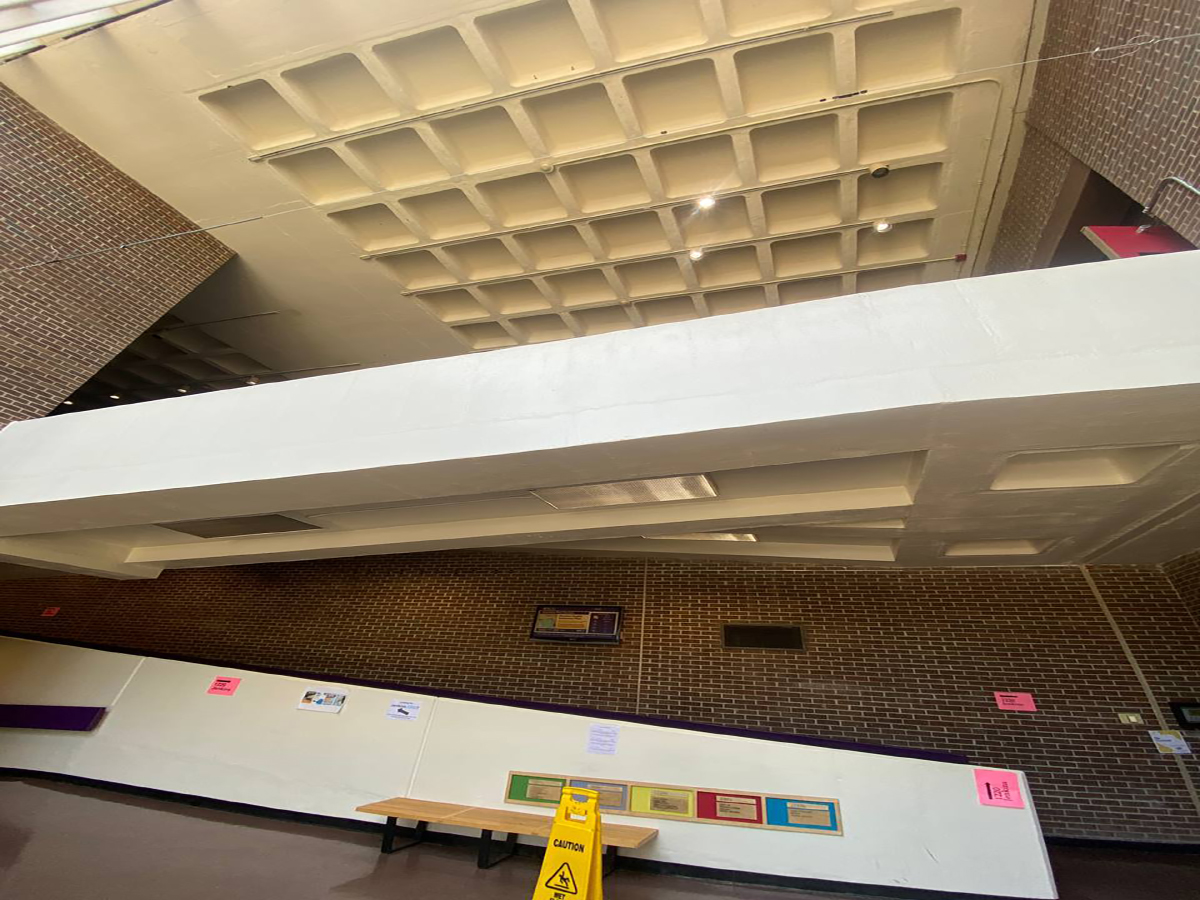
The project materializes these insights through a site-specific typographic installation in the lobby of the art school. Laser-cut plexiglass letters in English and Persian are suspended at varying heights. Installed at a zero-degree horizontal angle, they are unreadable from upper floors. Yet from the ground-floor lobby—by looking upward from below—the fragments align until they become legible as the full sentence “What does BELONG mean?” The work thereby demonstrates that belonging is always present but coherent only in relation to position and perspective.
A digital installation developed in p5.js is presented alongside the physical work. As the cursor moves from top to bottom of the screen, fragments shift from dispersed to legible, simulating the move from upper floors to the lobby. A QR code with the installation links viewers to this interactive version, accessible on devices.
The contribution is twofold: first, it materializes theories of hybridity, positioning, and trace through typographic and spatial practice; second, it advances communication design as a method for making the fluidity of identity in migration visible, participatory, and open to dialogue.
This design research is presented at Design Incubation Colloquium 12.3: Virtual Summer on Friday, June 26, 2026.