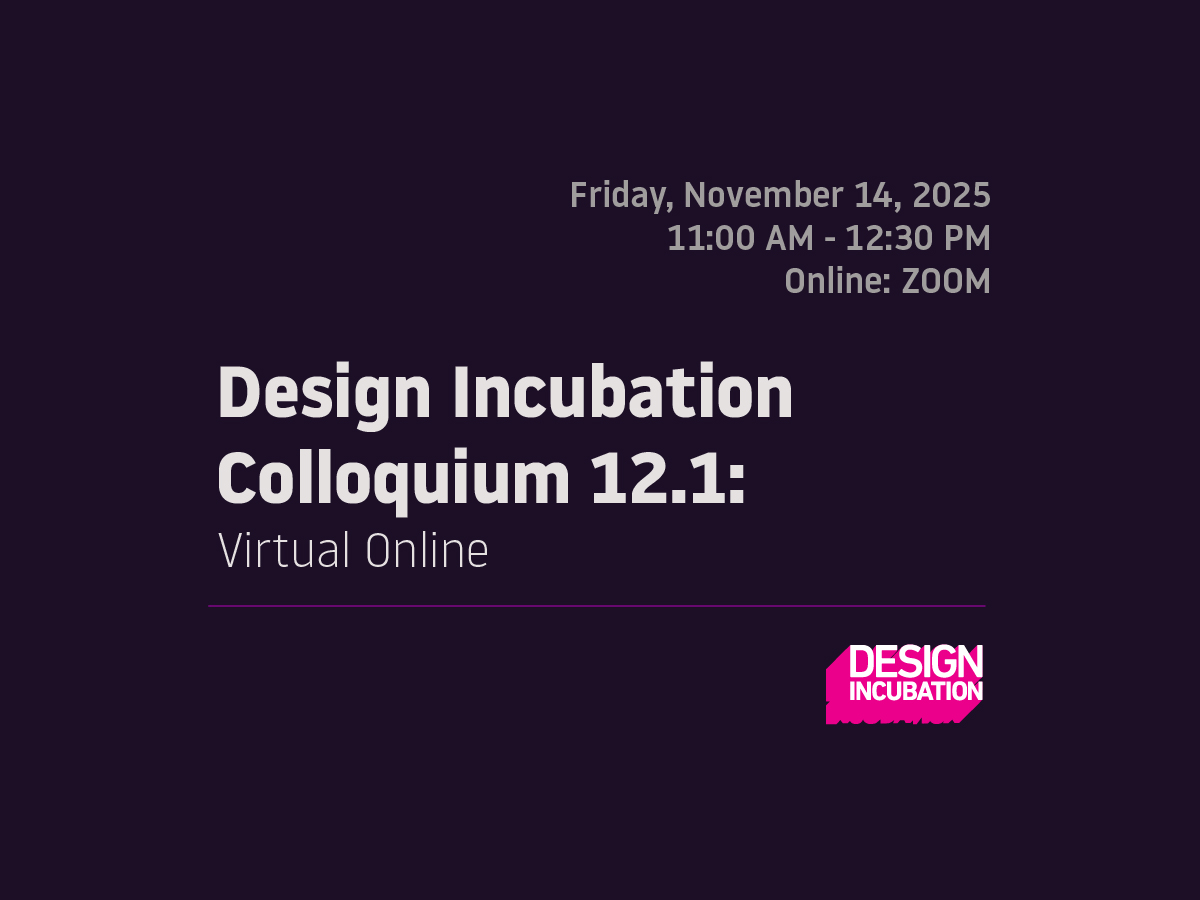
Design Incubation Colloquium 12.1: Virtual: Online

Friday, November 14, 2025
11:00AM – 12:30PM EDT
Online (ZOOM)

Recent research in Communication Design. Presentations of unique, significant creative work, design education, practice of design, case studies, contemporary practice, new technologies, methods, and design research. A moderated discussion will follow the series of presentations.

Friday, November 14, 2025
11:00 AM – 12:30 PM EDT
Online

Moderator

Cat Normoyle
East Carolina University

PRESENTATIONS

Women Graphic Designers: Rebalancing the Canon
Elizabeth Resnick
Professor Emerita
Massachusetts College of Art and Design

The Keywork: Using AI for Insight, Not Replacement, in Creative Practice
RJ Thompson
Associate Professor

University of Pittsburg

Make, Print, Share: Fold, Print, Share: Collective Learning Through Risograph Printing
Kyla Paolucci
Assistant Professor

St. John’s University

Vic Rodriguez Tang
Assistant Professor
Texas State University

From Denim Wars to AI: Rethinking Fashion Advertising in the Classroom
Summer Doll-Myers
Associate Professor

Kutztown University

Born Digital: Fresh Attempts around Typography Courses for Students Today
Jialun Wang
Assistant Professor
Otis College of Art and Design

Eager Zhang
Assistant Professor
Otis College of Art and Design

Mis/Understanding: Reframing Language Barriers and Miscommunication Through Interactive Design
Najmeh Pirahmadian
Graduate student
Ohio University

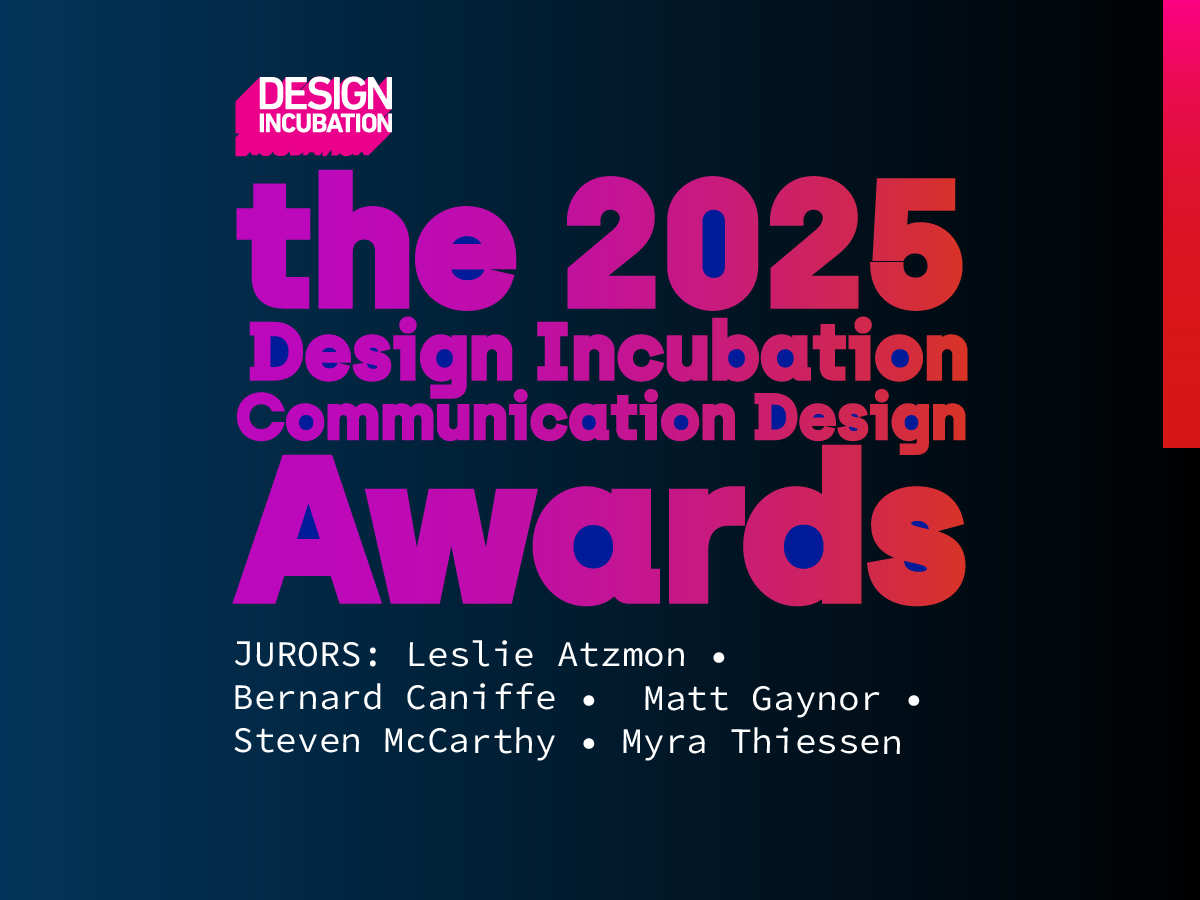
CFP: 2025 Design Incubation Communication Design Educators Awards

Call for Nominations and Entries for the 2025 Design Incubation Educators Awards Competition.

Design Incubation announces a call for nominations and entries for the 2025 awards for communication design educators in the areas of scholarship, teaching, service. The aim of the awards program is to discover and recognize new scholarship (creative work and publications), teaching, and service in our broad and varied discipline. We hope to expand the design record, promote excellence and share knowledge within the field.

Nominations and Entries

We ask colleagues and mentors to identify outstanding creative work, publications, teaching, and service being created by design educators in the field communication design and to nominate these individuals for an award. Nominations will be accepted until December 31, 2025 .

Entry Guidelines

Entries will be accepted until (December 31, 2025). Nominations are not required to enter in this scholarly competition. Complete the online entry form (https://designincubation.com/design-incubation-awards-competition-entry-form/) with the following:

Title: Description of project and outcomes (not to exceed 500 words.)

Supporting Materials: (limited to 5-page medium resolution pdf of artwork; web links to websites, videos, other online resources; published documents or visual documents.)

Biography of applicant/s (150 words per applicant.)

Curriculum vitae of applicant/s.

Entry fee: $35.00 USD.

2025 JURY

Steven McCarthy (Chair) University of Minnesota

Leslie Atzmon https://www.emich.edu/art/faculty-staff/l_atzmon.php

Bernard Caniffe – http://piecestudio.org/case-studieshttps://www.design.iastate.edu/profiles/canniffe/

Matt Gaynorhttps://www.memphis.edu/artanddesign/people/matthew-gaynor.php

Myra Thiessenhttps://www.monash.edu/mada/design/people/myra-thiessen

Leslie Atzmon is a designer, design historian, and design critic. She has published in Eye, Design and Culture, Communication Design, and Design Issues. Atzmon edited Visual Rhetoric and the Eloquence of Design (Parlor Press 2011) and co-edited Encountering Things: Design and Theories of Things (Bloomsbury 2017) with industrial designer Prasad Boradkar. Most recently, she edited The Graphic Design Reader (Bloomsbury 2019) with Teal Triggs of the Royal College of Art. In 2016, she was a Fulbright Fellow at Central Saint Martins in London investigating the topic of Darwin and design thinking. Atzmon and colleague Ryan Molloy were awarded a Sappi Ideas that Matter Grant, which supports design that changes lives for the better. For the grant, students rebranded Ypsilanti’s non-profit Riverside Arts Center as a community arts hub. Atzmon recently curated the exhibition Design and Science, and is currently working on a collection also entitled Design and Science (forthcoming Bloomsbury 2020).

Bernard Canniffe is a current professor and former department chair of graphic design at Iowa State University, and has held faculty positions at MICA (Baltimore), MCAD (Minneapolis) and Ringling College of Art and Design (Sarasota), A native of Wales (UK), he has presented and exhibited on a global scale since earning an MFA from the Savannah College of Art and Design in 1999. PIECE Studio, a creative venture he founded in 2006, is an agency that “engages in and with communities, organizations, activists, governments and municipalities and has run projects and workshops that promote social justice and community empowerment internationally,” primarily through the design of identities, publications and posters. 

Matthew Gaynor received his BA and MFA in graphic design from Yale University, and is currently chair of the Department of Art and Design at the University of Memphis. He has held faculty and leadership positions at University of Kansas, California State University at San Bernardino, University of Cincinnati, University of Illinois at Chicago, and Kansas State University. He also served as creative director for F+W Publications, which published HOW magazine. Gaynor has won numerous awards for his design work, which is focused on the intersection of type and image, and continues his practice of typographic design, as well as an ongoing interest in photographic portraiture.

Myra Thiessen is a researcher and senior lecturer at Monash University in Melbourne, Australia and is the program coordinator of the communication design program in the Faculty of Art, Design, and Architecture. She earned a PhD in typography and graphic communication at the University of Reading and a Bachelor of Design degree in communication design from the University of Alberta. She has published her research widely, especially about typography and cognition, in the journals Visible Language, Ergonomics, and The Design Journal among others, and co-edited the book The Routledge Companion to Criticality in Art, Architecture, and Design. 

Steven McCarthy is professor emeritus of graphic design at the University of Minnesota, where he taught for over two decades. He earned an MFA from Stanford University and a BFA from Bradley University. His book The Designer As… Author, Producer, Activist, Entrepreneur, Curator and Collaborator: New Models for Communicating was published in 2013. McCarthy’s creative work has been in over 150 juried and invitational exhibitions, and has been awarded inclusion in the AIGA annual, the STA 100 show and in Graphis Poster. He has published in the journals Design Issues, Message, Visible Language, Design and Culture, Visual Communication, and occasionally writes for Eye magazine. In 2017 he was awarded the Minnesota Book Artist Award.

http://stevenmccarthy.design

Call for Submissions, Colloquium 12.1: Virtual, Online

Call for design research abstracts. Deadline: Friday, October 3, 2025.

Submission Deadline: Friday, October 3, 2025.

Event date: Friday, November 14, 2025
Format: Virtual/Online
Location: ZOOM

We invite designers—practitioners, creators, and educators—to submit abstracts of design research, creative investigations, and productions. This is a virtual online event format. Abstracts can be submitted online now for peer review.

Abstract submissions are double-blind peer-reviewed. Accepted abstracts will be published online. Please review the articles, Quick Start Guide for Writing Abstracts and Writing an Academic Research Abstract: For Communication Design Scholars before submitting.

There is a $10 conference fee required upon acceptance of the research abstract for non-members. The conference fee is waived for active annual members. Find out more about our annual memberships.

Researchers will videotape their 6-minute presentations which will published online in advance of the colloquium. The video recording is due by Friday, October 24, 2025. We encourage all attendees to watch the videos in advance of the moderated discussion.

Presentation format is Pecha Kucha. For more details, see the colloquia details and description.

The colloquium is a moderated panel discussion of the research involving the researchers, thought leaders, and Design Incubation members.

Reflections from Past Award Recipients: 2016-2025

Why we do what we do. Design Incubation awards for research in communication design.

Aggie Toppins’ reflections

Unlike many design awards, which tend to judge projects according to aesthetics, Design Incubation takes the conceptual intent and the impact of the work into account. This award means more than “peer approval” — it is national recognition of an educator’s research, teaching, or service-based contribution to the field. This is important for tenure and promotion candidates whose institutions expect evidence of excellence, often through external forms of validation. Beyond this, design and designers benefit from institutions that recognize the full scope of our work. In my case, much of my research and teaching seeks to build bridges between historical research and contemporary practice. Receiving the DI teaching award has helped me communicate the value of design and design history to my colleagues, peers, partners, and potential students.


Taekyeom Lee’s reflection

Some ideas need time, space, and the right community to develop. For my project, that place has been Design Incubation. I am honored to join in celebrating the 10th anniversary of the Awards and deeply grateful to the organization, nominators, and reviewers who continue to recognize and uplift design research, especially work that does not always follow a straight line.

I first encountered Design Incubation at the 2017 UCDA Design Education Summit in Kutztown, Pennsylvania. The founders’ vision, voiced through a panel presentation, made a lasting impression. In 2020, at Colloquium 6.3, I shared an early version of what would become Tangible Graphic Design. That moment gave the project language, direction, reflection, and confidence.

Receiving the Design Incubation Award in 2022 was a meaningful moment of affirmation. It validated not only the outcome of my work but also the process behind it—messy, iterative, and deeply personal. The recognition opened new opportunities, broadened the visibility of my research, and encouraged me to continue asking challenging, yet necessary, questions through design.

The Design Incubation Awards offer more than recognition; they provide a platform for growth. As the program marks a decade of generous and inclusive vision, I invite designers, educators, and researchers to help shape its next chapter. Together, we can build a more expansive, reflective, and impactful future for design research.


Kareem Collie’s reflection

In 2017, I was acknowledged by Design Incubation’s Scholarship: Creative Work Award after finishing my graduate work at NYU. The project was rooted in personal and intellectual growth, not in advancing my career. While I felt fulfilled, I soon realized my questions needed to translate into something meaningful beyond myself. I needed to share a story that others could connect with.

The recognition from Design Incubation marked a turning point. It helped me understand that my inquiry held value, and that I could shape it into something legible to the world. That award gave me clarity at a time of uncertainty, showing me that my work had potential to resonate beyond academia. It transformed what had felt internal and esoteric into something that could live beyond the studio or classroom. It helped me to move forward with more direction and a clearer voice, carrying with me not just the confidence of that moment, but a broader understanding of the impact creative inquiry can have on the world.


Jenn Stucker’s reflection

Design Incubation’s Communication Design Educators Awards for my collaborative projects, The Sit&Tell Project (awarded in 2017) and In The Round (awarded in 2023), in the service category, are meaningful recognitions. A significant mode of my academic work centers around Design as a Scholarship of Engagement, where my creative and collaborative work aims to foster growth in communities, spotlight the value of design, and contribute to the common good of the design discipline and the public. In these works, the designer and communities work together locally, and accolades from such a reputable organization as Design Incubation provide illumination and validation of the project’s impact and significance to extend beyond the project’s regional situatedness. As there are few venues where design educators can receive recognition for comprehensive service work by a jury of academic peers nationally, Design Incubation’s acknowledgment through a service category amplifies value to institutional and community stakeholder investments in Scholarship of Engagement projects and fortifies confidence for future opportunities.

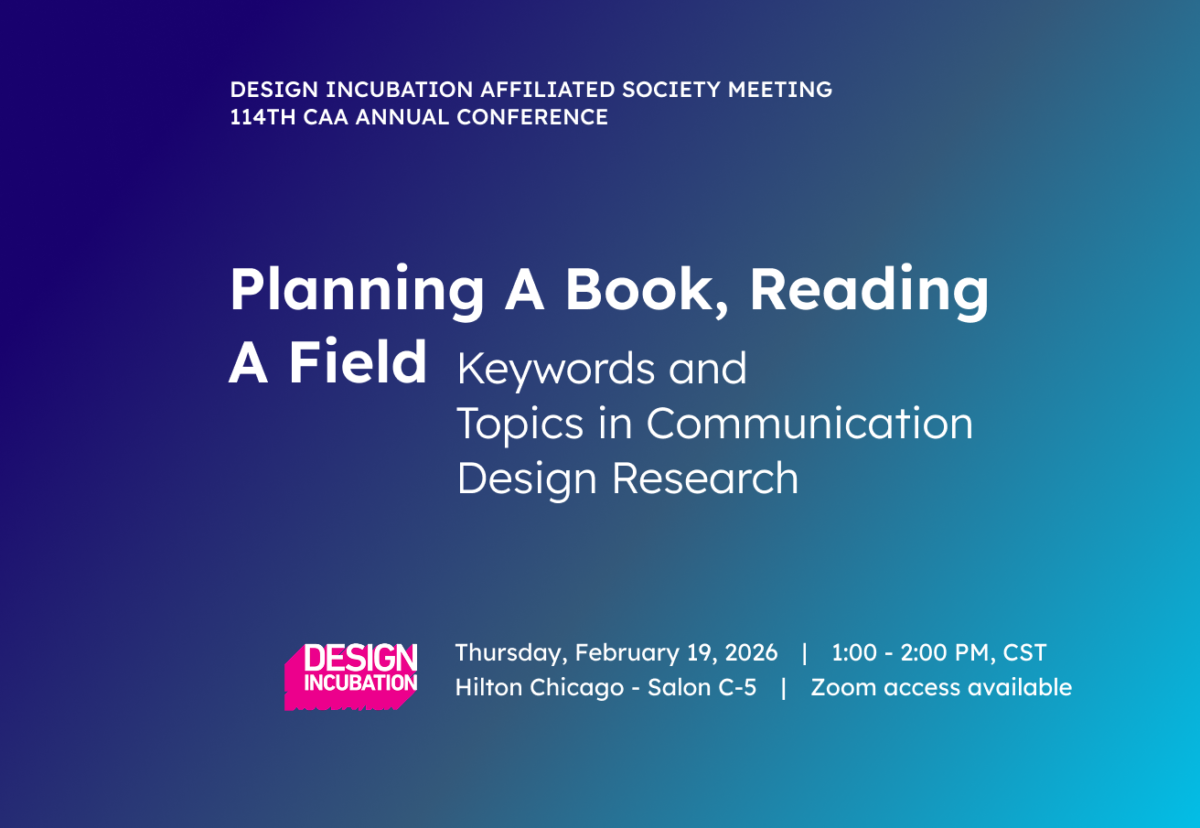
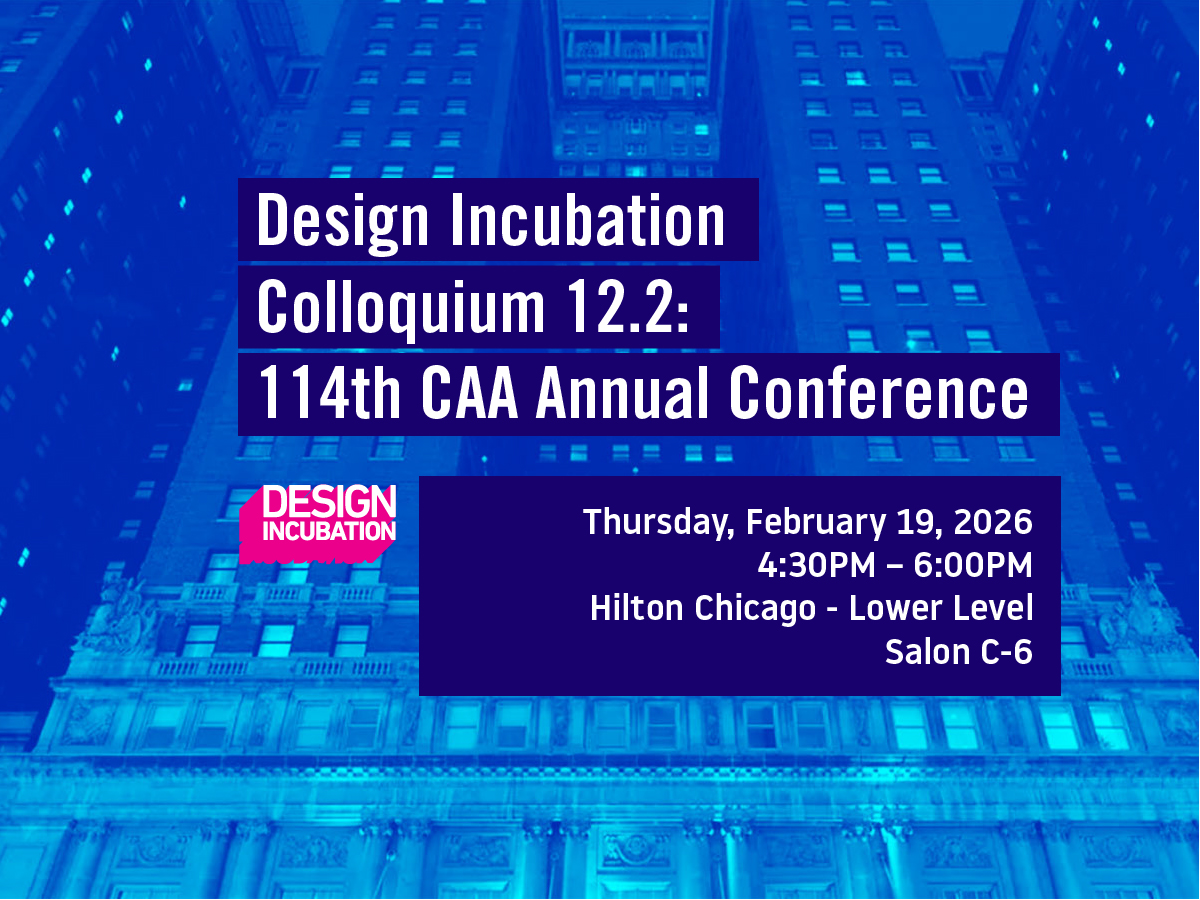
Colloquium 12.2: CAA Conference 2026 Call for Submissions

114th CAA Annual Conference, In Person Format.
Deadline for abstract submissions: August 29, 2025.

We invite abstract submissions on presentation topics relevant to Communication Design research. Submissions should fall into one or more of the following areas: scholarly research, case studies, creative practice, or design pedagogy. We welcome proposals on a variety of topics across the field of communication design.

Submit an abstract of 300 words using the Design Incubation abstract submission form found here:
https://designincubation.com/call-for-submissions/

Submissions are double-blind peer-reviewed. Reviewers’ feedback will be returned. Accepted presentation abstracts will be published on the Design Incubation website.

Accepted researchers will be required to produce a 6-minute videotaped presentation that will be published on the Design Incubation channel. The CAA conference session will consist of a moderated discussion of those presentations.

The session will involve a quick 3-minute presentation overview from each accepted submission researcher, followed by a moderated group discussion.

114th CAA Annual Conference
In Person

Hilton Hotel, Downtown
Chicago, IL
February 18-21, 2026

Presentations and Moderated Discussion

Presenters will follow the basic membership and fee requirements of CAA.

We are accepting abstracts for presentations now until August 29, 2025.

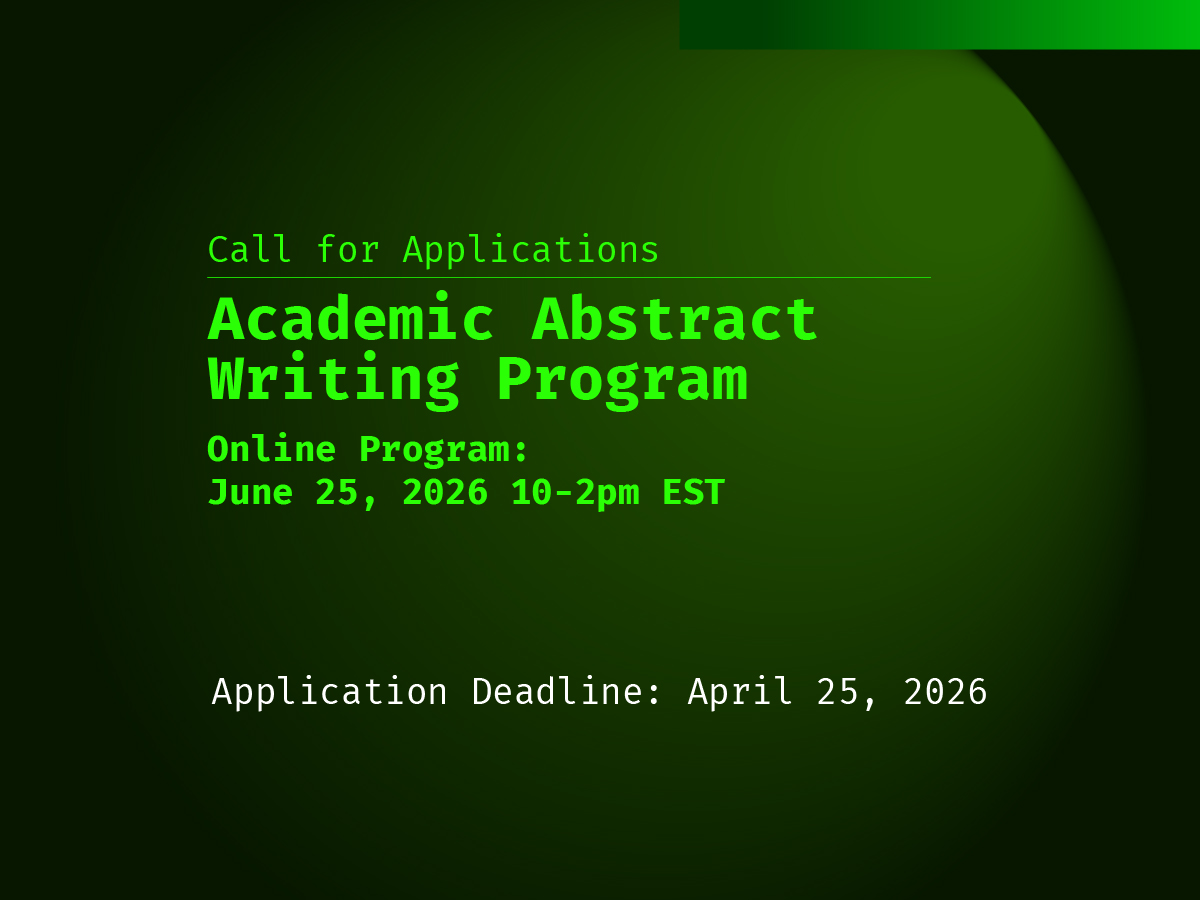
Academic Abstract Writing Program

Thursday, June 19, 2025
10:00am – 2:00pm EDT

The online Academic Abstract Writing Program at Design Incubation offers a series of activities that will help design researchers to craft a written synopsis of their research. The outcome(s) will be a concisely written document typically expected of academic publication venues. This includes conferences, journals, grant applications, publishers, and academic organizations.

The program is designed along two tracks:

  1. The first track is for design faculty who are new to academia and want a program that will help them to navigate the academic publication arena.
  2. The second track is aimed at design faculty who have established their research agenda and activities, and would like to explore ways to broaden their scope of publication opportunities.

We are excited to announce Leslie Atzmon, Eastern Michigan University, Jess Barness, Kent State University and Dan Wong, CityTech, CUNY will be facilitating and moderating the various activities.

Agenda

Time (EDT)Activity
10:00am-11:15amPresentation on Abstracts.
Dan Wong, Jess Barness.
Abstracts Reviewed. Breakout rooms with Mentors.
Atzmon, Barness, Wong.
11:15am-12:15pmFellows Abstract Workshop
12:15-1:00pmLunch Break
1:00pm- 2:00pmAbstracts—Repurposing Research. Leslie Atzmon.
Group Consultation with Mentors. Atzmon, Barness, Wong.

Fellows

Katie Blazek
Assistant Professor
University of Illinois- Urbana Champaign

Grace Hamilton
Assistant Professor
CUNY, Baruch College

Brooke Hull
Assistant Professor
Pennsylvania State University

Megan Asbeck
Assistant Professor
SUNY Brockport

Ruichao Jiang
Artist/Designer

Minoo Marasi
Graduate Student
University of Illinois Chicago

Golnoush Behmanesh
Assistant Professor
University of Mississippi

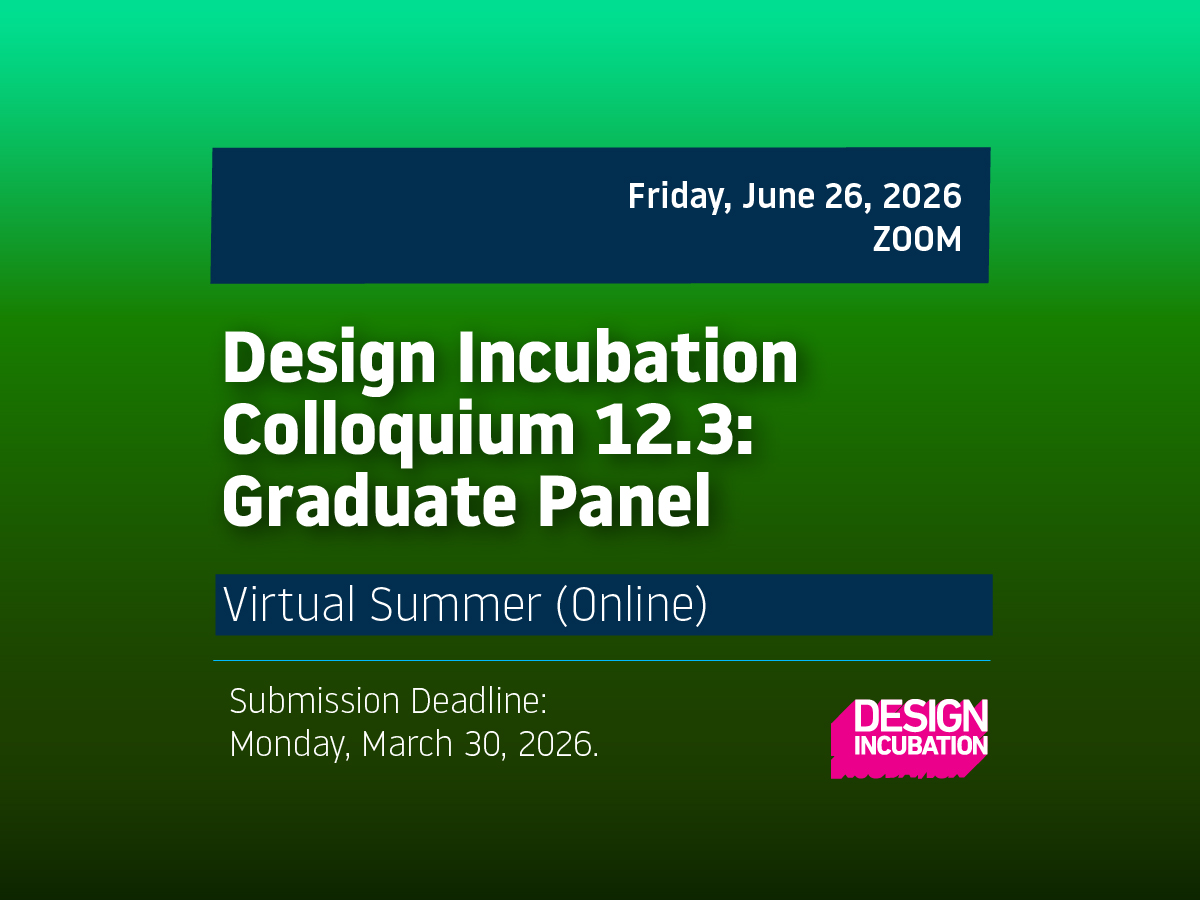
Design Incubation Colloquium 11.3: Virtual Summer

Friday, June 20, 2025
11:00AM – 12:30PM EDT
Online (ZOOM)

Recent research in Communication Design. Presentations of unique, significant creative work, design education, practice of design, case studies, contemporary practice, new technologies, methods, and design research. A moderated discussion will follow the series of presentations.

Friday, June 20, 2025
11:00 AM – 12:30 PM EDT
Online

Moderator

Cat Normoyle
East Carolina University

PRESENTATIONS

Resonant Pages: Artist Books, Natural Rhythms, and Digital Interactivity
Lingyi Kong
Adjunct Professor
Parsons School of Design, The New School

Inclusive Characters: Merging Aesthetics and Accessibility in Type Design
Katie Krcmarik
Assistant Professor
Illinois State University

Typography of the Transreal: N.H. Pritchard’s The Mundus
Andrew Shurtz
Assistant Professor 
Louisiana State University

Creative Computation in the Age of AI: Reimagining the Boundary of Human Creativity
Bei Hu 
Assistant Professor 
Washington University in St. Louis

From Designer to Design Facilitator: Turning Studios into Dewey-Inspired Learning Labs 
Michael Berrell
Assistant Professor 
SUNY Farmingdale

Type as Cultural Bridge: An Interactive Fusion of Iranian and American Design
Narges Sedaghat
Graduate student
East Carolina University

CFP: Academic Abstract Writing Program

Application Deadline: May 2, 2025

The online Academic Abstract Writing Program at Design Incubation offers a series of activities that will help design researchers to craft a written synopsis of their research. The outcome(s) will be a concisely written document typically expected of academic publication venues. This includes conferences, journals, grant applications, publishers, and academic organizations.

The program is designed along two tracks:

  1. The first track is for design faculty who are new to academia and want a program that will help them to navigate the academic publication arena.
  2. The second track is aimed at design faculty who have established their research agenda and activities, and would like to explore ways to broaden their scope of publication opportunities.

Application:

Academic Abstract Writing Workshop Program

This program is designed to facilitate design researchers in the development of their academic research abstract(s) for conferences, grant proposals, journal articles, and other publications.

The program does not guarantee abstract submissions will be accepted by the academic venues. The program is designed to improve your understanding of abstract writing, and the factors involved in developing a successful abstract submission.

Complete all required application information. Submit as much information as possible in the other fields to help us to understand your interests, goals, and challenges.

Seats are limited for this fellowship program. Upon acceptance, there is a $100 (members)/ $150 (non-members) program registration fee.

Step 1 of 2

This field is for validation purposes and should be left unchanged.
Name(Required)
Email(Required)
Secondary Email
Sometimes emails get spam filtered out and a secondary email helps with correspondences.
We generally do not call or text, unless it seems that our emails are not getting to you. Whenever possible, provide a telephone number that we can sms you.
Professional Title

Program Track(Required)
I am applying to the following track:
Goals
I am interested in:

Submit a short biography (250 words) describing your current position and professional research goals.
Please describe (250 words) the research project that you are considering.
Formats
Please select all the program formats in which you are interested.
Challenges
Select all that reflect your challenges.
Please add comments or other information you would like to share.
Please list and/or describe the publications, conferences, grants, organizations, venues, or types of places where you would like to submit your abstract(s).
Submit a draft of an existing abstract, or a summary proposal of the work you are doing, challenges you encounter, and goals you aim to attain.
Accepted file types: pdf, docx, doc, rtf, txt, Max. file size: 5 MB.

Submit a cv or resume.

This will help us to understand your experiences and interests and to develop the program that best suits your needs.

Accepted file types: docx, doc, pdf, txt, rtf, Max. file size: 5 MB.

Colloquium 11.3: Virtual Summer

Call for design research abstracts. Deadline: Fri, April 25, 2025.

Submission Deadline: Friday, April 25, 2025.

Event date: Friday, June 20, 2025
Format: Virtual/Online
Location: ZOOM

We invite designers—practitioners, creators, and educators—to submit abstracts of design research, creative investigations, and productions. This is a virtual online event format. Abstracts can be submitted online now for peer review.

Abstract submissions are double-blind peer-reviewed. Accepted abstracts will be published online. Please review the articles, Quick Start Guide for Writing Abstracts and Writing an Academic Research Abstract: For Communication Design Scholars before submitting.

There is a $10 conference fee required upon acceptance of the research abstract for non-members. The conference fee is waived for active annual members. Find out more about our annual memberships.

Researchers will videotape their 6-minute presentations which will published online in advance of the colloquium. The video recording is due by Thursday, June 5, 2025. We encourage all attendees to watch the videos in advance of the moderated discussion.

Presentation format is Pecha Kucha. For more details, see the colloquia details and description.

The colloquium is a moderated panel discussion of the research involving the researchers, thought leaders, and Design Incubation members.

Host: Cat Normoyle, Design Incubation Director of Peer Reviews.

Mashq Conference 2022 on Arabic Type and Typography 

Seasoned pioneers in Arabic typography to emerging younger practitioners and academicians.

Yara Khoury Nammour
Assistant Professor
American University of Beirut, Lebanon

Khajag Apelian
Lecturer
American University of Beirut, Lebanon

Mashq 2022 conference was held on October 20–21, 2022 at the American University of Beirut [AUB]. It was the first event dedicated entirely to Arabic type and typography. Organized by AUB’s Arabic Type Unit, a research body committed to advancing Arabic type and typography, the conference marked a groundbreaking milestone in the Arab region.

AUB has long been at the forefront of design education. More than thirty years ago, it pioneered the first graphic design program in the Arab world and was the first to integrate the graphic use of Arabic script into its core curriculum. Building on this legacy, the Arabic Type Unit was established in 2018. Naturally, Mashq 2022 served as an extension of these efforts that provides a platform to explore the historical evolution, current practices, and future directions of Arabic typography in the region.

The organizers made sure that the event spotlighted regional expertise that has long been overlooked, with more than 80% of the speakers being of Arab origin while talks by non-Arab speakers were curated to focus exclusively on Arabic type and typography. The team also made sure to design and develop a dedicated conference bilingual website [www.mashqconference.org], with a strong emphasis on Arabic, further reflected the conference’s dedication to its cultural and linguistic roots. All conference talks were made freely available on the Arabic Type Unit’s dedicated YouTube channel [www.youtube.com/@ATU_org], to extend the event’s reach to a global audience. A summarized video is here: https://www.youtube.com/watch?v=gcNUw5HOgH4&t=17s

Attendees and Participating Institutions

Mashq 2022 succeeded in attracting over 400 attendees, including students (62%), professionals (38%), and professors (13%). Participants mostly came from Lebanese universities such as the Lebanese American University, Notre Dame University, Middle East University, Lebanese University, and Académie Libanaise des Beaux-Arts. International attendees included those from Egypt, Turkey, Iraq, and the United Arab Emirates.

Speakers and Sessions

The conference featured presentations from 15 distinguished speakers, with a diverse spectrum, from seasoned pioneers in Arabic typography to emerging younger practitioners and academicians. This mix fostered a rich exchange of perspectives, blending deep-rooted expertise with fresh, innovative approaches to Arabic type design and visual communication.

Among the speakers, Kameel Hawa’s presentation, “The Spring of Arabic Type,” showcased his innovative efforts to rejuvenate Arabic script through type design and calligraphy, reflecting on its potential for both tradition and modernity. Lara Assouad discussed the graphic visual expression of language and its alphabet, offering insights into how typographic design can shape visual communication. Hatem Imam analyzed the relationship between cultural production and graphic arts, proposing methods to bridge the gap between these two domains. While Onür Yazıcıgil explored the history of Ottoman naskh and its spread beyond the borders of Istanbul in order to contextualize the influence of these typefaces on Turkish and Arabic printing and publishing in Beirut and Cairo. Naïma Ben Ayed also presented collaborative new research that aims to expand Arabic type design pedagogy, emphasizing the importance of ‘self-organized knowledge’ under the School of Commons.

Exhibitions and Workshops

The conference hosted two exhibitions: 100 Best Arabic Posters which celebrated contemporary Arabic poster design of 2021-2022, while the Granshan Type Design Competition Winners exhibition highlighted award-winning Arabic typefaces from 2019 and 2021/2022.

Complementing the exhibitions, workshops were also planned to provide participants with hands-on learning opportunities. Azza Alameddine guided attendees through the complexities of harmonizing Arabic and Latin scripts in logo design during her workshop, “Arabic/Latin Logo Matchmaking.” Georg Seifert introduced participants to the creation of Arabic fonts using Glyphs software in his workshop, “Introduction to Glyphs.”

Diversity and Inclusion

The organizers made it a priority to amplify diverse voices within the Arabic typography community. They took special care to give a platform to the older generation of Arabic typographers and designers, many of whom had not previously been afforded the opportunity to share their work on such a prominent stage. This effort ensured their invaluable contributions and experiences were recognized, preserving their legacy while inspiring a new generation of practitioners.

Additionally, the speaker lineup reflected a wide range of experiences and expertise, spanning seasoned pioneers to emerging practitioners and academicians. This intentional curation fostered an inclusive dialogue that bridged generations and enriched the discussions with diverse perspectives.

Sponsors and Support

Sponsors contributed a total of $12,000 from different entities in the profession and the educational sector. Their contributions were essential to the success of the event. Key sponsors included:

  • Gold Sponsor: Commercial Type
  • Silver Sponsors: Glyphs and TypeTogether
  • Brass Sponsors: Rosetta Type, ISType, Koein, and Morcos Key

Impact and Reflection

Mashq 2022 challenged the dominance of Eurocentric design paradigms by fostering a space where Arabic typography and regional practices took center stage. It offered a compelling alternative to the often homogenized global design landscape. The conference highlighted the possibilities of moving beyond standardized, Westernized approaches in design education and practice, encouraging attendees to rethink the role of cultural identity as an intrinsic element in the creative process rather than a background influence.
Through it all, Mashq demonstrated how design can transcend corporate functionality to serve as a medium for personal narratives, cultural preservation, and regional storytelling. It explored the potential for a design philosophy rooted in local visual culture.

This project was the 2024 Design Incubation Educators Awards runner up recipient in the category of Service.

Biography

Yara Khoury Nammour — Assistant Professor of Graphic Design, Arabic Type Unit, AUB

Yara is a graphic and type designer, author and educator. She is an assistant professor of graphic design at the American University of Beirut and an independent designer since 2017 after a long-standing career of 20 years as design director at Al Mohtaraf design house. Her work is published in several international books and has authored a book titled ‘Nasri Khattar: A Modernist Typotect’ from Khatt Books. She heads the Arabic Type Research Unit and co-organizes the biennial Mashq conference on Arabic typography at AUB.

Khajag Apelian — Part-time Lecturer of Graphic Design, AUB

Khajag is a lettering artist, type and graphic designer. Khajag has developed typefaces in various scripts, including Arabic, Armenian, and Latin. He designed Arek, a typeface that was awarded the Grand Prize at Granshan 2010 Type Design Competition, and was among the winners of Letter.2, the 2nd international type design competition organized by the Association
Typographique Internationale. He currently operates under the name “debakir” Armenian for “printed type”. He …. and co-organizes the biennial Mashq conference on Arabic typography at AUB.