Design Incubation is excited to announce important additions to our team.
Alex Girard, Assistant Professor of Graphic Design in the Art Department at Southern Connecticut State University, will be the Director of Peer Reviews.
He has had a distinguished career as an design educator and academic administrator, teaching at the University of Minnesota and Community College of Aurora, and Associate Dean of Academic Affairs at the Community College of Aurora.
Girard will direct the peer review process and ensure academic integrity and standards within the organization.
Bruno Ribeiro, Assistant Professor of Graphic Design in Department of Art and Design at California Polytechnic State University will be the Director of Community Outreach for West Coast Initiatives. His research specialization is in interaction and motion design. His background is in visual communication and industrial design, having studied at the Escola Superior de Desenho Industrial – ESDI (Rio de Janeiro), an an MBA in marketing from Fundação Getúlio Vargas – FGV (Rio de Janeiro) and an MFA from Ohio State University.
Ribeiro will be expanding our reach on the west coast, as we continue to expand our support of research in communication design.
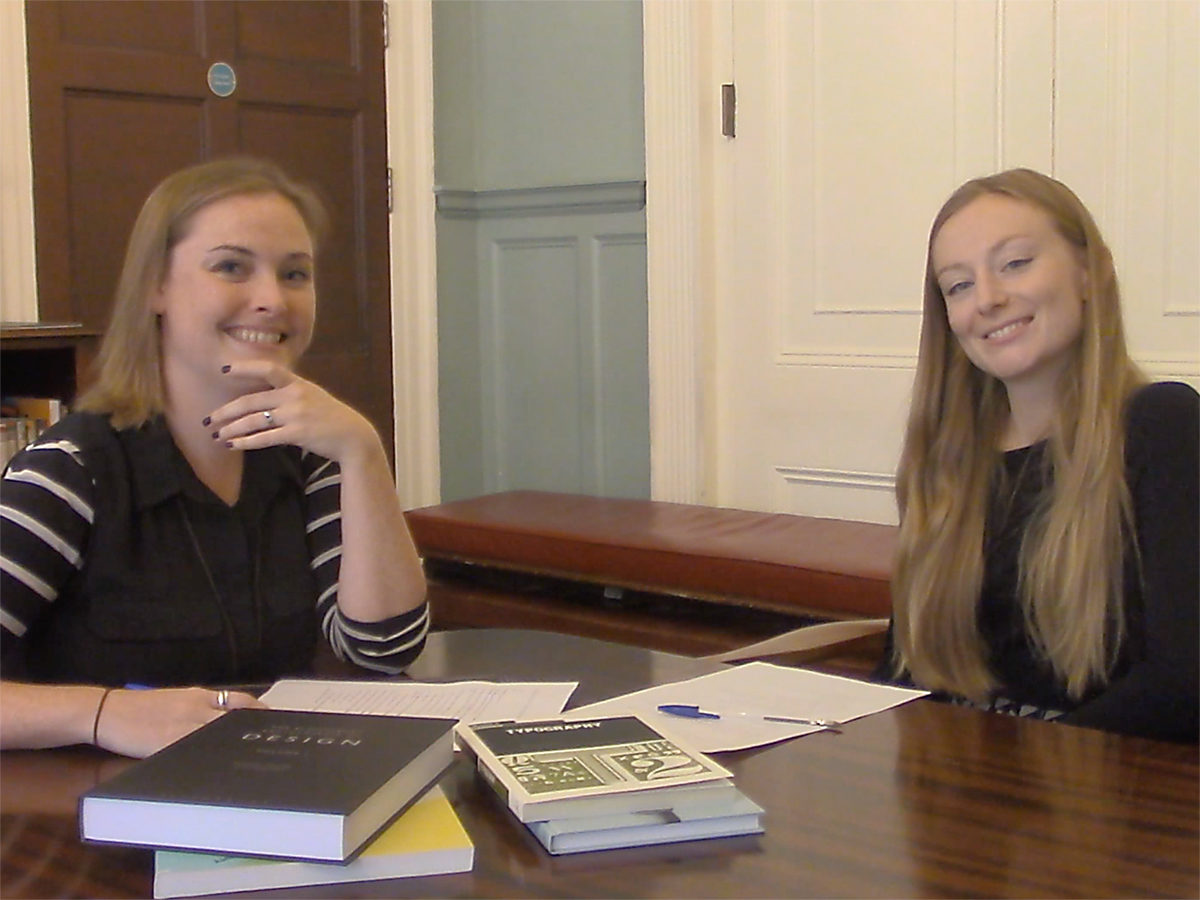
CC: My name is Catherine C, I’m the Assistant Editor for Design at Bloomsbury Visual Arts
LB: and I’m Louise Baird Smith, im the Commissioning Editor for Design and Photography books
LB: So this is a talk in collaboration with the Design Incubation team and Bloomsbury Publishing, just talking you through really how to start off with the book proposal, how to present it, and is it what we are looking for.
What is Your Book?
LB: So the first thing you want to establish is, what is the book? What sort of book is it?
Is it a going to be a research book—so you are looking at a quite high level specific academic scholarly work?
Or is it something that might be used by students and professionals in their day-to-day lives?
Or is it something like a text book, that would be used by a first year or above undergraduates.
Or is it going to be a big reference book which is covering the whole state of a specific topic or subject?
Once you establish what sort of book its going to be, you have to work out who it is for. So like these ones, this is what you would have for the students, books for the researchers, and books for academics.
You need to look at why they actually want that book? Is it something that is going to be aligning to their course, or is it going to be something that they need to pass exams, or is it looking at a new technology that they might be using in their work?
So those are the key considerations that you need to think about when you start looking at a book proposal. And then you’ll need to think about which publisher you’ll be looking to contact.
Choosing Your Publisher
CC: In terms of choosing a publisher, doing some research and just looking at websites is obviously a really good idea. You’ll want to look at a publisher who already publishes books in your area. And just checking websites is a really good way to.
LB: And different publishers might have different lists they work from, and so you might have one publisher, like Taschen, who do big beautiful books that might end up in museums. But you might have others who are like university presses, who wouldn’t necessarily have books that go into bookstores, but are very high level research. So having a look at the different focus they have is very important.
The Proposal
CC: When you get to the stage of wanting to put together/prepare a proposal, most publishers, definitely Bloomsbury, has a set book proposal document which we like authors to complete. You can find that on our website, and all academic contacts are listed on the website. So if you just get in touch, someone will be very happy to send you their document.
Its really good to give as much detail as possible and to stick (obviously) to the structure of their proposal document. So that’s just basically looking at things like—what your books is about, what is its coverage, what is the kind of structure. We ask for an annotated table of contents— that can be very really useful for us in terms of gauging what the book is going to be used for.
LM: That’s basically like how you would have an abstract for a journal—so just a really short description of each chapter.
CC: If you can give us some information about what is unique about your book, what is special about it, in what way is it better than competitive titles, who you think the potential readers will be.
And also see what your experience is, sometimes some authors submit CVs, alongside their proposal documents — which can be really helpful.
LM: Particularly if you teach in the area, or have done specific research already— that is really good for us to know.
And, depending on the publisher as well, they may ask for some sample material. Particularly on the certain textbook side, its really important for us to have a sample chapter, or a sample of a few pages from a chapter, so we can see the writing style, and the level that you write at. For academic books, it might be less important. But each publisher will work in a different way. Some will ask for the whole book, but the majority of publishers will want to see some sample material, and then they can work with you on that.
So the general process is, once you have put together this proposal document, it will go to me or one of my colleagues, who will send you feedback on whether it looks roughly appropriate for the list. If it aligns with the current books that we have got. It is not competing with something we already have? Is it filling a gap in our list, for a market that we can reach with our contacts?
If it is all looking good, and it is looking like a topic of interest, then we will send you feedback— it is a sort of collaboration between you and us making sure it is as strong as it can be at proposal stage. A lot of the development work happens up front, particularly with the more academic books. We want to make sure it is we are both clear on the process and what the actual project would be.
Then we, sort of, look at financial aspects as well at that point. If it is going to be a book based around gallery or archival material—that is obviously very expensive. So if it is a book that has a very small market that could mean financially it would not work for us. So these are the sorts of things we consider at that first, initial stage.
Once we are happy with it, then we will take it onto peer review, which CC will mention in a second. Occasionally it will not be the right book for us or if needs changes—it might not quite what you want to publish. So if it does not look like it would work for the first publisher you contact that does not mean it is not a good potential book and we would be happy to put in the direction of someone it might fit with better if it is not right for our list at that point.
Peer Review to Contract
CC: So if we think it is a project that might be interesting for us, we would send it up for peer review to academics who teach or research in the area, just to get some initial feedback of what they think of it. Obviously we can advise from a publishing perspective but it is really good to get expert advice from people working in that area. We do organize that anonymously, but you do see on the proposal document that we invite suggestions if there’s someone that would be particularly suitable to review a book. We are always very happy to hear your ideas.
LM: And it helps guide us where we send it to, and if we don’t need some specific thing.
CC: That is something that we organize. We aim to get peer review feedback completed in a month. Sometimes the process can take longer, We will return that feedback to you anonymously and then it would be…
LM: And then we discuss it through— both in terms of the editor and editor’s assistant—whomever is working with you on the project at that point. We chat through peer review and work out if its something that we need to do changes on, or if it is looking strong as it is. Occasionally there might be a second round of peer reviews if big changes need to be made. But we use that, like I said as guidance, we can look at it as a book project but actually from the academic side its really helpful to have that extra peer review level of assessment as well.
So if we decide at that point if the project can work for us both financially and in terms of adding something to the field that is new then we put together a proposal pack for our publishing committee—that is sales, marketing, and editorial colleagues—who will look at the project as a potential investment basically for the publisher. We’ll look at potential print run, costings, royalties, looking at the scope of the book, whether is it international coverage. And the marketing, where will be pushing the book to?
And hopefully at that point if all goes through then we’ll be able to offer a contract. That is the point at which you and your editor will discuss and agree what you are agreeing to and what the publishers are agreeing to. That is usually in terms of delivery time scales, what it is that each party are doing? For most publishers its a pretty standard template of what is covered, it usually includes things like proofreading, and who’s responsible for that, who is responsible for the indexing, and number of images and words.
LM: I don’t if know if you want to run over, quickly the time frame that are usually involved in each stage up to the contract?
CC: Yeah. definitely. So when you send us a proposal we will always acknowledge it and then aim to get our in-house editors feedback to you within a month. On from that, we aim to have peer review back to you within hopefully the maximum of 3 months. And then typically the full process—from us receiving the proposal to making revisions as necessary following the review to being able to offer a contract—would be hopefully about 6 months.
LB: That is the ideal. Sometimes its quicker, sometimes its slower. It sort of depends on the time of year and often the kind of revisions that are needed.
After Contract
So once you are offered a contract, once its signed, you usually have, it is usually about a year to a year-and-a-half to write the book, but obviously that is done in collaboration with you, if you are going up for tenure, or if you are having a sabbatical that might affect the time frame that you have to write the book. So we want to work with you to make sure you’ve got a date that is accurate that we don’t end up missing because that could be quite disasterous for our books. So that is done in collaboration with you, and during that process there are various points where you check-in with the editorial team in house. So you might be working with the development editor if you are working with one of the thick textbooks. So they will be working with you on individual chapters, and images, and things like that. So there is various stages throughout that process. That is before it gets peer reviewed, and taken through to the production process, which is when its copy edited, proofread, typeset, all the rest of that.
Bloomsbury Information
Some reasons to publish with Bloomsbury: we combine the best of an academic press in that we have 2 stages minimum of rigorous anonymous peer review.
And we combine that with the best parts of a trade publisher in that our books look really nice. This is especially relevant for Visual Arts publishing.
We really pride ourselves on having good relationships with authors. Its a much more personal relationship than perhaps some of the bigger publishers. You will have one editor who will work with you through the publishing process.
Final Points
That is a very quick run through of the publishing process, up to contract. After that point you just have to write the book. So pretty easy (laugh). So if you have any questions, our contact details will be available after this. Thanks!
Academic Publishing
Design Incubation/Bloomsbury
Louise Baird-Smith – Commissioning Editor for Design and Photography, Bloomsbury
louise.baird-smith@bloomsbury.com
In this paper, we expand upon our guest presentation from Design Incubation 3.3 at Kent State University on March 11, 2017. This paper is written for faculty, scholars, administrators, and practitioners interested in learning more about critical practices and their connection with design scholarship. We also draw attention to strategizing and evaluating critical practices as design scholarship in the context of tenure and promotion.
Conventional academic scholarship typically involves publishing one’s research findings in journals and books. In the arts, it may pertain to performing or exhibiting creative work. Design straddles these worlds and adds its own cultural norms, such as industry competitions that seek the commercial work of professional practitioners. Design scholarship, whether written or visual, does not always fit these models.
And so, we ask:
How might design faculty approach the production and dissemination of creative work that is neither client-based nor fine art?
Over the past decade, other paths to knowledge formation and scholarly productivity have emerged, and we refer to these as critical practices. Involving a speculative approach to design (experimental, expressive, future-oriented), critical practices combine an authorial point-of-view with research and the tangible aspects of media, technology, materials, and process.
Critical Practices of Design Scholarship
Critical Design
Products (often) that embody a polemical approach to a prevailing social, cultural, technical, or economic condition.
Critical Making
An approach undertaken in order to explain or understand a theory, phenomenon, or technology. Knowledge is formed through process and product.
Design Authorship
Increased agency through confluence of designing, writing, and production. Includes project intitation and entrepreneurship.
Critical Practices are experiential and use design as scholarship: the collective learning, attainments, and knowledge of scholars within one discipline or across many. Merging intellectual inquiry with designed ‘things’ is the key component to forming a scholarly agenda through critical practice. Scholarship is shaped by the institutional frameworks available for legitimizing and sharing that knowledge, such as the peer review process, learned societies, universities and libraries, and books and journals.
Engaging in critical practices requires an enhanced, rigorous approach to scholarship – a strategic integration of making and writing – that moves beyond industry practice and fine arts traditions, and is distinctly relevant to the design discipline. Some design faculty working in these areas have found diverse scholarly venues to share their creative and intellectual work. These dissemination venues often take their cues from other disciplinary cultures like the arts, humanities, science, engineering and business, and may include conference presentations, juried exhibitions, competitions, publication (written or visual essays), media products, live performances, hybrid venues, collections, and commissions. These venues can be an advantage to design scholars as they are already generally recognized and legitimized by academic culture.
The following pages contain past and emerging scholarship models; considerations for strategizing and evaluating scholarship; case studies of scholarly critical practice; and concludes with implications for purposes of tenure and promotion.
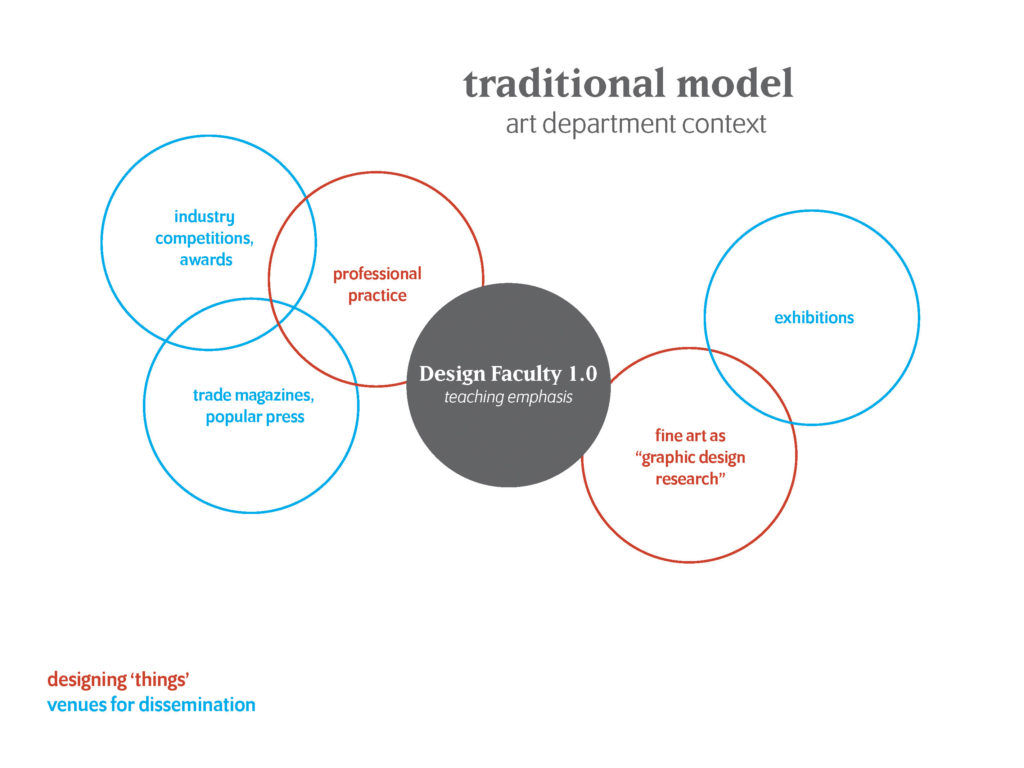
Figure 1: Traditional Scholarship Model for Design Faculty. Barness and McCarthy, 2017.
Traditional Scholarship Model: Art Department Context
The traditional scholarship model for design faculty, at least in second half of the twentieth century, was situated within fine arts departments. In this context, the emphasis was on teaching pre-professional courses and designing “things,” either through professional practice (typically client-oriented commercial work) or through creating personally expressive art work. The former found dissemination through industry competitions and trade publications, while the latter was exhibited in galleries and museums.
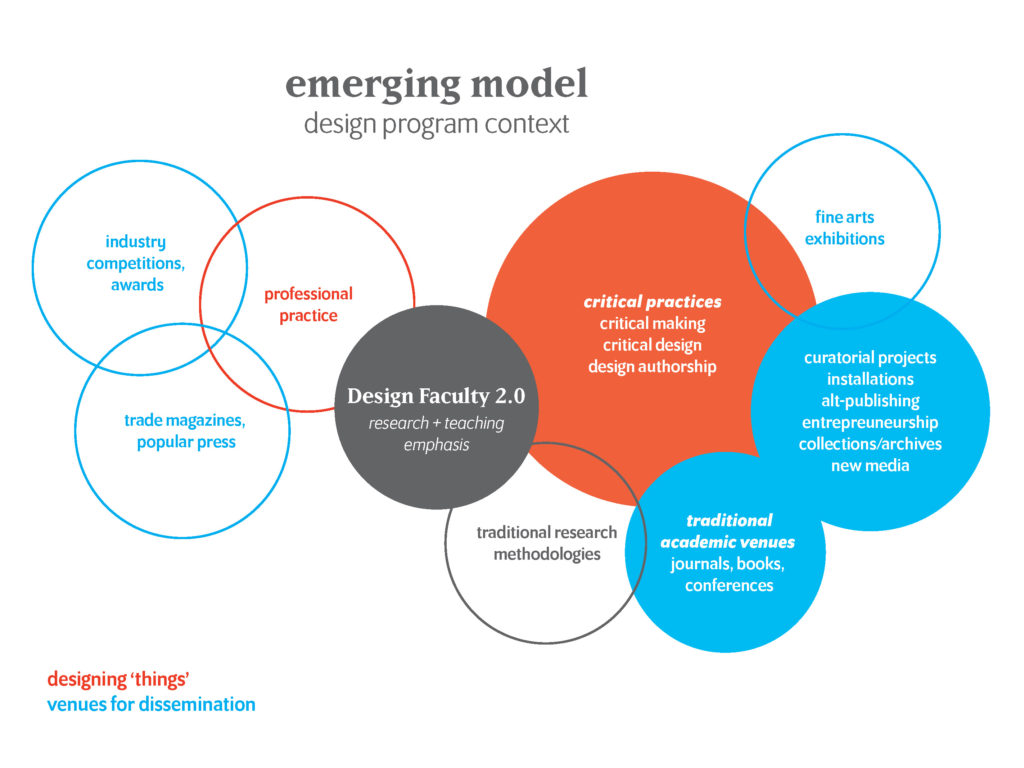
Emerging Scholarship Model: Design Program Context
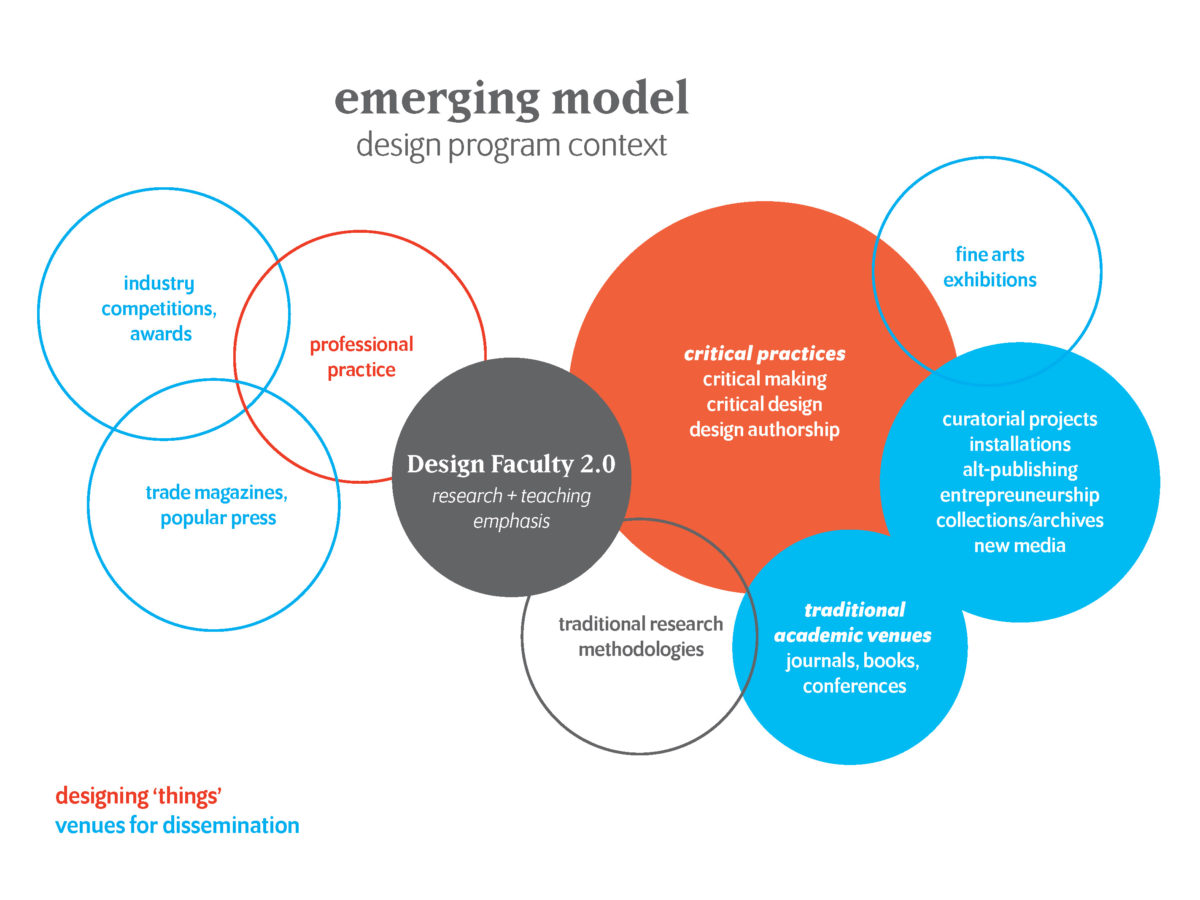
In this emerging model, with design often in its own academic department, research informs teaching and is conducted to create new knowledge for the discipline. Critical practices such as critical making, critical design and design authorship are used to inquire about, and respond to, complex social challenges that often lie outside of professional practice concerns.
Figure 2: Emerging Scholarship Model for Design Faculty. Barness and McCarthy, 2017.
Strategizing and Evaluating Design Scholarship
Considerations for evaluating design scholarship in higher education include faculty effort, the scholarly product, the selection process, dissemination venues, scope (local, regional, national, international), and the resulting impact. The design scholarship matrix below provides specifics on considerations such as these. Evaluating design scholarship necessitates an understanding of how these works “fit” into traditional academic contexts.
Design faculty must strategize their work to connect with expectations for tenure and promotion; however, this may pose challenges if tenure and promotion guidelines do not explicitly allow for diverse forms of scholarship. Thus, the faculty member may need to strategize competitive dissemination as well as determine the impact of a project for purposes of tenure and promotion.
The case studies on the following pages are all self-initiated, critical practice projects. For each, authorship, links, and brief descriptions are provided. Additionally, we have included suggestions on the ways this design scholarship matrix may be applied as projects are approached (by faculty) and evaluated (by colleagues, reviewers, and administrators).
Design Scholarship Matrix
(can be applied sequentially from left to right columns, and non-sequentially with different entry points)
Citations, collections, awards, number of viewers/users/visitors, funded, licensing, media attention, legislation, regulation, human welfare, policy, environmental impact, quality of life, commercial success, other evidence
1. Consideration of role if collaborative scholarship
2. Consideration of relationship to core discipline if interdisciplinary or extra-disciplinary
3. The product is tangible and/or retrievable
4. Designed work can be: object, image, experience, interaction, performance, service, environment, etc.
5. Consideration of acceptance rate if known
6. “Blind reviewed” refers to anonymity between reviewer and submitter, and can apply to selection criteria beyond journal articles, such as juried exhibits and competitions
7. Consideration of reputation or ranking of venue or publication if known
8. If exposed to different audiences, works can be disseminated in multiple venues (i.e. traveling exhibits, different jurors)
9. includes in print and online, and analog and digital formats
10. Consideration of scope (local, regional, national, international) if known
11. Consideration of impact factor
Figure 3. Design Scholarship Matrix, courtesy of Steven McCarthy.
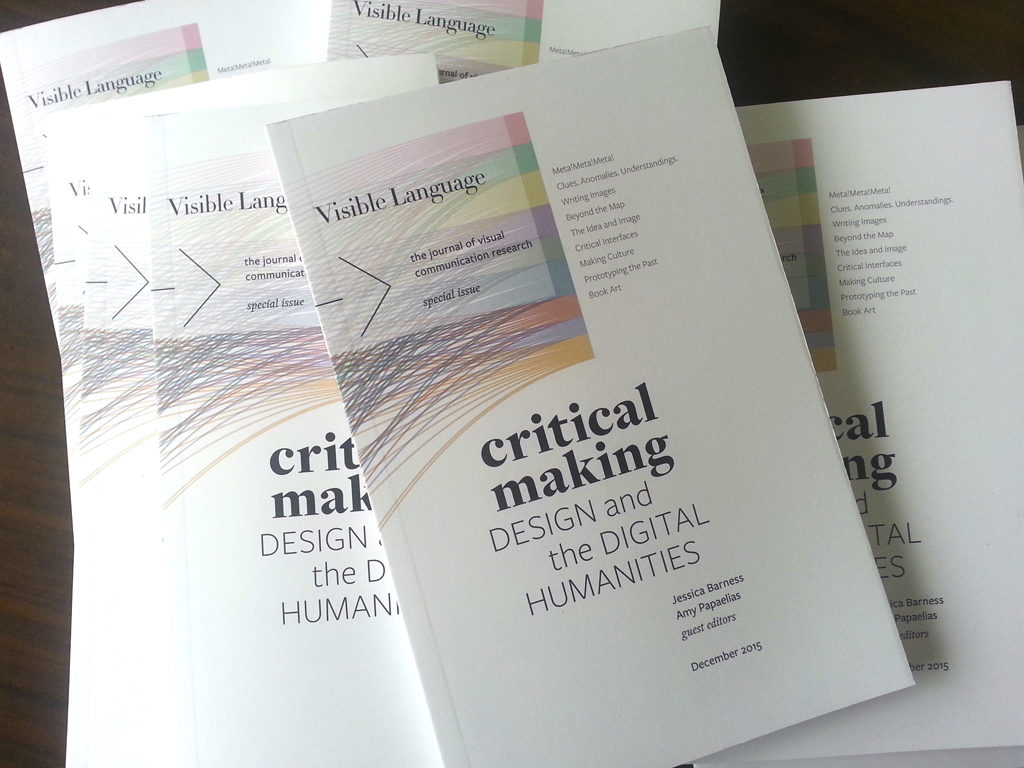
Critical Making: Design and the Digital Humanities, Visible Language (2015)
Jessica Barness, Amy Papaelias (editors)
Anne Burdick, Donato Ricci, Robin de Mourat, Christophe Leclercq, Bruno Latour, Holly Willis, Tania Allen, Sara Queen, Stephen Boyd Davis, Florian Kräutli, Steve Anderson, Padmini Ray Murray, Chris Hand, Jentery Sayers, Steven McCarthy (authors)
The special issue of Visible Language journal, “Critical Making: Design and the Digital Humanities” (vol. 49, no. 3; double-blind peer reviewed) locates where, how, and why critical making is emerging and the scholarly forms it takes. Nine articles by an international group of authors were organized into two areas that blurred disciplinary boundaries: Theories and Speculations (methods and systems to facilitate research), and Forms and Objects (publishing, prototyping, and hacking practices). The editors approached the issue itself as research in critical making by performing a text analysis and created data visualizations to better understand the language used to communicate the concept of critical making and show structural connections among the articles.
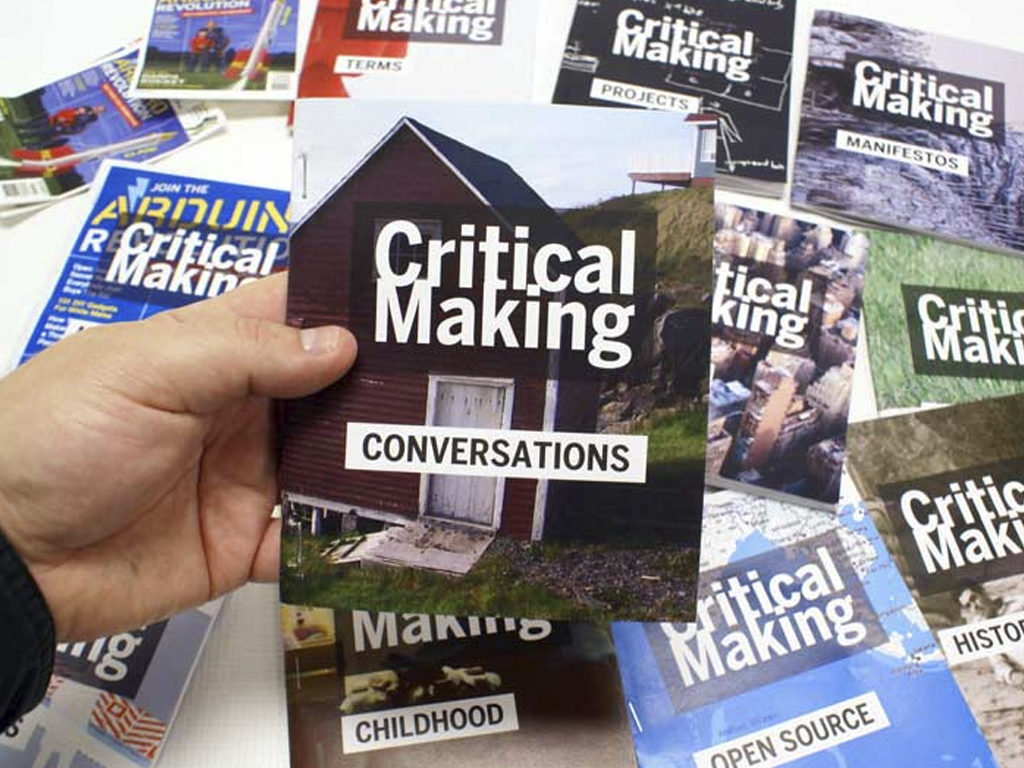
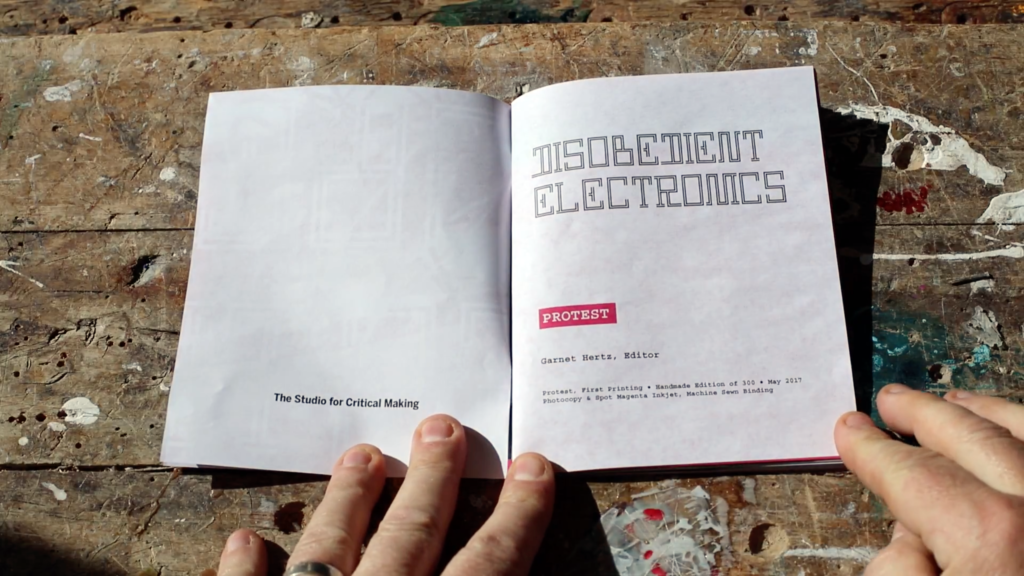
Critical Making Zine and Disobedient Electronics are self-published, handmade book projects that critically examine the ways making can extend conversations on technology, society, and culture. The ten volumes of Critical Making contain works by over 70 contributors from various disciplines, and produced using a photocopy machine and staples. Similarly, the contributors to Disobedient Electronics are also scholars, writing on projects and perspectives surrounding the theme of ‘Protest’. Both works have been exhibited internationally and acquired by permanent collections.
They were also given away for free to project contributors, individuals, and organizations.
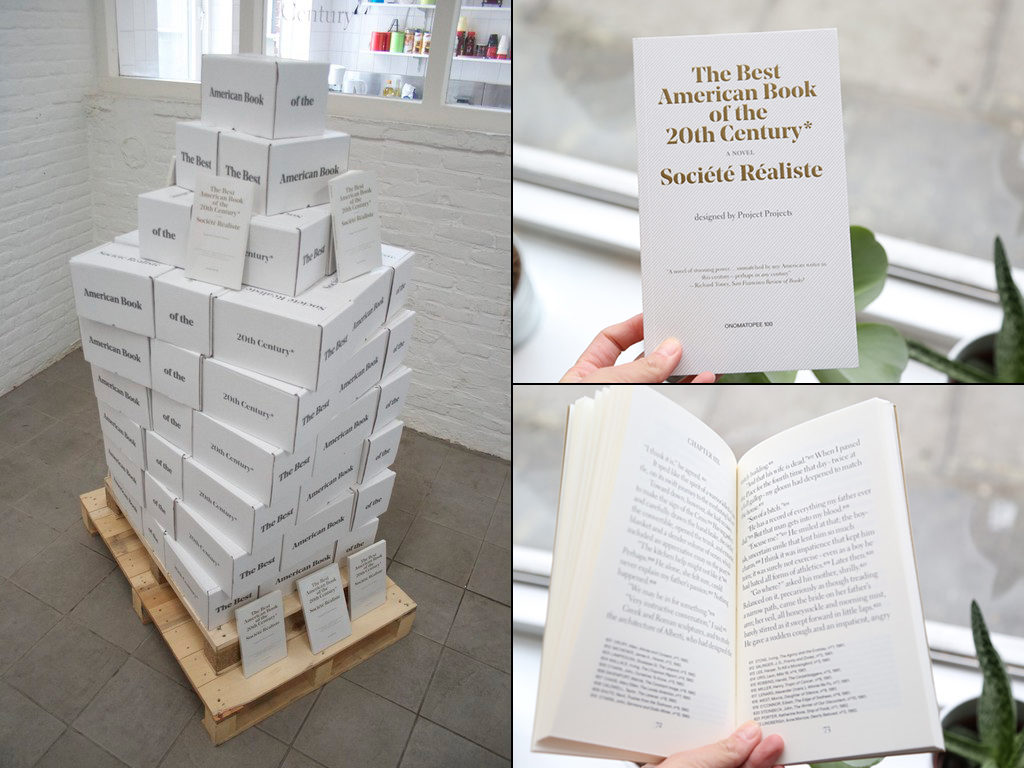
An investigation into language and collage, The Best American Book of the 20th Century presents the intertextuality of multiple narratives, author-reader dynamics, and shape of language over time. The project was also conceived as an exhibition, as a “‘stockroom-booksale’, resonating the symptoms of mass-distribution as visualized both on a sculptural and a graphic, formalized level” (Onomatopee web site). The book is composed entirely of the first lines from best selling books spanning 1900–1999.
IMPACT
• media attention
• commercial success
• citations
MediaWorks Pamphlet Series (2002–05)
Image credits: Courtesy of the authors.
MIT Press, various authors and designers
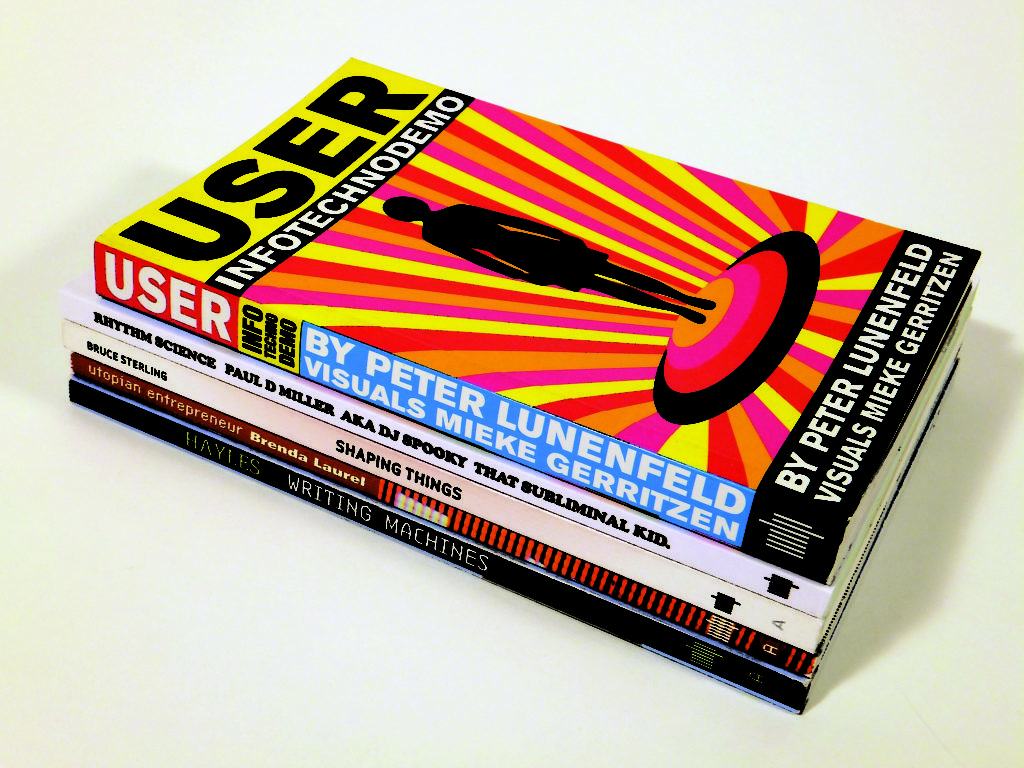
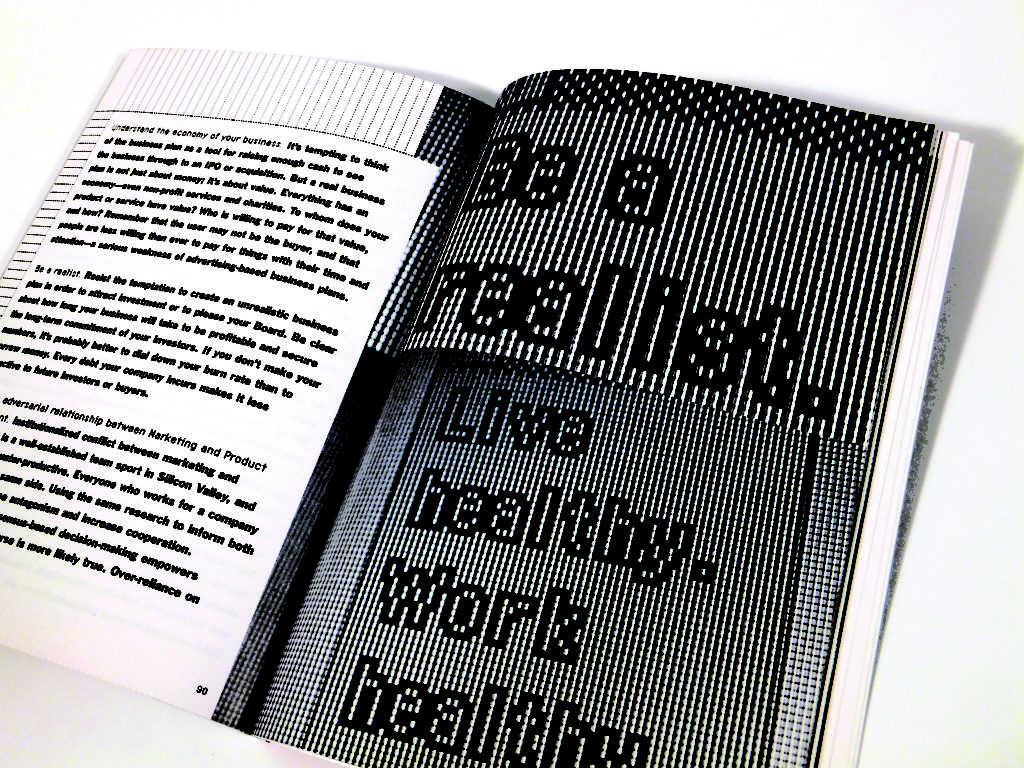
The MIT Press MediaWorks Pamphlet Series merges form and function through collaborative pairings of writers and designers. The presence of co-authorship is amplified through the weaving together of design decisions and primary written narrative, resulting in objects that are “zines for grown-ups, commingling word and image, enabling text to thrive in an increasing visual culture” (MIT Press website).
SELECTION PROCESS
• editor reviewed
• commissioned
DISSEMINATION
• marketplace
IMPACT
• media attention
• commercial success
• citations
The Electric Information Age Book and album (2011–12)
Image credits: Project Projects website.
Image credits: We Are the Masses website.
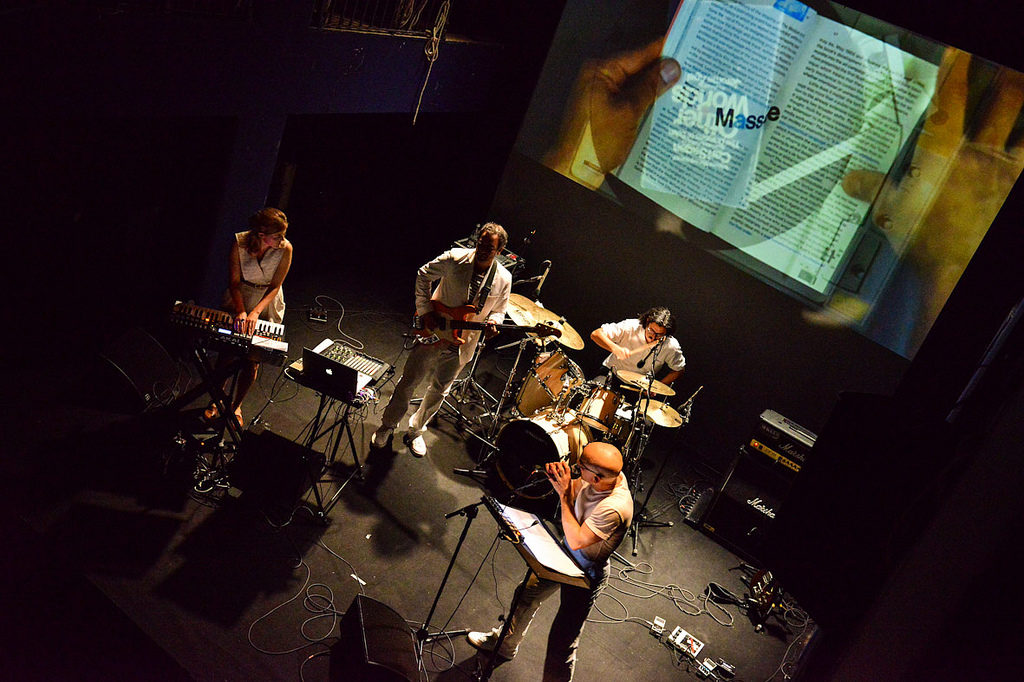
Jeffrey T. Schnapp, Adam Michaels (book) The Masses (album) Project Projects (design)
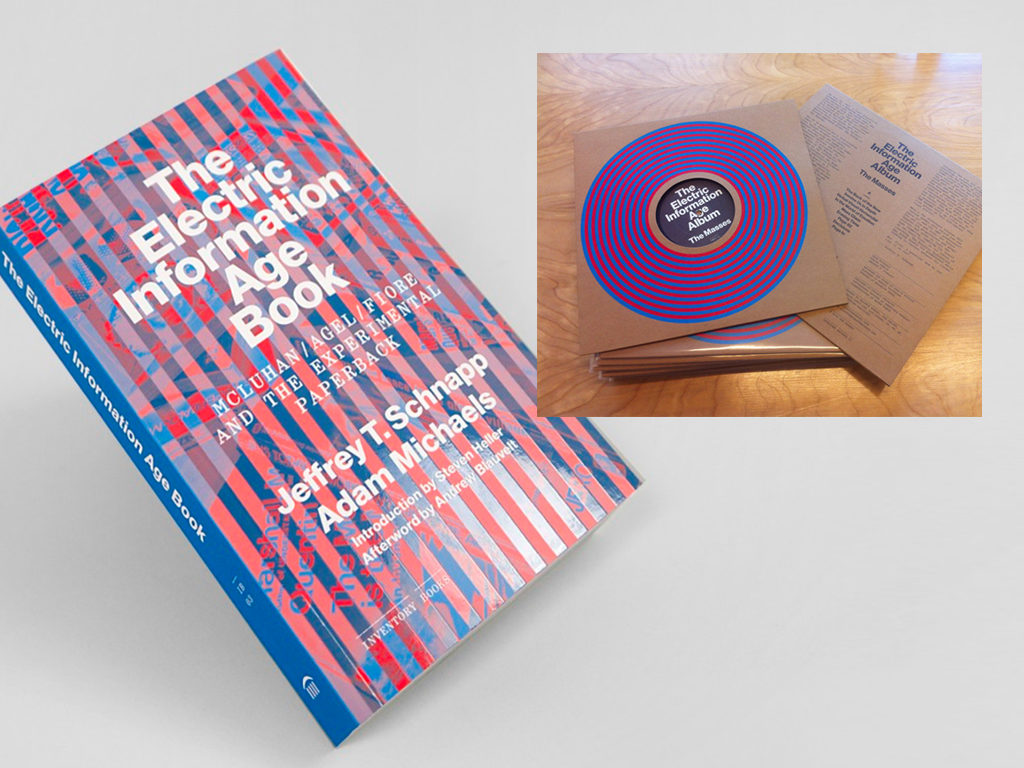
The Electric Information Age Book, and its audio extension, continue the investigation of mass-market publishing and graphic experimentation begun in the late 1960s by Jerome Agel, Quentin Fiore, and Marshall McLuhan with The Medium is the Massage. The LP mixes musical genres with text samples from the book. This project exemplifies collaborative work that explores the edges of media and performance, while also encompassing scholarly thought and creative practice.
SELECTION PROCESS
• self-initiated
• editor reviewed
DISSEMINATION
• marketplace
• digital distribution (audio tracks)
IMPACT
• media attention
• commercial success
• citations
Best Made / Re Made
Image credit: ReMade Co. website.
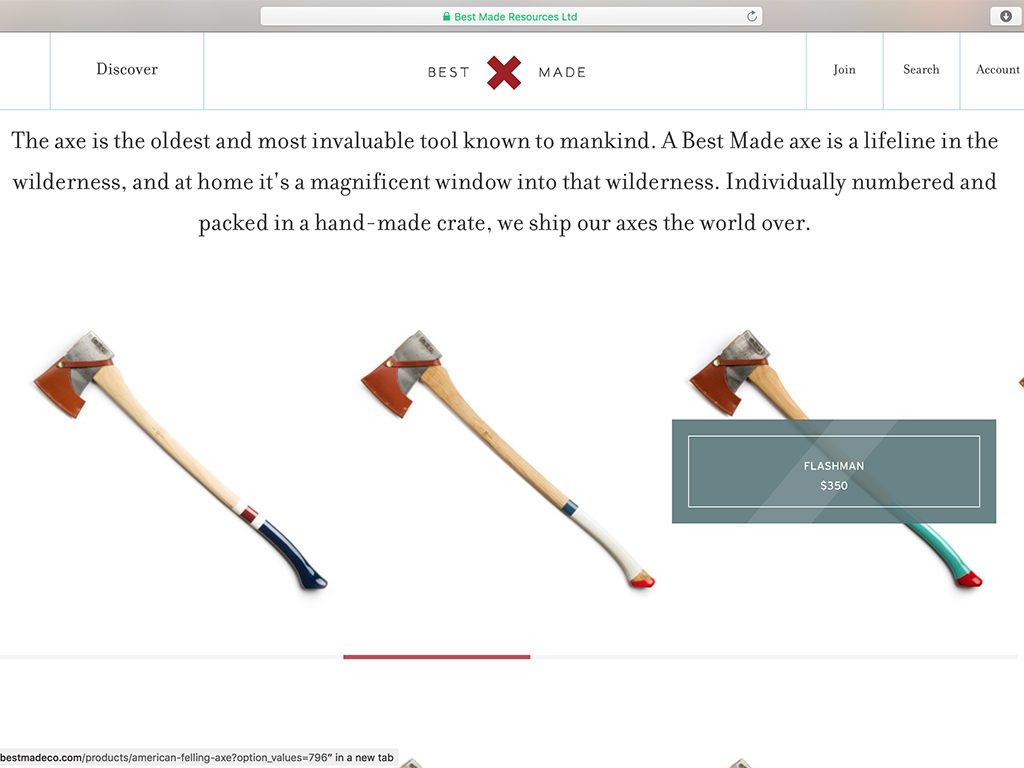
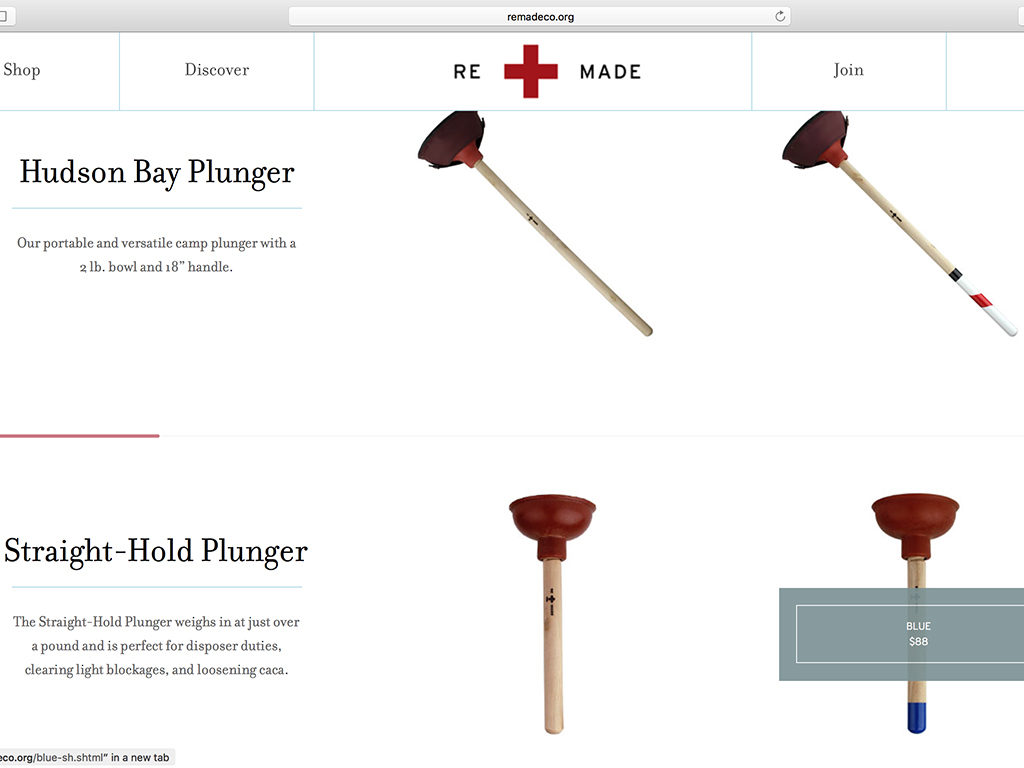
Peter Buchanan-Smith (left) Rebekah Modrak (right)
Re Made Plunger, a project by Rebekah Modrak, is a parody of Best Made Axe, a retail product by Peter Buchanan-Smith. Re Made is “a very pointed, and useful, example of object-as-critique, setting off a very serious line of questioning about the ideologies and biases embedded in designed things.
If a picture is a worth a thousand words, maybe sometimes the right critical object is worth a thousand critical essays”
SELECTION PROCESS
• self-initiated
• peer reviewed
• invited
DISSEMINATION
• published articles
• presentations
IMPACT
• media attention
• citations
• number of views
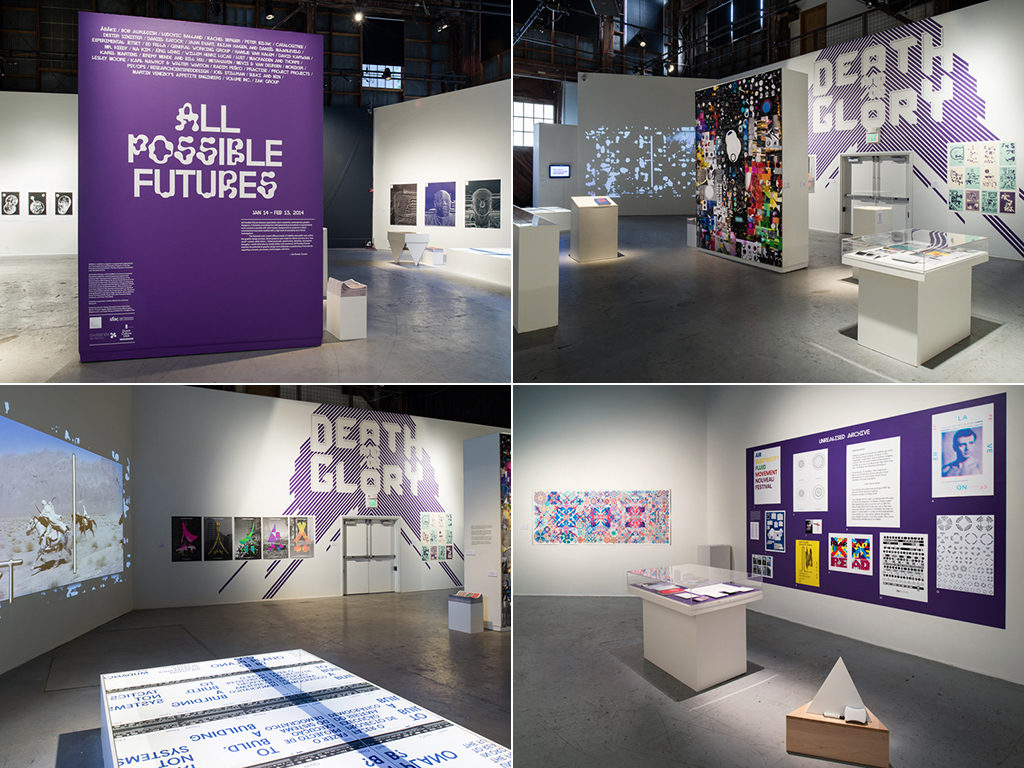
All Possible Futures (2014)
Image credits: All Possible Futures website.
Jon Sueda (curation)
Curation as critical practice is also a scholarly means to investigate a topic and engage the public. All Possible Futures explores speculative work by contemporary graphic designers. This broad spectrum of work includes self-initiated projects, experimental client work, and other endeavors that respond to a question of “what if?” – and highlights the potential for expanding the conventional boundaries of design practice. Moving design away from its expected context, the exhibition provides opportunity for visitors to interact with designed “things” in a new way.
SELECTION PROCESS
• self-initiated
• invited (exhibition venue)
DISSEMINATION
• exhibition
IMPACT
• media attention
• number of visitors
• citations
Curarium (2015)
metaLAB, Harvard University
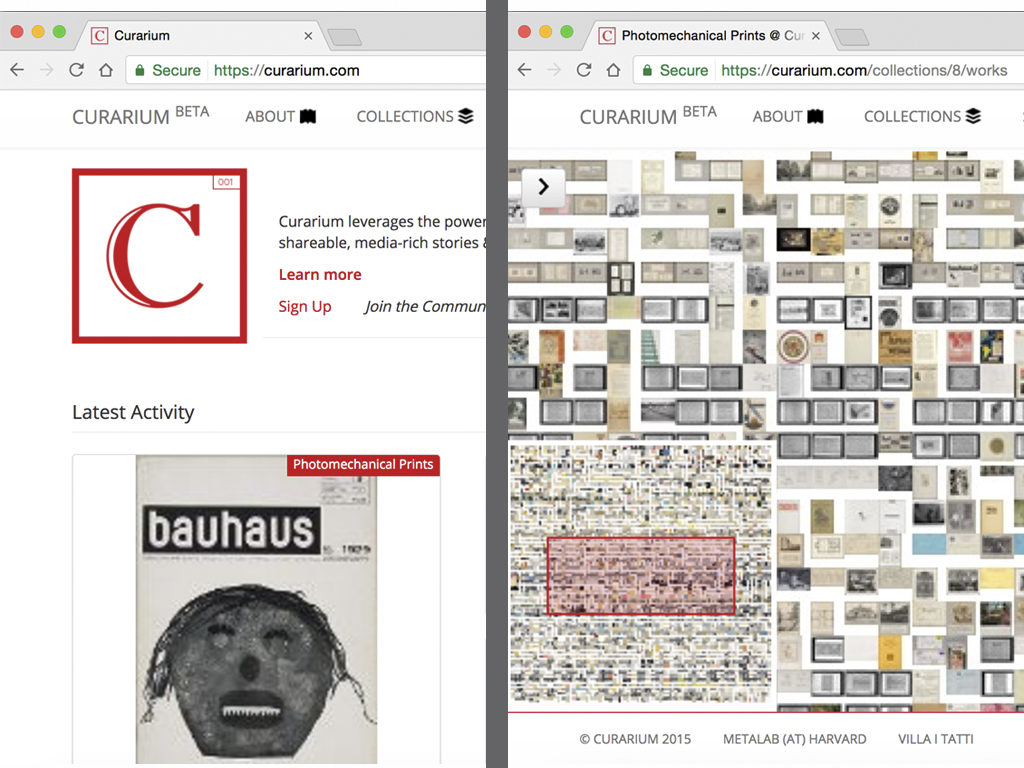
Curarium is an example of research at the intersection of experimental humanities, data visualization, and design. According to the project webpage, the interface is a “collection of collections, an ‘animated archive,’ designed to serve as a model for crowdsourcing annotation, curation, and augmentation of works within and beyond their respective collections.” Curarium integrates visual and interactive argumentation with storytelling and annotation, and presents a possible means to explore museum collections in a compelling, engaging way.
SELECTION PROCESS
• self-initiated
• peer reviewed
• invited
DISSEMINATION
• published articles
• presentation
IMPACT
• number of viewers or users
• citations
Casualties of War (2005)
Image credits: Daniel Jasper.
Daniel Jasper
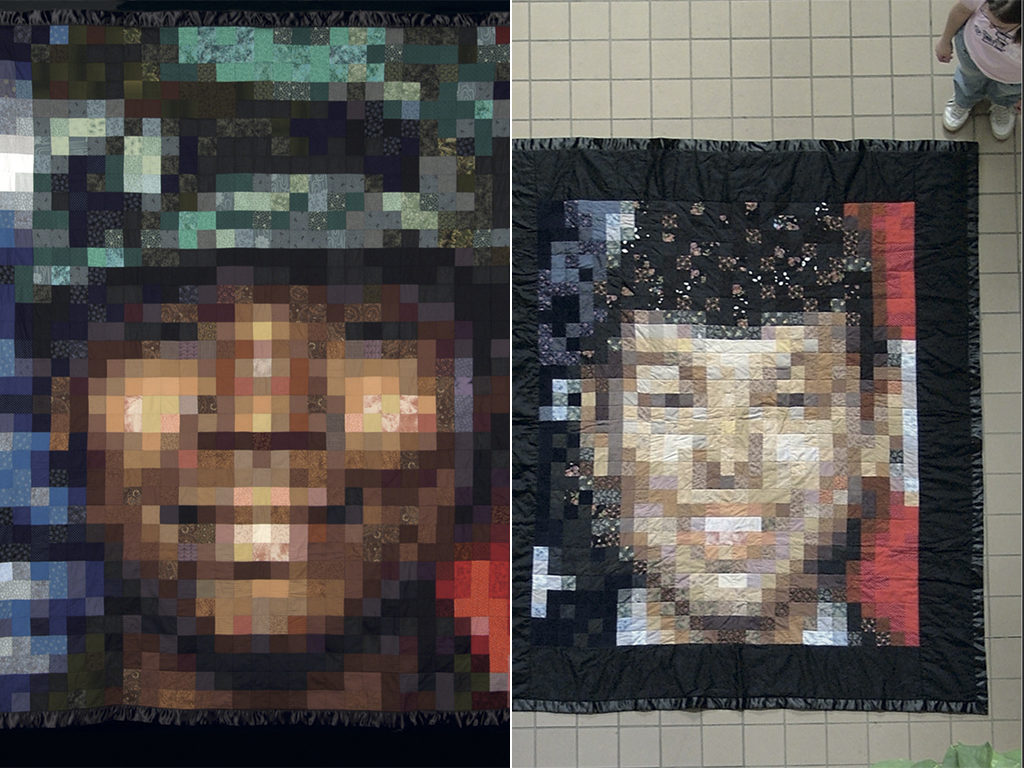
Casualties of War is a series of design projects that sought to visually enumerate and differentiate the growing list of United States military fatalities in the current Iraq War. These are projects that enumerate the total number of fatalities (quantity) yet strive to differentiate among the individual soldiers (quality). For the first time in the history of the United States women are fighting in a war zone as enlisted soldiers and as a result many are dying. The quilt results from a process by which portraits of American women soldiers killed in the Iraq War are repurposed from digital images grabbed from the Faces of the Fallen interactive feature on WashingtonPost.com into large-scale patchwork quilts. The fabric is also repurposed from second hand clothing and upholstered furniture.
DISSEMINATION
• exhibitions
• published articles
• presentation
• collections
IMPACT
• citations
• awards
• collections
• media attention
Emigre Magazine Index (2012), Vision in the Making (2017)
Image credits: Courtesy of the authors.
Jessica Barness
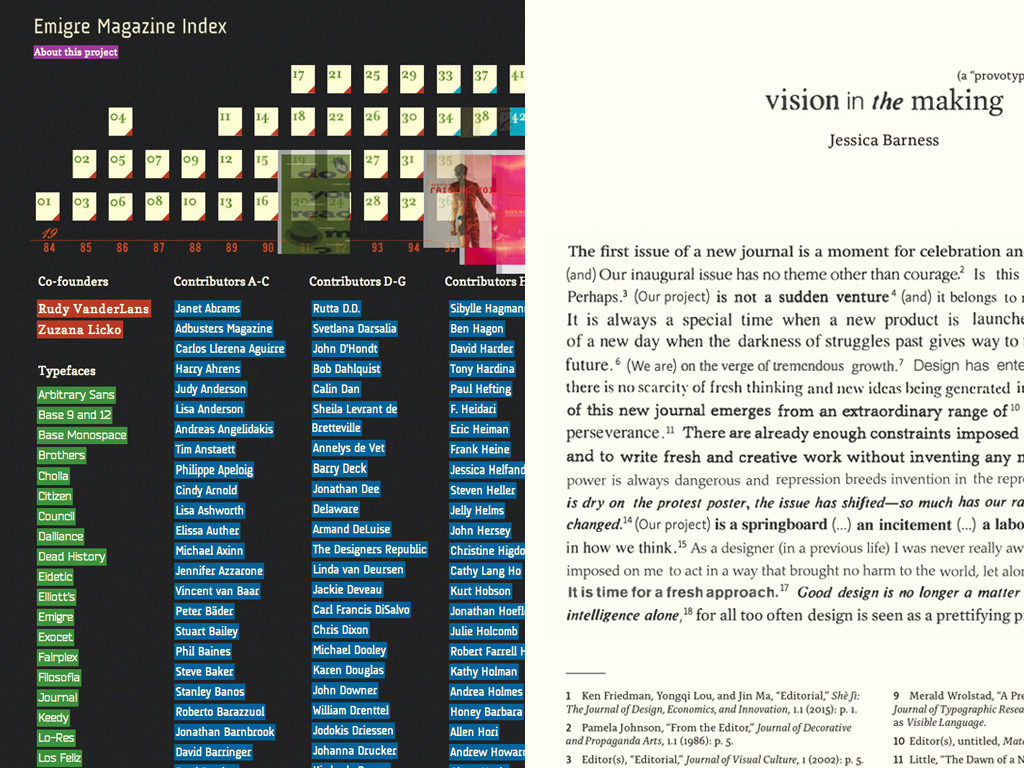
In these two projects, the contents of an archive or collection are translated to new contexts. The Emigre Magazine Index (left) is a digital interface developed as part of a public engagement program at the Goldstein Museum of Design. This online finding tool situates the contents and contributors of all sixty-nine issues in an interactive context, and served as a means to investigate authorship hierarchies and resulting navigational challenges. The close reading of texts outside traditional design literature prompted the development of Vision in the Making (right), a visual essay-manifesto composed of text snippets found within the editor’s introductions to inaugural issues of design periodicals. This textual assemblage preserves original typefaces and presents a glimpse of design publication history through critical, creative analysis.
SELECTION PROCESS
• self-initiated
• peer reviewed
• invited
DISSEMINATION
• published articles
• presentations
IMPACT
• citations
• number of viewers
• media attention
WYSi-WE (What You See is What Emerged) (2013)
Image credits: Courtesy of the authors.
Jessica Barness
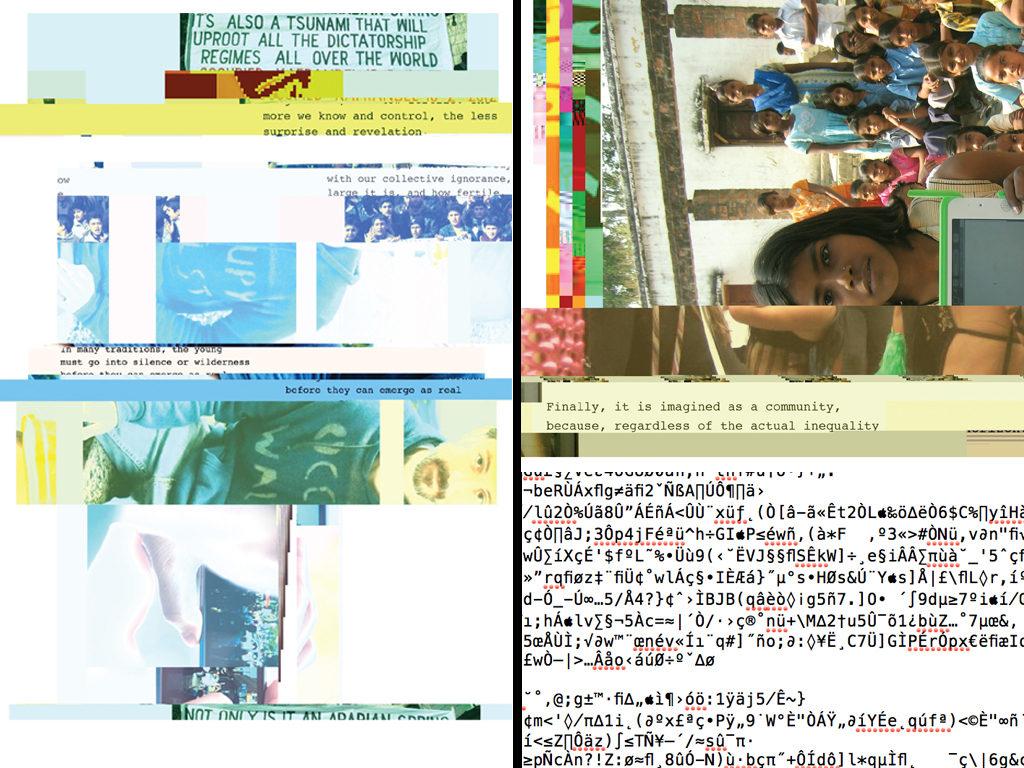
WYSi-WE (What You See is What Emerged) is a series of graphic assemblages created to investigate social intersections and photographic documentation of human nature. Photographs, sourced by keywords related to class, faith, gender, politics and sexuality, are fused together at the level of code bits (a technique known as databending or glitching) to graphically expose the influence of one piece of social identity on another. Understanding the visual work requires viewing the assemblages in published or exhibited form; each work is accompanied by documentation of its text-image parts, and the viewer is invited to read through the compositions in multiple ways.
DISSEMINATION
• published articles
• presentation
• exhibitions
IMPACT
• citations
• number of exhibition visitors
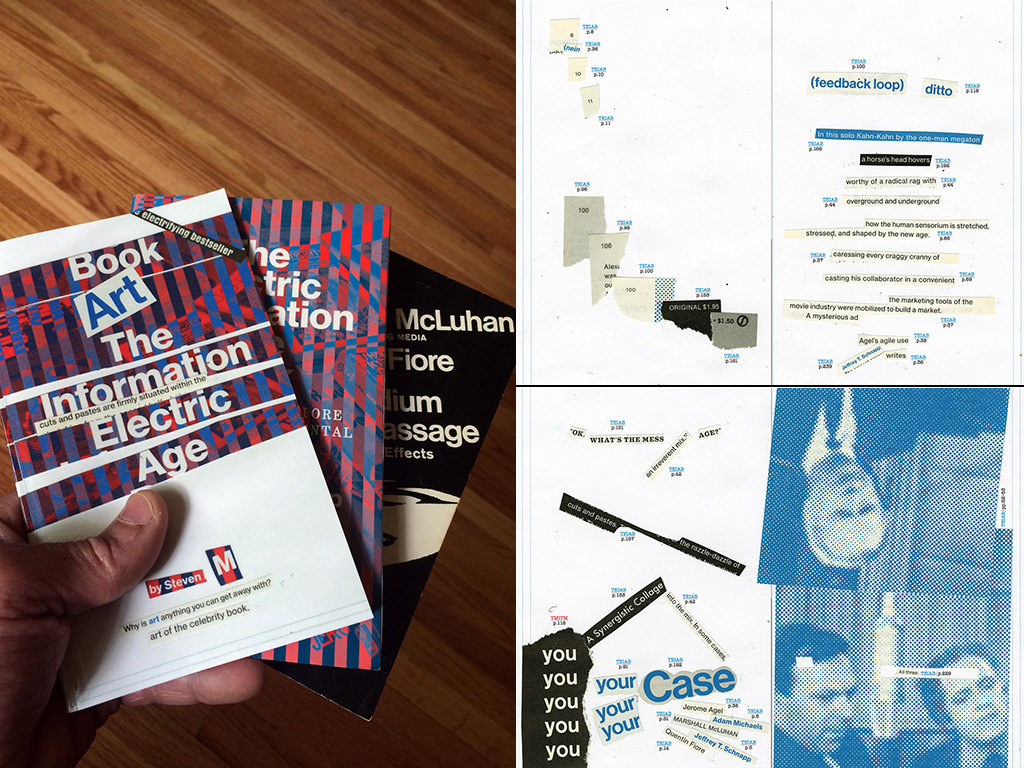
Book Art The Information Electric Age (2015)
Image credits: Courtesy of the authors.
Steven McCarthy
Operating under the theoretical frameworks of ‘remediation’, ‘recontextualization,’ and ‘critical design,’ this project proposes an alternative method to standard book reviews and to notions of publishing. It is a critical book review with a supporting essay that includes an in-depth description of the author’s hybrid digital-analog process. Book Art is a critical remix of The Electric Information Age Book McLuhan/Agel/Fiore (Jeffery Schnapp and Adam Michaels), with cameo appearances by The Medium is the Massage. Book Art uses collage to reconfigure and re-imagine these books as a commentary on mediation, information, expression, communication, and authorship.
DISSEMINATION
• published articles
• presentation
• exhibitions
• marketplace
IMPACT
• citations
• awards
• commercial success
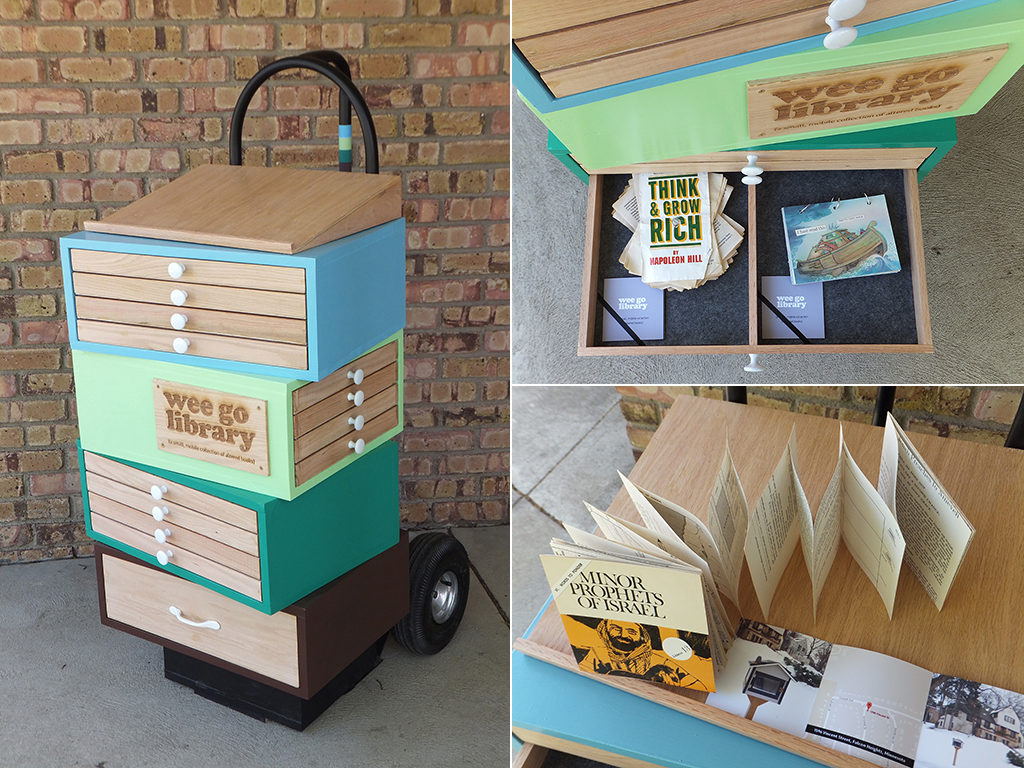
Wee Go Library (2016)
Image credits: Courtesy of the authors.
Steven McCarthy
Wee Go Library is a small, mobile display unit for twenty-two altered books. The books were harvested from Little Free Libraries in the Twin Cities (“take a book, leave a book”) as a commentary on neighborhood, community, design, architecture, and of course, books. Custom-built oak and pine cabinets are mounted to a metal hand-truck; drawers are felt-lined; the Wee Go Library sign is laser-cut in oak. Each book is sourced to its donor library with a small pamphlet that has a pin-pointed map and photos of the library structure and sponsoring house. Various re-mixing techniques were used to enliven the books: collage, rebinding, cutting, folding, tearing and gluing.
DISSEMINATION
• published articles
• presentation
• exhibitions
IMPACT
• citations
• awards
• media attention
Implications for Tenure and Promotion of Design Faculty
In conclusion, we recommend the following be considered by faculty engaging in critical practice as design scholarship. These questions should be addressed in the early stages of projects and research agendas — in connection with an institution’s guidelines for tenure and promotion – to clarify expectations and possibilities.
Academic Culture
Is your environment accepting of diverse forms of scholarship?
Are senior colleagues supportive?
Tools and Procedures
Do your tenure and promotion guidelines “literally” accommodate diverse forms of scholarship?
Can ‘novelty’ of critical practices be leveraged into impact, rigor, etc.?
Interdisciplinary and Collaborative Work
Can documentation, support, and legitimacy be garnered from other fields (humanities, the arts, sciences, etc.)?
Is collaborative work supported, and in what ways?
External Reviewers
Are the external reviewers appropriate for evaluating the candidate’s dossier for tenure and/or promotion?
Jessica Barness (MFA University of Minnesota) is an associate professor in the School of Visual Communication Design at Kent State University. Her research resides at the intersection of design, humanistic inquiry, and interactive technologies, investigated through a critical, practice-based approach. She has presented, exhibited, and published her work internationally, and co-edited the special issue of Visible Language journal, Critical Making: Design and the Digital Humanities.
Steven McCarthy (MFA Stanford University) is a professor of graphic design at the University of Minnesota, Twin Cities campus. His long-standing interest in design authorship, as scholar and practitioner, has led to publications, presentations, exhibits and grant-supported research in a dozen countries. His book on the topic, The Designer As… Author, Producer, Activist, Entrepreneur, Curator and Collaborator: New Models for Communicating was published in 2013 by BIS Publishers, Amsterdam. McCarthy is currently serving a three year term on the board of the Minnesota Center for Book Arts.
Design Incubation, the esteemed 2017 awards jury, and Bloomsbury Publishing is pleased to announce the recipients of the Design Incubation Educators Awards in Communication Design 2017 in the categories of Scholarship: Creative Work, Scholarship: Published Research, Service, and Teaching.
Thank you to all who entered the competition and those who participated in recognizing the efforts of academics in design research.
Warren Lehrer Professor School of Art+Design Purchase College, SUNY Founding Faculty Member Designer as Author Graduate Program SVA (School of Visual Arts)
Anne Galperin Associate Professor Graphic Design SUNY New Paltz
Like so many other endeavors contemporary designers find themselves involved in, fashiontech (a marriage of conventional apparel and electronic/digital technology for fun and/or function) unites a variety of professionals in collaboration. Experience and interaction designers, industrial and fashion designers, engineers, programmers and users all have a role to play in the conceptualization and creation of fabrics, garments, hardware, and programming.
Hybrid practices such as this one require new theoretical frameworks in order to describe, understand and innovate in emerging fields.
As an initial step toward the creation of a such a framework for fashiontech, selected concepts originating in areas as diverse as tangible computing, fashion, semiotics, sociology, women’s studies, craft and maker culture will be described, compared and contrasted. (This will not exclude issues of concern in the apparel, technology and design industries including unsustainable or ethically compromised resource production, labor, and manufacturing, and the planned obsolescence typical of both fashion and technology.)
This synthetic construction is intended to be useful to students, educators and makers in fashiontech-related fields as they envision, create and theorize about such garments. As a demonstration the framework will be used to analyze and position pivotal fashiontech garments, one possible example being the Cute Circuit-designed dress Katy Perry wore to the 2010 Met Costume Institute Gala.
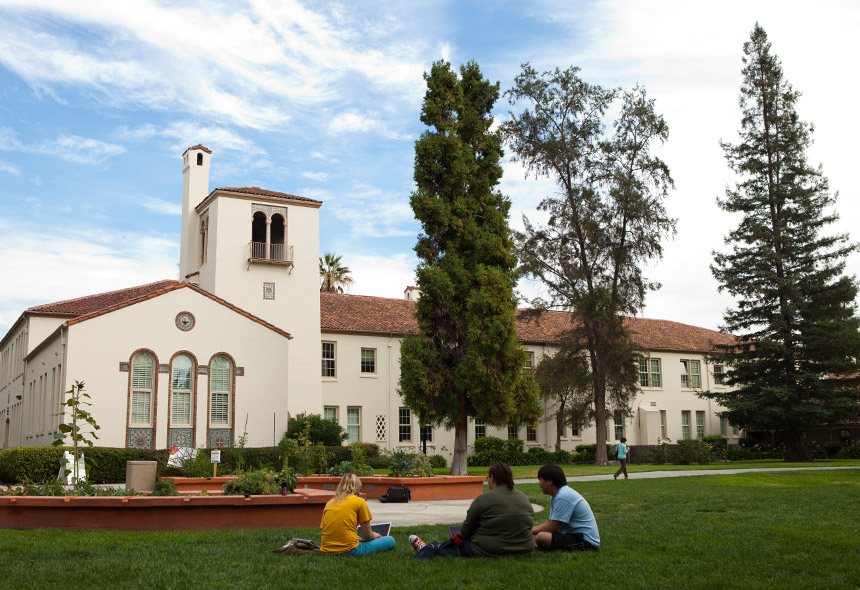
Design Incubation Colloquium 4.1 (#DI2017sep2) will be held at San Jose State University on Saturday, Sept 30, 2017.
Design Incubation is going to the Bay Area! We are excited to announce our first trip to Silicon Valley, and we hope that the West Coast will be regular destination for discussions in design thinking and collaboration in academic design research and scholarship.
Hosted by John Delacruz
Design Incubation Colloquium 4.1 (#DI2017sep2) will be held at San Jose State University. This event is open to all interested in Communication Design research.
Saturday, September 30, 2017
Time: 10:30–4:30
Dwight Bentel Hall 117
School of Journalism and Mass Communications
One Washington Square
San Jose, CA 95192-0000
Renée Stevens Assistant Professor Multimedia Photography & Design Department S.I. Newhouse School of Public Communications Syracuse University
The future of AR and mixed realities are here. With Apple’s introduction of ARkit launching this fall, I was able to design and develop an app concept to use inside this new space called tagAR. An app that will help enhance social networking and empower those who struggle to remember people’s names in a crowd. I will share my concept, workflow, limitations of the technology as it changes and finally show how AR is going to advance the power of design for social good, specifically those who have a learning disability or are dyslexic, like myself.
Alex Liebergesell Associate Professor Graduate Communications Design Pratt Institute
“The Future of Employment”, published by the Oxford Martin School in 2013, predicts significant displacement of human labor forces over the coming two decades, as computerization and robotics continue to migrate from routine manual to non-routine cognitive tasks. While designers fare well in the study’s susceptibility-to-displacement rankings, we will need to establish new “complementarities” with the creative and social intelligence capabilities of cutting edge robotics if we are to thrive. The recent acquisition of Google xLab/Boston Dynamics and their proprioceptively advanced robots by Softbank, the Japanese inventor and domestic distributor of the emotionally responsive home companion “Pepper,” is just one indication of how quickly technological, market and social developments are converging to propel smart, autonomous machines into our everyday lives. These machines’ near-future capacity for causal reasoning and insight — and uncanny humanoid presence — will call upon designers’ expertise in shaping language, user experiences and interactions, all unique and generalist meta-cognitive skills that still define specific human advantages. Having shifted from a preoccupation with form to the construction of meaning, design practice — whether in communications, products or space planning — can seek to take additional steps in creating conversations, codifying behaviors, and defining new artifacts and physical ecosystems that are sensible, graspable and navigable to both humans and machines in innumerable settings. Moreover, by modeling positive speech and behavior, shared environments and common social values, designers, when creating and coexisting alongside autonomous machines, will do no less than encourage humans to recognize and cherish reciprocity, civility and labor.
Peter P. Bella, Jr
Assistant Professor Indiana University–Purdue University Fort Wayne
How human can the machine become in relation to the craft of moveable type and modern printing technologies? The letterpress has been an instrumental aspect of typography for centuries. The mechanical process of raised letterforms transferring ink to paper has a humanistic quality that exemplifies our senses and emotions. Movable type has seen centuries of adaptations—lead, wood, polymer and more; along with the creation tools and technologies—such as pantographs, plate makers, and computer. Has moveable type met its end, has letterpress found its zenith? Has technology surpassed this mechanical time machine and the cold nature of cast metal?
3D printing has varying qualities and expectations dependent on numerous variables. These virtues of 3D printing offer the design of typography, moveable type, and printing techniques an amplitude of potential expressions and experiential opportunities. Examples of 3D printing’s use in the realm of typography are found in 3D sculptures expressive of the letters architecture, and letterforms designed in three-dimensional space, never intended for physical traditional letterpress printing methods. This research is concerned with something entirely different finding a middle ground between perfection and form defining its own voice and concept through the qualities that are characteristically built into the machine.
This research suggest letterpress printing and moveable type has untapped life yet to be revealed presenting the challenging demands of typography and the mechanical properties of 3D printing methods applied to the creation of moveable type, its design, printing, and communicative qualities by personifying 3D printing technologies to create a moveable typeface with humanistic qualities and design voice. This moveable type exploration embraces the 3D printer as a machine to create a typeface never intended to meet the standards of perfection, but to embody the inherent artistic and humanistic aesthetics of the machine by pushing technology to its limits and discovering how human a 3D printed movable typeface can become.
Design Incubation is excited to announce a partnership with Bloomsbury Publishing for the Design Incubation Educators Awards.
Bloomsbury publishes books on various design education topics from academic research on the history and theory of the discipline through introductory textbooks to practical guides and manuals.