Designing Dialogue: Leveraging Technology for Cultivating Inclusion and Belonging in Classroom Critique

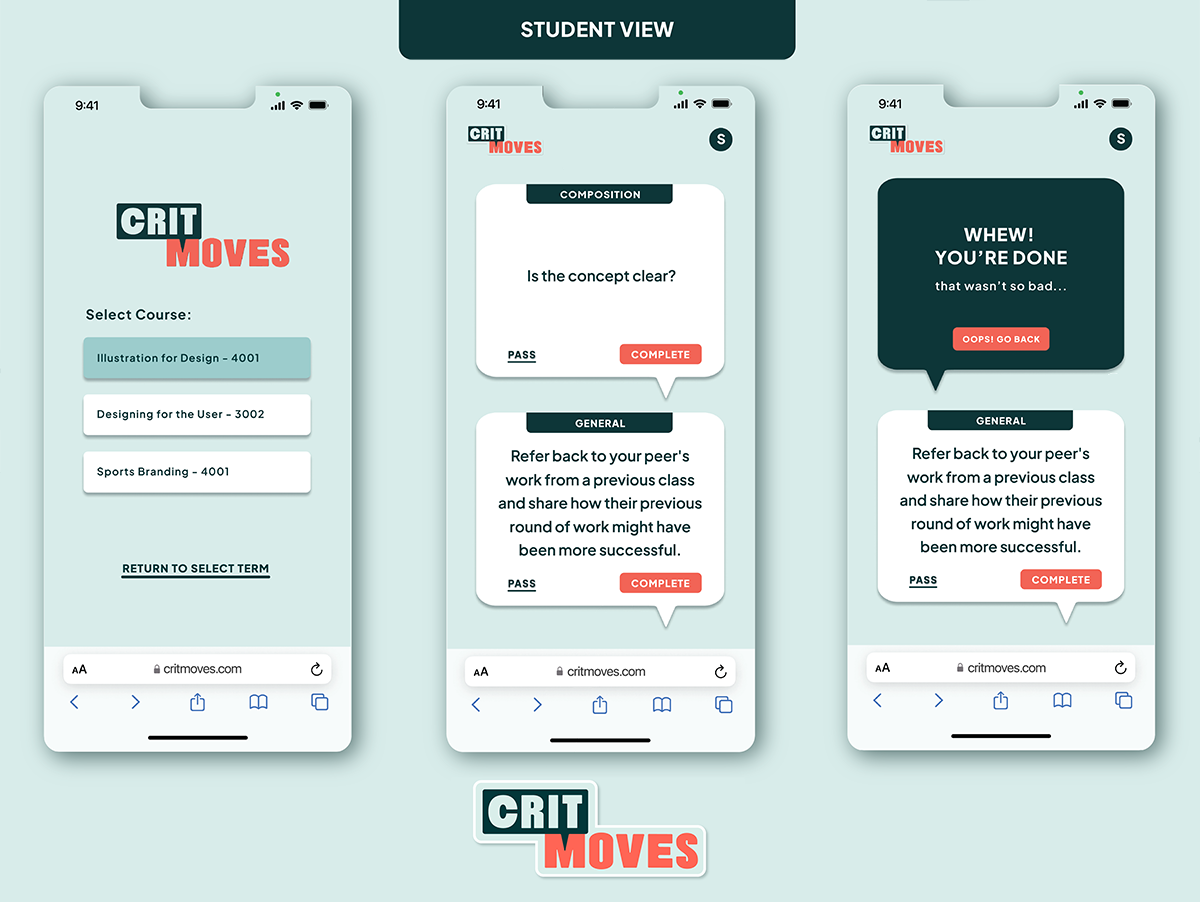
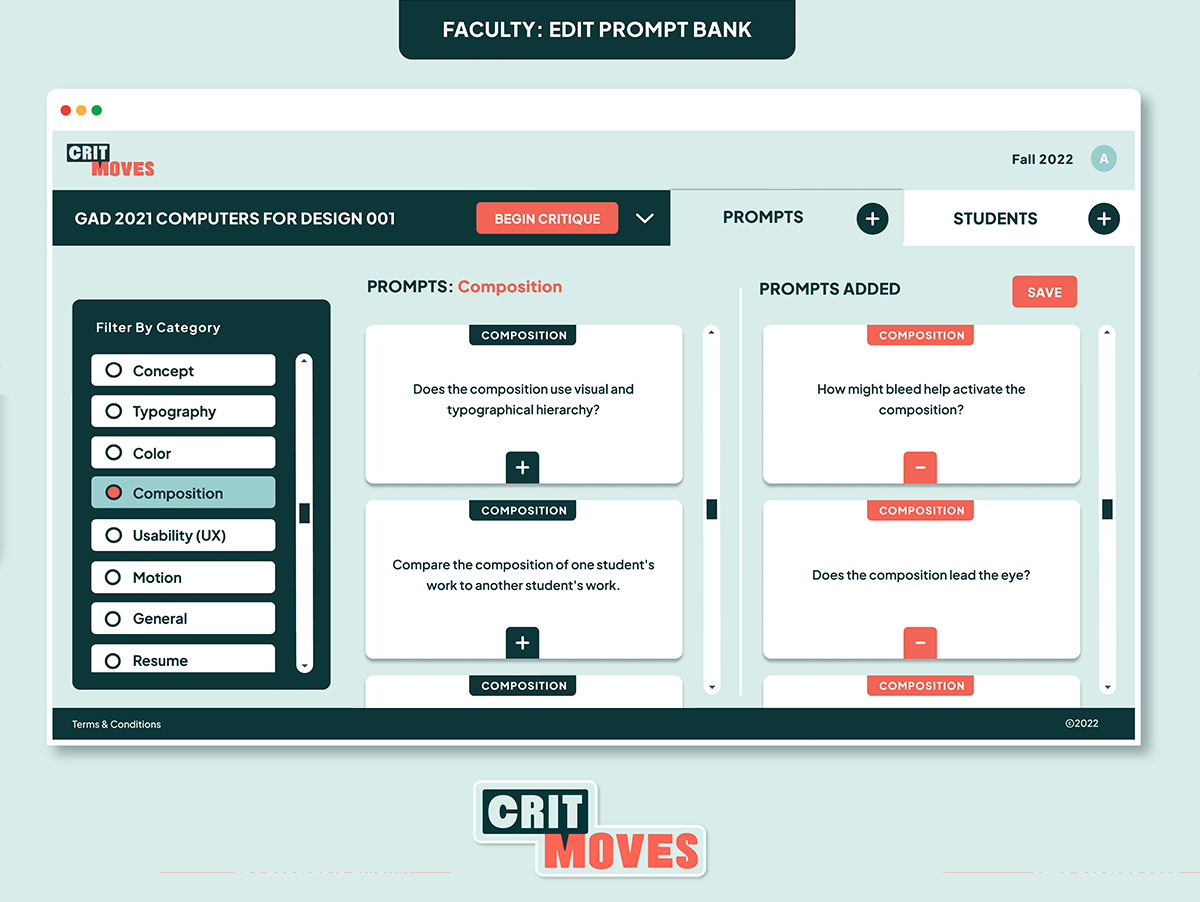
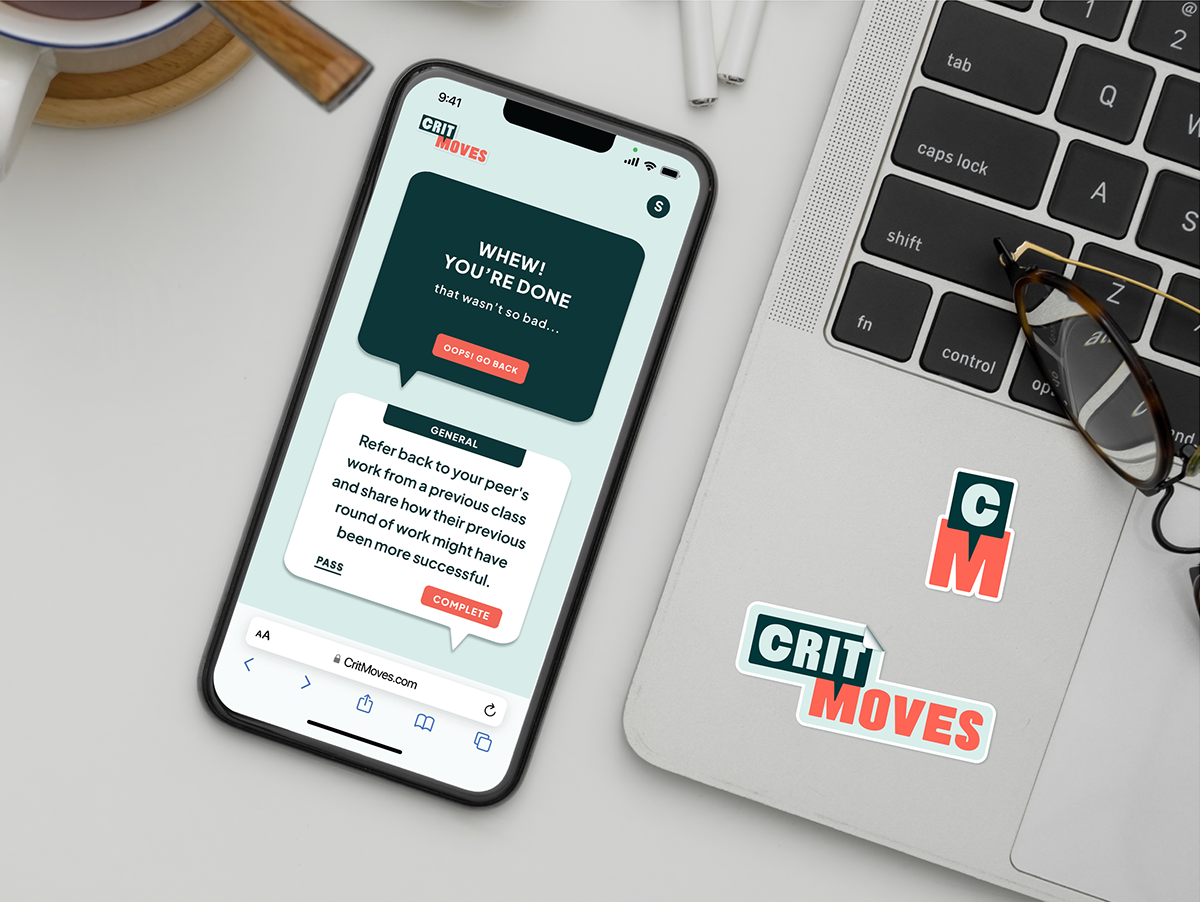
CritMoves would allow faculty to create a set of specific prompts that would be randomly assigned to students via student cell phones

Jenny Kowalski
Assistant Professor
Lehigh University

Abby Guido
Associate Professor
Temple University

Peer critique is a tool for formative and summative assessment in art and design classrooms (Motley, 2016). Although some forms of critiques are dominated by the instructor (Barrett, 2000), a framework encouraging peer discussion establishes a collaborative environment and fosters meta-cognitive skills (Topping, 1998).

Two graphic design professors are proposing a tool called CritMoves to enhance participation in classroom critiques. Based on the concept of conversational moves (Nichols, 2019), CritMoves would allow faculty to create a set of specific prompts that would be randomly assigned to students via student cell phones. Students could “execute” prompts during the critique, gamifying the critique experience and encouraging peer communication.

Prompts such as “agree with what was just said and add additional feedback” or “disagree with what was just said and share an opposing view” encourage students to engage in a full discussion. Other prompts such as “discuss the color contrast in this piece” direct students to focus on specific details that can be connected to pedagogical goals. Our intention is that the structure of the curated prompts will lead to more positive feelings towards peer critique and a greater sense of belonging in the classroom.

This presentation will discuss the early stages of this research and the development of a prototype through an interdisciplinary collaboration of students in Computer Science and Graphic and Interactive Design programs. We are interested in engaging in a conversation about how best to utilize technology to foster human interaction and connection in art and design classrooms.

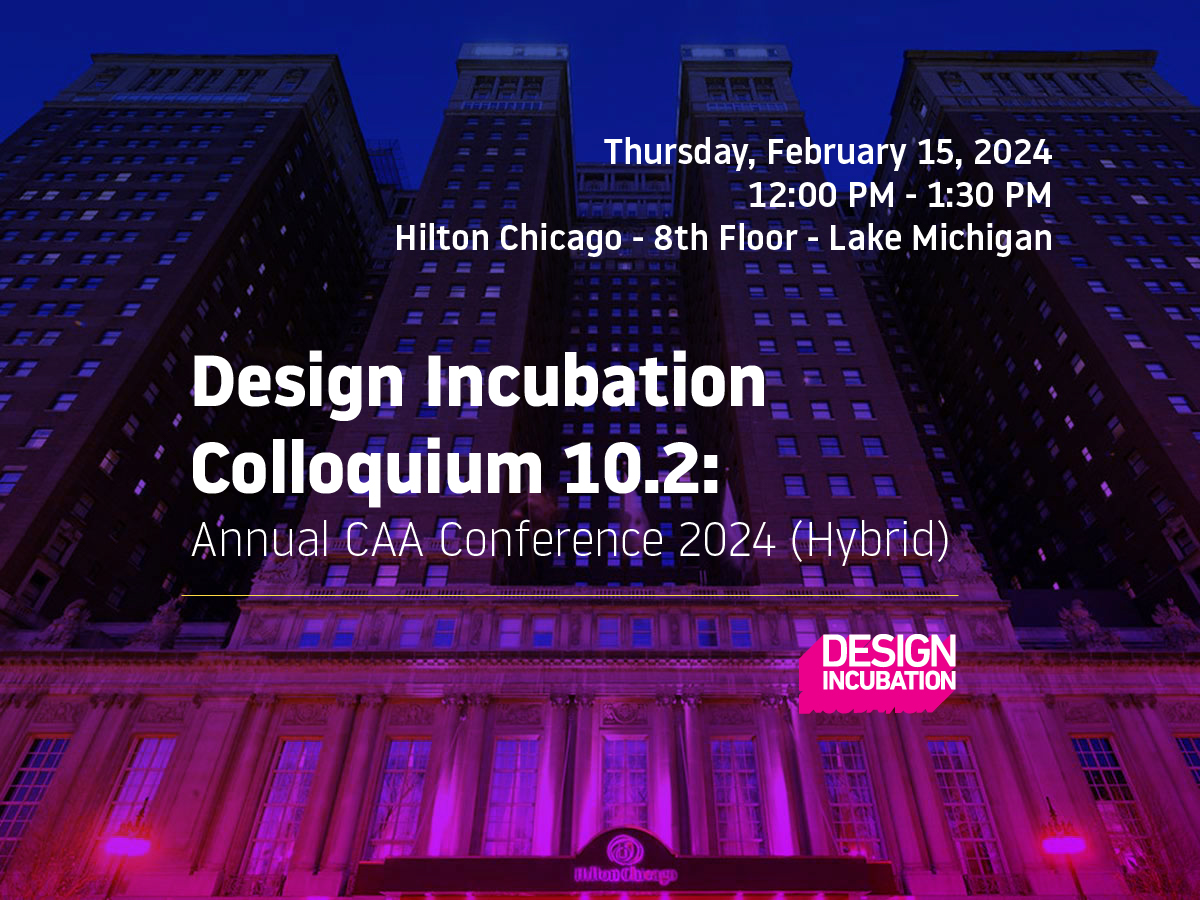
This design research is presented at Design Incubation Colloquium 10.2: Annual CAA Conference 2024 (Hybrid) on Thursday, February 15, 2024.

Convergence of Science and Art to Support Climate Resilience in Central American Smallholder Communities

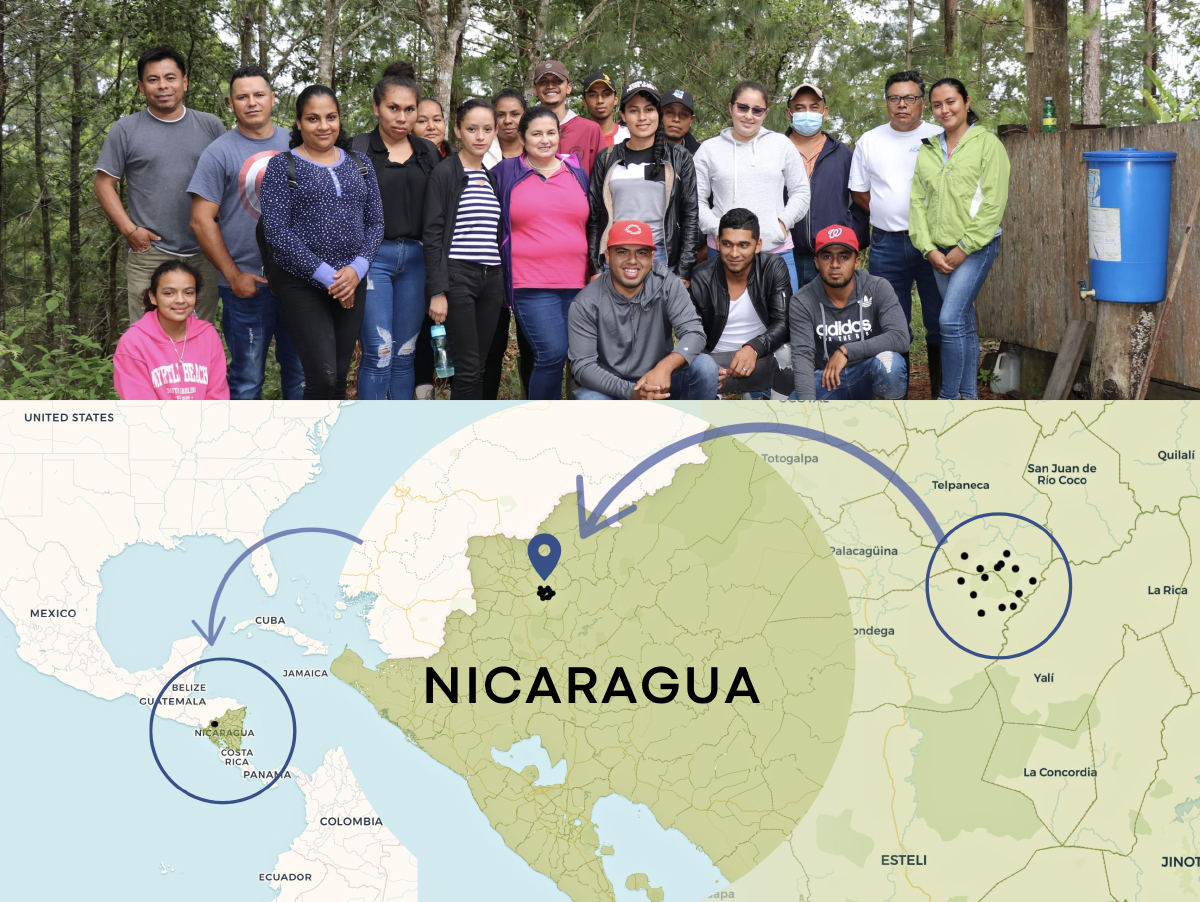
This innovative application assists farmers in planning their planting and harvesting activities based on rainfall forecasts

Qiuwen Li
Assistant Professor
Santa Clara University

Sara Wheeler
Undergraduate Student
Santa Clara University

Contributors: Iris Stewart-Frey, Ed Maurer, Allan Báez Morales, Gautam Chitnis, Alex Avila, Tanmay Singla, Turner Uyeda, Briana Guingona

Farming communities in vulnerable regions of Northern Nicaragua heavily rely on rain-fed agriculture amidst climate variability. Unfortunately, smallholder farmers often lack timely climate forecasts to inform their decisions. To address this challenge, a collaborative team from Santa Clara University (SCU) has partnered with a Nicaraguan NGO to develop the NicaAgua app. This innovative application assists farmers in planning their planting and harvesting activities based on rainfall forecasts.

This app innovatively simplifies presenting probabilistic rainfall forecasts. Our project leverages resources and advocates integrating data visualization with shapes, symbols, and attributes, following human-centric principles for accessible climate data.

Forecasts’ use relies on perceived skill (Babcock, 2016). The main challenge is converting rain forecasts across language and geography, aligning with local knowledge and ensuring accessibility. We employed participatory methods, surveys, focus groups, and workshops. In design, Gestalt principles make our visuals digestible, aiding in identifying relevant metrics for local climate efforts.

Through visual aids and expertise, this initiative empowers Nicaraguan farmers. We’ll share insights in the session, covering student-centered research, participatory methods, and app design.

References

Babcock, Gabrielle Wong-Parodi, Mitchell J. Small and Iris Grossmann, Stakeholder perceptions of water systems and hydro-climate information in Guanacaste, Costa Rica, Earth Perspectives (2016) 3:3, DOI 10.1186/s40322-016-0035-x

This design research is presented at Design Incubation Colloquium 10.2: Annual CAA Conference 2024 (Hybrid) on Thursday, February 15, 2024.

From Bricks to Pixels: The Evolution of Banna’i Kufic

During the prosperous Islamic era, Persian architecture began to incorporate calligraphy as an ornamental element in mosque design

Sajad Amini
Assistant Professor
DePaul University

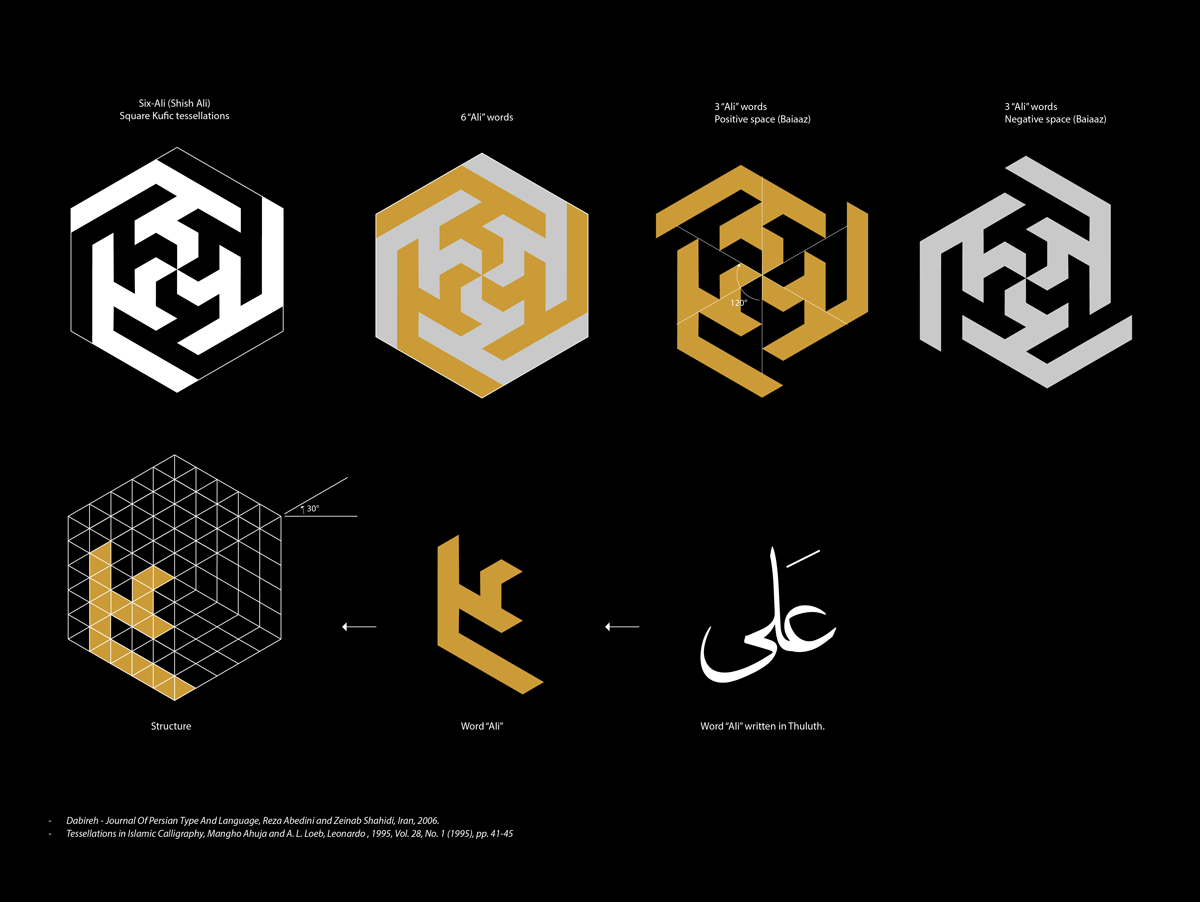
By exploring the historical roots of calligraphy and typography in one of the world’s most ancient civilizations, we can uncover the origins of some genuinely captivating scripts that still serve as powerful symbols of Arab and Persian cultures today. This narrative commences with the Islamic doctrine’s prohibition of natural imagery, prompting Iranian scholars and calligraphers like Ibn Muqla (10th century) to craft various distinctive scripts, including Naskh, Muhaqqaq, Rayhani, Thuluth, Riqa’, and Tawqi.’

During the prosperous Islamic era, Persian architecture began to incorporate calligraphy as an ornamental element in mosque design, sparking the creation of a new script known as Banna’i Kufic (Banna in Farsi means building), often referred to as Square Kufic. This progressive typographic approach borrowed the square and solid geometric characteristics of its foundational structural components: bricks. It’s noteworthy that Square Kufic’s minimalistic design coexisted alongside complex calligraphic scripts like Thuluth. Diacritics were deliberately omitted, pushing the boundaries of typography to extremes and enabling the intricate formation of holy names and Quranic verses. Architects ingeniously intertwined two or more texts by manipulating negative and positive spaces. The fundamental structure of Square Kufic bears a striking resemblance to the inherent nature of pixels and the constraints of early computer graphic art. Banna’i Kufic’s modular design and adaptability have allowed it to endure as a versatile typographic foundation still in use today.

This presentation will provide an in-depth exploration of the historical underpinnings of the Banna’i Kufic and its structural rationale and aesthetic through the design lens.

This design research is presented at Design Incubation Colloquium 10.2: Annual CAA Conference 2024 (Hybrid) on Thursday, February 15, 2024.

Design Is Not Neutral

A podcast featuring design educators discussing gaps in design education

Grace Hamilton
Assistant Professor
Baruch College
 City University New York

This project confronts design and design education’s historical exclusion of marginalized voices due to Eurocentric, capitalist, and patriarchal biases. It champions a feminist, practice-driven approach for an anti-patriarchal and post-capitalist design pedagogy, challenging the notion that design is confined to formal structures.

The “Design is Not Neutral” podcast is central to this initiative, featuring design educators discussing gaps in design education. It reveals the entanglement of design education with corporate capitalism, especially in the United States, while dismantling the division between craft, design, and art. This scrutiny exposes oppressive structures sidelining craft-based design, aiming to broaden design education’s horizons.

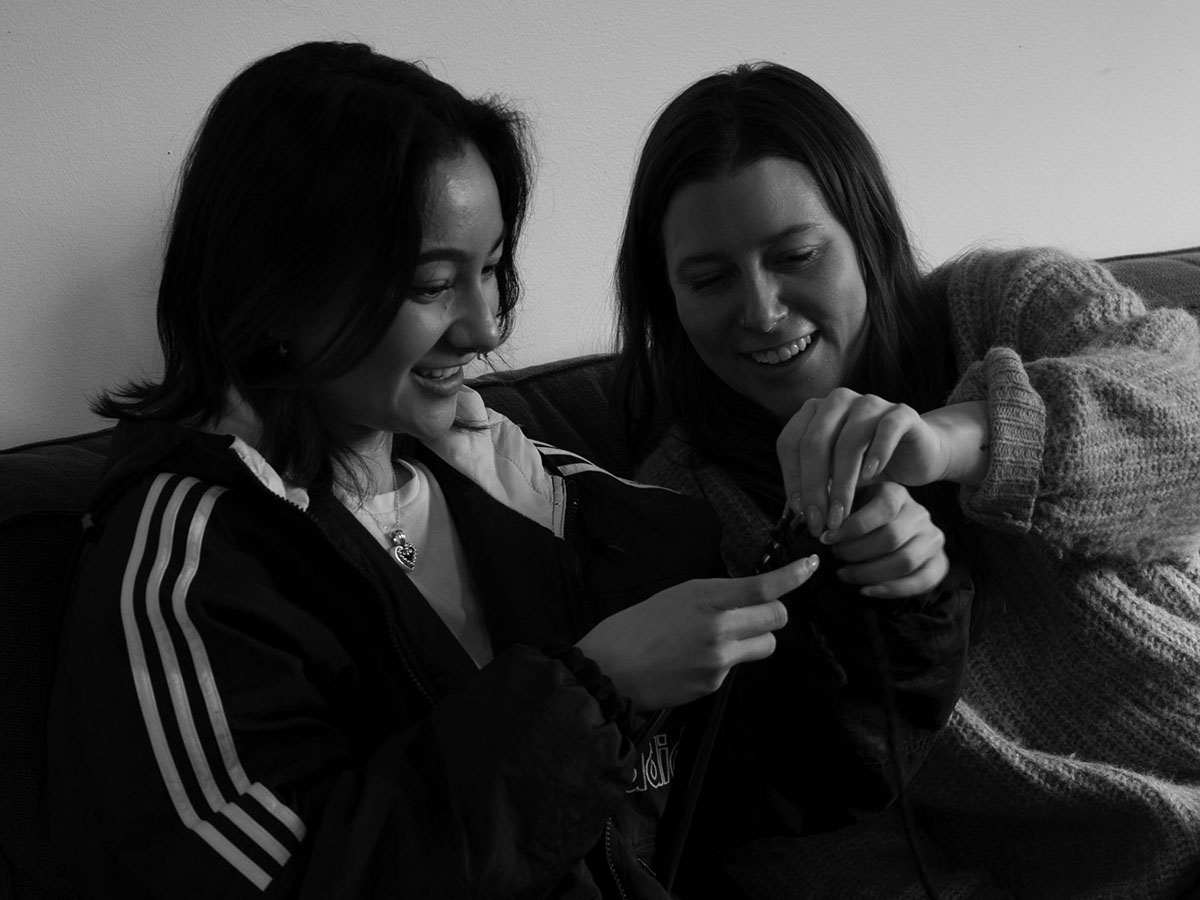
In the following phase, a knitting workshop was introduced to confront power dynamics and reintegrate “low design” or craft into the classroom. This hands-on workshop encourages everyday creativity, collaborative learning, and questions gender-based hierarchies in design curricula, empowering what’s traditionally labeled “craft.”

Aligned with scholars like bell hooks, Louise Schouwenberg, Paulo Freire, and Cheryl Buckley, this feminist intervention emphasizes “design in the margins” in education. The project’s podcast serves as a centralized resource, ensuring accessibility for educators looking to integrate feminist curricula.

This initiative reimagines design education through a feminist lens, challenging craft-based design stereotypes and engaging with design education’s historical ties to capitalism. Its aim is to create a more inclusive, equitable design pedagogy, centering marginalized perspectives and subaltern forms of making, contributing to a diverse, accessible, and just society.

This design research was presented at Design Incubation Colloquium 10.2: Annual CAA Conference 2024 (Hybrid) on Thursday, February 15, 2024.

A Plural Pedagogy for Graphic Design History

Revised documentation integrates more women, people of color, and underrepresented stories into the curriculum

Kristen Coogan
Associate Professor
Boston University

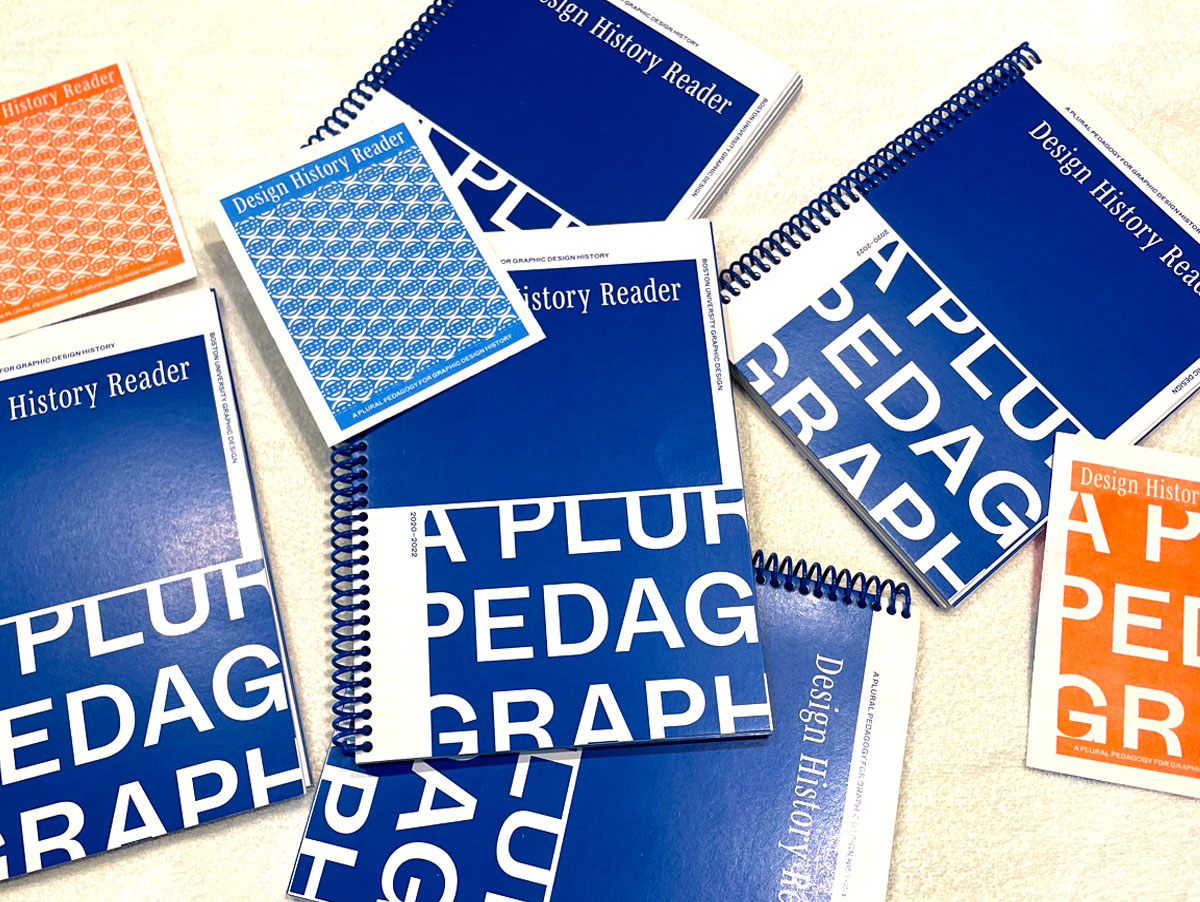
Today’s pressing social and political landscape prompts reflection. As people, designers, and educators, how can we actively contribute to the cultivation of more inclusive and balanced cultures? Amidst these circumstances, established historical narratives face renewed scrutiny, challenging their authority and the traditional confines of academic discourse. Nikole Hannah-Jones’ groundbreaking “The 1619 Project” confronts the whiteness of American History. Paulo Freire’s “Pedagogy of the Oppressed” envisions educational spaces where a reimagined teacher-student dynamic invites diverse contributions. This research also recognizes the inherent bias found in any historical discourse built on collective knowledge yet often within a singular perspective. As the demand for a decentralized history grows, the question arises: how do we build a more inclusive design history? At Boston University, Graphic Design History students foster inclusivity through a plural design history pedagogy. Revised slide presentations integrate more women, people of color, and underrepresented stories into the curriculum — enabling students to find more of themselves throughout the narrative. Through interactive lab sessions, students contribute distinct viewpoints informed by supplementary readings, written responses, and collaborative discussions. Culminating in extended essays, students disrupt the Western design canon, spotlighting lesser-known designers and movements. These responses culminate in the “Design History Reader,” where specific texts reveal narratives beyond the established versus marginalized dichotomy. Chapters unveil conceptual ecosystems, emphasizing visual and contextual symmetries bridging dominant and minority narratives. The “Reader” serves as a dynamic starting point, open to interpretation. While not fully representative, it’s an expanding, living archive shaped by collective research.

This design research is presented at Design Incubation Colloquium 10.2: Annual CAA Conference 2024 (Hybrid) on Thursday, February 15, 2024.

Design Incubation Colloquium 10.2: Annual CAA Conference 2024 (Hybrid)

Presentations and discussion in Research and Scholarship in Communication Design at the 112th Annual CAA Conference 2024

Recent research in Communication Design. Presentations of unique, significant creative work, design education, practice of design, case studies, contemporary practice, new technologies, methods, and design research. A moderated discussion will follow the series of presentations.

The colloquium session is open to all conference attendees.

Design Incubation Colloquium 10.2: Annual CAA Conference 2024
Thursday, February 15, 2024
12:00 PM – 1:30 PM
Hilton Chicago – 8th Floor – Lake Michigan (Hybrid)

CHAIRS

Camila Afanador-Llach
Florida Atlantic University

Heather Snyder Quinn
DePaul University

Discussants

Jessica Barness
Kent State University

Liz DeLuna
St John’s University

Dan Wong
New York City College of Technology, CUNY

PRESENTATIONS

A Plural Pedagogy for Graphic Design History
Kristen Coogan
Associate Professor
Boston University

Design Is Not Neutral
Grace Hamilton
Assistant Professor
Baruch College
City University New York

From Bricks to Pixels: The Evolution of Banna’i Kufic
Sajad Amini
Assistant Professor
DePaul University

Convergence of Science and Art to Support Climate Resilience in Central American Smallholder Communities
Qiuwen Li
Assistant Professor
Santa Clara University

Sara Wheeler
Undergraduate Student
Santa Clara University

Designing Dialogue: Leveraging Technology for Cultivating Inclusion and Belonging in Classroom Critique
Jenny Kowalski
Assistant Professor
Lehigh University

Abby Guido
Associate Professor
Temple University

Assessing Student Learning Outcomes in an Interdisciplinary, Experiential Course
Denise Anderson
Assistant Professor
Kean University

Analyzing Local Graphic Design History: A Pedagogical Approach
Christina Singer
Assistant Professor
University of North Carolina at Charlotte

Uncanny Ways of Seeing: Engaging AI in Design Practice and Pedagogy
Drew Sisk
Assistant Professor
Clemson University

The Design Writing Fellowship

Three Tracks: Books, Academic Articles and Book/Exhibition Reviews

Are you trying to bolster your research agenda or are you a design writer trying to decide where to publish? TheDesign Writing Fellowship (formerly the Design Incubation Fellowship) can help. The 2024 Fellowship has three tracks: Books, Academic Articles and Book/Exhibition Reviews. Participants take part in a 3-day virtual writing workshop where they learn about the publishing process, receive feedback on their writing and commit to working on their writing projects for 3-6 months. The Design Writing Fellowship is for design faculty, researchers, writers, and academics.

Applications will be accepted through November 30th

The 2024 Fellowship Workshop will be held May 29-31, 2024. All participants must participate in the workshop. 

https://writingspacechi.com/design-writing-fellowship

CFP: 2023 Design Incubation Communication Design Awards

Call for Nominations and Entries for the 2023 Design Incubation Educators Awards Competition.

Design Incubation announces a call for nominations and entries for the 2023 awards for communication design educators and graduate students in the areas of scholarship, teaching, service. The aim of the awards program is to discover and recognize new scholarship (creative work and publications), teaching, and service in our broad and varied discipline. We hope to expand the design record, promote excellence and share knowledge within the field. 

Nominations and Entries

We ask colleagues and mentors to identify outstanding creative work, publications, teaching, and service being created by design educators in the field communication design and to nominate these individuals for an award. Nominations will be accepted until January 15, 2024 

ENTRY GUIDELINES

Entries will be accepted until January 15, 2024. Nominations are not required to enter in this scholarly competition. Complete the online entry form (https://designincubation.com/design-incubation-awards-competition-entry-form/) with the following:

  • Title: Description of project and outcomes (not to exceed 500 words)
  • Supporting Materials: (limited to 5-page medium resolution pdf of artwork; web links to websites, videos, other online resources; published documents or visual documents)
  • Biography of applicant/s (150 words per applicant)
  • Curriculum vitae of applicant/s
  • $20 entry fee donation

2023 JURY

Steven McCarthy (Chair), University of Minnesota

Helen Armstrong
Professor
North Carolina State University

Anne H. Berry
Associate Professor
Cleveland State University

Warren Lehrer
Founding Faculty
School of Visual Arts, MFA Design

Ana Raposo
Lecturer
ESAD – Escola Superior de Arte e Design
Porto, Portugal

Neeta Verma
Associate Professor
University of Notre Dame

BIOGRAPHIES

Helen Armstrong

Helen Armstrong is Professor of Graphic & Experience Design at North Carolina State University. She has an MFA in Graphic Design from The Maryland Institute College of Art. Armstrong has authored several books including her latest: Big Data, Big Design: Why Designers Should Care About Artificial Intelligence. Armstrong is a past member of the AIGA National Board of Directors and she served on the editorial board of the journal Design and Culture.

Anne H. Berry

Anne H. Berry is Associate Professor in the Department of Art and Design at Cleveland State University. She has an MFA in graphic design from Kent State University. Her research focuses on race and representation in design, and ethnic and racial disparities within the field of graphic design. Berry was managing editor of the book The Black Experience in Design: Identity, Expression, and Reflection, which was included in Fast Company’s “Best Design Books of 2022.”

Warren Lehrer

Warren Lehrer is a founding faculty member of SVA’s Designer as Author/Entrepreneur MFA program and Professor Emeritus at Purchase College, SUNY. Lehrer has an MFA from Yale University, is a writer and designer known internationally as a pioneer in the fields of visual literature and design authorship. His artists’ books and multimedia projects have been widely exhibited and are in many collections including MoMA, The Met, Pompidou Centre, and Tate Gallery. Among many honors, he is a 2019 Ladislav Sutnar Laureate, and 2016 Center for Book Arts Honoree.

Steven McCarthy (Chair)

Steven McCarthy is Professor Emeritus of graphic design at the University of Minnesota. He has an MFA from Stanford University. He authored the book The Designer As… Author, Producer, Activist, Entrepreneur, Curator and Collaborator: New Models for Communicating. McCarthy’s creative work has been in over 135 juried and invitational exhibitions and has been honored by the AIGA, STA 100 and Graphis Poster. He has published in the journals Design Issues, Message, Visible Language, Design and Culture, She Ji, and AIGA Dialectic, and occasionally writes for Eye magazine.

Ana Raposo

Ana Raposo is Lecturer at art and design academy ESAD (Escola Superior de Arte e Design) located in Porto, Portugal. She is a graphic designer, educator and design researcher who has a PhD from Central Saint Martins / University of the Arts, London. Raposo has published a number of journal articles about punk rock music graphics, facism and politics and has presented at the Design History Society conference and the Popular Culture Association / American Culture Association national conference.

Neeta Verma

Neeta Verma is an Associate Professor of Visual Communication Design at the University of Notre Dame. She has an MFA from Yale University. Verma’s areas of research and teaching explore the critical use of design as a tool for social equity and justice. She has been the recipient of numerous awards. Her professional design work includes clients such as the American Red Cross, Cooper-Hewitt Design Museum, Liberty Science Center, The New York Botanical Garden, The New York Public Library, the Whitney Museum of American Art, and The Wildlife Conservation Society.

Designing Your Research Agenda (DYRA) 3.1

Design scholars and researchers discuss various aspects of their research agendas

Friday, November 17, 2023
12pm Eastern / 11am Central
Virtual Event

Designing Your Research Agenda is a panel discussion and open forum for design scholars and researchers to discuss various aspects of their research agendas. We aim to open a dialog regarding multiple challenges of discovering one’s design research inquiry. Designing Your Research Agenda is an ongoing design research event series.

  • Ayako Maruyama (RISD)
  • Nate Matteson  (DePaul University)
  • Johanna Mehl (TU Dresden)

Some of the questions we will discuss with panelists include:

  • How did you determine your research agenda (high-level timeline of your career/trajectory)
  • How do you define research and why do you think it matters/for society, the field, and yourself?
  • How do your department and institution define and support the work you do?
  • How would you describe/categorize your department and institution?
  • If you were going to position your work within a category, would you say your research addresses: design theory, design history, design practice, design research (traditional graphic design, speculative design, UXUI, typography, AR, VR, creative computing, design solutions, etc.), design pedagogy, or something else?
  • What barriers (if any) exist at your institution or in the field for creating and disseminating your research?

Moderators

Jessica Barness
Kent State University

Heather Snyder Quinn
DePaul University

Biographies

Ayako Maruyama
Rhode Island School of Design

Akayo

Ayako Maruyama (she/her) is a Filipina-Japanese designer, educator, and illustrator whose practice revolves around intentional collaboration, reflection, collective recovery, maintenance, and repair within the design domain. Working with organizers, artists, designers, students, and planners, Ayako’s involvement with the Design Studio for Social Intervention commenced in 2012. Notably, she recently co-authored and co-illustrated the published book, “Ideas Arrangements Effects: Systems Design and Social Justice.”

Ayako and her team at the Design Studio for Social Intervention focus on creating public engagement strategies that prioritize community development without displacement, along with reimagining public spaces at the Design Gym. With a rich background, Ayako has conducted numerous zine workshops, contributed as a faculty member at Boston University’s City Planning and Urban Affairs program since 2013, and initiated the annual Experience of Public Engagement studio at RISD in 2017.

Having served as an Urbanist in Residence and currently being part of the Collective Recovery Team at the University of Orange, Ayako holds a position as a Board Member at the institution. Additionally, she serves as an Assistant Professor in the Industrial Design department at the Rhode Island School of Design, where she imparts knowledge through teaching graduate thesis studio, foundational, and advanced design studios.

Nate Matteson 
DePaul University

Nathan Matteson is an Associate professor at DePaul University’s School of Design; a co-director of DePaul’s ‘Scandinavia: design, landscape, and society’ study abroad program; a researcher with the Center for robust decision-making in climate and energy policy at the University of Chicago; and a principal and designer at Obstructures. He is a ruthlessly collaborative designer whose work merrily ignores the perceived boundaries among disciplines, and is currently engaged with dead Swedish architects, guitars, the US energy sector, obstacles, and objects in the distance. His practice situates itself at an intersection amongst intersections, dead ends, superhighways, and goat paths, wringing its metaphorical hands over the relationships among computation, intention, materiality, and immateriality.

Johanna Mehl
TU Dresden

Johanna Mehl (she/her) is a designer, scholar, and educator interested in the politics and relations that take shape through and around design practices. She holds a B.A. in Communication Design and an M.A. in Art and Design Studies. Besides her artistic and curatorial practice, she has taught in the fields of digital media, culture studies, and design theory at different design schools across Europe. She is an editorial board member of the Design+Posthumanism Network and part of the research group Against Catastrophe. She holds research fellowship at TU Dresden where she is a  PhD candidate at the Chair for Digital Cultures. Her dissertation is about design responses to the climate crisis and stems from critiques of design that acknowledge its entanglements not only with the material realities, but also the geopolitical, psychological, and social conditions of climate change.

https://tu-dresden.de/gsw/slk/germanistik/digitalcultures/forschung/research-projects/the-world-as-a-design-problem

Tangible Graphic Design 

Lee is committed to making the field of art and design more diverse and inclusive with people from diverse ethnic, cultural, social, and economic backgrounds.

Taekyeom Lee 
Assistant Professor
University of Wisconsin-Madison

The project, Tangible Graphic Design, was initiated during Taekyeom Lee’s graduate study. The eye surgery and the face-down recovery were life-changing experiences academically and personally. For a young graphic designer and an international student, it was a horrifying experience, especially the surgery. A gas bubble injected into the eyeball applies gentle pressure and helps the detached retina to reattach to the eyeball. It took almost three months to recover fully. After the surgery, Taekyeom Lee was fully healed, but it left minor vision issues. This invisible disability made Taekyeom Lee embrace the experience and initiate a new graphic design project with vision, tactility, design, and materiality.

Since graduation in 2014, Taekyeom Lee lost access to the ceramics facility. It inspired him to build DIY 3D printers to work with various conventional and unconventional materials in three-dimensional printing. The most exciting feature of these Do-It-Yourself 3D printers is that anyone can be a tool maker building affordable machines and customizing them for individual creative practices. The project was a self-funded low budget project. Since Taekyeom Lee SNS went viral, the project inspired many people across the globe to build their own 3D ceramic printers. During the artist in residency at the Internet Archive, Taekyeom Lee created and shared the detailed plan and instructions online to make it accessible to everyone.

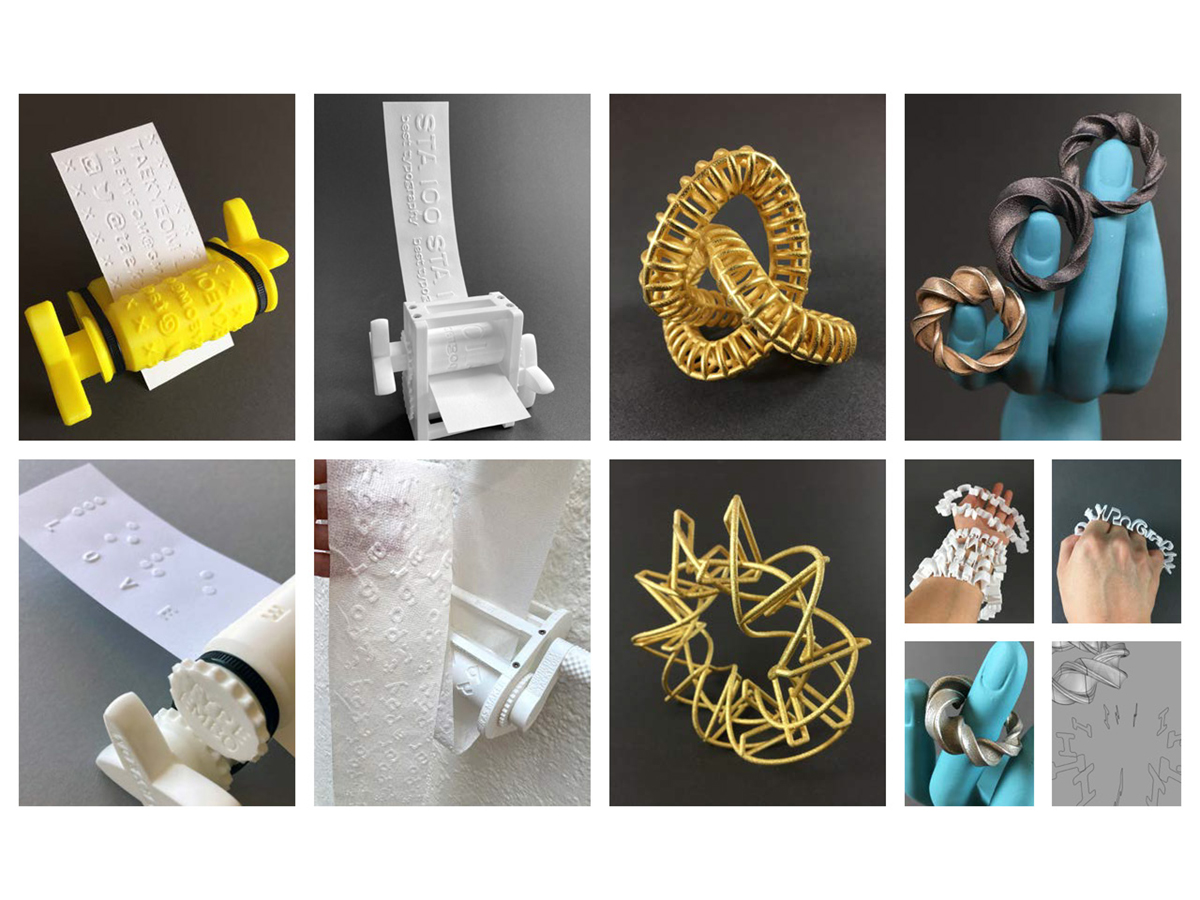
Designers can use various printing techniques to produce visual materials and solve visual problems. Since the invention of printing technologies, type designers have spent hundreds of years developing impeccably proportioned, beautiful typefaces to use on flat and static space and print technologies to support the perfection of printed materials. Digital fabrication can change the notion of printed text and how we experience materialized type since the tangible type does not lie on the static surface or live on-screen as a mirrored image. Digital fabrication, particularly 3D printing, has become more refined, common, and accessible. These new technologies have introduced new tools for pushing the boundaries of typography both in terms of concept and medium. 3D-printed tangible graphic elements acquire characteristics such as dimension, structure, materiality, and even physical interactivity. For this project, various conventional and unconventional materials in 3D printing were used to explore both the challenges and potential for typography. 3D printed tangible type not only amplified visual but physical interactions. The tangible type provides engaging tactile experiences, which would be more intuitive, expressive, and memorable.

Humans have five basic senses. Sensing organs send information to the brain to help us perceive the surroundings and the world. The sense of touch is the first sense to develop, and we have the largest sensing organ for touch as touch occurs across the whole body. Visuals and touch are closely linked together, although touch is fundamentally a non-visual perception. Touch can enhance and reinforce the user’s experience with the text, and the idea has been done with traditional printing methods.

The 3D printed embosser and other tangible graphic design applications combine both senses. The concept of the embossing technique can trace back to the cylinder seal, invented around 3500 BC to make an impression in wet clay. As this new embosser is portable, affordable, and customizable, there are a few possible applications. It can be used for participatory activities for promotional events and campaigns. It provided not only visual experiences but also engaging physical experiences. Not like today’s digital printing, the process involves a rich tangible experience, which is more intuitive, fun, and memorable. As the outcome provides a three-dimensional experience and substance, with braille, it could be developed for people with vision impairment.

Through his research, Taekyeom Lee has tried to bridge different areas of art and design. There are more design tools and processes in different industries, such as product design, architecture, sculpture, and metal smithing that have been working with various physical media. The tools and processes those areas have developed could be adapted to graphic design education. An extension of the project addressed how dimensional typography could utilize Rhino, computer-aided design (CAD) software, and Grasshopper 3D, a visual programming language run within Rhino, could be implemented in design processes and methods for typography in graphic design education. They bring extended physical experiences in typography from computer screen to physical space to enhance the interaction of typography directly. The outcome of the method was exhibited via many exhibitions.

Diversity is more than just a popular buzzword in discussions about art and design, and education. Taekyeom Lee is committed to making the field of art and design more diverse and inclusive with people from diverse ethnic, cultural, social, and economic backgrounds. As a first-generation college student and a foreign-born (Korean-born) designer, Taekyeom Lee wants to create opportunities to appreciate and embrace diversity and inclusion. Hangul Alphabet typeface highlights intercultural and bicultural experiences between Korean and English. Currently, Taekyeom Lee is working on a collaborative project with a group of design educators.He is very interested in supporting the new generation of artists and designers using emerging technologies such as 3D printing, digital fabrication, and creative coding.

The next chapter of my research is called Graphic Design for Accessibility, based on years of experience working with tactility as a graphic designer. Crafting better and more accessible experiences for people with low vision and vision impairment has been demanded. Fostering accessibility is inevitable. It will be developed as a regular course to embed my research and practice into my teaching and increase the understanding of diversity and inclusion for future graphic design students. The course will be an introduction to visual communication design for accessibility. Fostering accessibility in Graphic Design education is inevitable. This direction has excellent potential as a future design research project.

Biography

Taekyeom Lee is an educator, multidisciplinary designer, and maker. He is currently an Assistant professor of Graphic Design at the University of Wisconsin–Madison. He received an MFA degree in Graphic Design from the University of Illinois at Urbana-Champaign. His research explores unconventional materials and alternative solutions to create tangible typography, graphics, and even designed objects using digital fabrication. He infused 3D printing into his research and has been experimenting with various methods and materials. He presented through national and international conferences, including AIGA Design Conference, AIGA DEC, UCDA Design Incubation, DEL, ISEA, IEEE VIS, ATypI, TypeCon, Education Summit, Tipografia México, and NCECA. His work has been featured in various media. His research draws attention nationally and internationally. He exhibited his work and provided workshops and lectures across the country and abroad.