Academic Abstract Writing Program

Thursday, June 19, 2025
10:00am – 2:00pm EDT

The online Academic Abstract Writing Program at Design Incubation offers a series of activities that will help design researchers to craft a written synopsis of their research. The outcome(s) will be a concisely written document typically expected of academic publication venues. This includes conferences, journals, grant applications, publishers, and academic organizations.

The program is designed along two tracks:

  1. The first track is for design faculty who are new to academia and want a program that will help them to navigate the academic publication arena.
  2. The second track is aimed at design faculty who have established their research agenda and activities, and would like to explore ways to broaden their scope of publication opportunities.

We are excited to announce Leslie Atzmon, Eastern Michigan University, Jess Barness, Kent State University and Dan Wong, CityTech, CUNY will be facilitating and moderating the various activities.

Agenda

Time (EDT)Activity
10:00am-11:15amPresentation on Abstracts.
Dan Wong, Jess Barness.
Abstracts Reviewed. Breakout rooms with Mentors.
Atzmon, Barness, Wong.
11:15am-12:15pmFellows Abstract Workshop
12:15-1:00pmLunch Break
1:00pm- 2:00pmAbstracts—Repurposing Research. Leslie Atzmon.
Group Consultation with Mentors. Atzmon, Barness, Wong.

Fellows

Katie Blazek
Assistant Professor
University of Illinois- Urbana Champaign

Grace Hamilton
Assistant Professor
CUNY, Baruch College

Brooke Hull
Assistant Professor
Pennsylvania State University

Megan Asbeck
Assistant Professor
SUNY Brockport

Ruichao Jiang
Artist/Designer

Minoo Marasi
Graduate Student
University of Illinois Chicago

Golnoush Behmanesh
Assistant Professor
University of Mississippi

Design Incubation Colloquium 11.3: Virtual Summer

Friday, June 20, 2025
11:00AM – 12:30PM EDT
Online (ZOOM)

Recent research in Communication Design. Presentations of unique, significant creative work, design education, practice of design, case studies, contemporary practice, new technologies, methods, and design research. A moderated discussion will follow the series of presentations.

Friday, June 20, 2025
11:00 AM – 12:30 PM EDT
Online

Moderator

Cat Normoyle
East Carolina University

PRESENTATIONS

Resonant Pages: Artist Books, Natural Rhythms, and Digital Interactivity
Lingyi Kong
Adjunct Professor
Parsons School of Design, The New School

Inclusive Characters: Merging Aesthetics and Accessibility in Type Design
Katie Krcmarik
Assistant Professor
Illinois State University

Typography of the Transreal: N.H. Pritchard’s The Mundus
Andrew Shurtz
Assistant Professor 
Louisiana State University

Creative Computation in the Age of AI: Reimagining the Boundary of Human Creativity
Bei Hu 
Assistant Professor 
Washington University in St. Louis

From Designer to Design Facilitator: Turning Studios into Dewey-Inspired Learning Labs 
Michael Berrell
Assistant Professor 
SUNY Farmingdale

Type as Cultural Bridge: An Interactive Fusion of Iranian and American Design
Narges Sedaghat
Graduate student
East Carolina University

Tips for Design Scholars Looking to Publish in a Design Research Journal

“Ask the Expert” is a series looking at various considerations and practices related to design research, scholarship, publication, and other academic topics.

We invited Design and Culture’s Principal Reviews Editor, Maggie Taft, to respond to questions about different aspects of journal publishing. This is the first of a series from Taft, an independent scholar and Director of Writing Space, a community-based writing center for artists and designers.

Question: What is your top tip for scholars and designers interested in publishing in a design research journal?

Answer: Read.

We often think of reading as a parallel activity to writing. (Consider the elementary school trifecta “reading, writing and arithmetic,” which seems to position reading and writing as separate enterprises.) Yet when it comes to academic writing, reading is essential in so many ways.

The most familiar way to connect reading with academic writing is in the form of research. You read existing scholarship on your topic so that you can reference and draw upon previous findings and build a bibliography that demonstrates your knowledge of the field. Reading for research is essential.

But reading supports academic writing in at least three other crucial ways–

  • Reading will strengthen your methodology.

The more you read, the more you’ll learn about different ways to structure an academic argument and mobilize evidence in support of that argument. You’ll encounter some authors who highlight their subjectivity as a researcher and others who minimize it. You’ll find some authors who interpret case studies and others who analyze data sets. By reading widely and keeping track of the texts you find most compelling, you can identify the kinds of arguments you want to make and get ideas about how to use your research to make them.

My colleague Liat Berdugo recommends prospective article authors identify “sample journal articles”. These need not be articles that address the same topic as yours, but rather articles that make the types of arguments and interventions you hope to make. Having a good example of the kind of writing you wish to do will make it easier to figure out how to put together your article.

  • Reading will help you to identify how your work fits into the conversations that are happening in your field.

Academic arguments offer new ways of understanding, new paths of inquiry, and/or new recommendations for practice. These interventions are meaningful insofar as they respond to existing conventions. What is your work responding to? What is it seeking to change or rethink? To do meaningful work, you need to know what other people in your field are paying attention to and talking about so that you can explain to them the connection between their concerns and yours. Keeping up with ongoing scholarship in your field by reading will allow you insight into the kinds of work people are doing right now and what they’re paying attention to. This will, in turn, allow you to connect your specific area of research to broader patterns in the field, whether your ambition is to shift or refocus these conversations or to develop them in new directions or through new approaches.

  • Reading will help you identify the journals that are the best fit for your article.

There are many international journals that publish design scholarship but that doesn’t mean every one of them will be a good fit for your design research article. Every journal has a different historical focus, thematic emphasis, and methodological bent. Familiarize yourself with different journals’ respective missions (available on journal websites) and read the scholarship they’ve been publishing recently so that you can evaluate which is most likely to publish your work.

During my five years as the Managing Editor of Design and Culture, I think we rejected 50% of the articles we received not because they were bad scholarship but because they simply did a different kind of work than that which the journal sought to highlight. Some submissions deployed a scientific approach whereas the journal favored a humanistic one. Others focused on architecture, which at that time fell outside of the journal’s purview. Read the journals in your field so that you can both target your article submission to the ones most likely to publish your work AND target your article to that journal’s constituents. For instance, if you’re publishing research on graphic design education in a design history journal (like The Journal of Design History) you might frame your argument a bit differently than if you were to publish the research in a design education journal (like International Journal of Designs for Learning).

Ultimately, it is easy to think of reading as extraneous to the publishing process. You’re busy. There are so many urgent personal and professional matters vying for your attention. It can be difficult and even feel indulgent to dedicate time to reading, a task that typically rewards slowness. But for all the reasons described above, reading is not extraneous to writing for journals (and to writing more broadly). It is fundamental to it.

Maggie Taft, PhD
Founding Director
Writing Space

CFP: Academic Abstract Writing Program

Application Deadline: May 2, 2025

The online Academic Abstract Writing Program at Design Incubation offers a series of activities that will help design researchers to craft a written synopsis of their research. The outcome(s) will be a concisely written document typically expected of academic publication venues. This includes conferences, journals, grant applications, publishers, and academic organizations.

The program is designed along two tracks:

  1. The first track is for design faculty who are new to academia and want a program that will help them to navigate the academic publication arena.
  2. The second track is aimed at design faculty who have established their research agenda and activities, and would like to explore ways to broaden their scope of publication opportunities.

Application:

Academic Abstract Writing Workshop Program

This program is designed to facilitate design researchers in the development of their academic research abstract(s) for conferences, grant proposals, journal articles, and other publications.

The program does not guarantee abstract submissions will be accepted by the academic venues. The program is designed to improve your understanding of abstract writing, and the factors involved in developing a successful abstract submission.

Complete all required application information. Submit as much information as possible in the other fields to help us to understand your interests, goals, and challenges.

Seats are limited for this fellowship program. Upon acceptance, there is a $100 (members)/ $150 (non-members) program registration fee.

Step 1 of 2

This field is for validation purposes and should be left unchanged.
Name(Required)
Email(Required)
Secondary Email
Sometimes emails get spam filtered out and a secondary email helps with correspondences.
We generally do not call or text, unless it seems that our emails are not getting to you. Whenever possible, provide a telephone number that we can sms you.
Professional Title

Program Track(Required)
I am applying to the following track:
Goals
I am interested in:

Submit a short biography (250 words) describing your current position and professional research goals.
Please describe (250 words) the research project that you are considering.
Formats
Please select all the program formats in which you are interested.
Challenges
Select all that reflect your challenges.
Please add comments or other information you would like to share.
Please list and/or describe the publications, conferences, grants, organizations, venues, or types of places where you would like to submit your abstract(s).
Submit a draft of an existing abstract, or a summary proposal of the work you are doing, challenges you encounter, and goals you aim to attain.
Accepted file types: pdf, docx, doc, rtf, txt, Max. file size: 5 MB.

Submit a cv or resume.

This will help us to understand your experiences and interests and to develop the program that best suits your needs.

Accepted file types: docx, doc, pdf, txt, rtf, Max. file size: 5 MB.

Colloquium 11.3: Virtual Summer

Call for design research abstracts. Deadline: Fri, April 25, 2025.

Submission Deadline: Friday, April 25, 2025.

Event date: Friday, June 20, 2025
Format: Virtual/Online
Location: ZOOM

We invite designers—practitioners, creators, and educators—to submit abstracts of design research, creative investigations, and productions. This is a virtual online event format. Abstracts can be submitted online now for peer review.

Abstract submissions are double-blind peer-reviewed. Accepted abstracts will be published online. Please review the articles, Quick Start Guide for Writing Abstracts and Writing an Academic Research Abstract: For Communication Design Scholars before submitting.

There is a $10 conference fee required upon acceptance of the research abstract for non-members. The conference fee is waived for active annual members. Find out more about our annual memberships.

Researchers will videotape their 6-minute presentations which will published online in advance of the colloquium. The video recording is due by Thursday, June 5, 2025. We encourage all attendees to watch the videos in advance of the moderated discussion.

Presentation format is Pecha Kucha. For more details, see the colloquia details and description.

The colloquium is a moderated panel discussion of the research involving the researchers, thought leaders, and Design Incubation members.

Host: Cat Normoyle, Design Incubation Director of Peer Reviews.

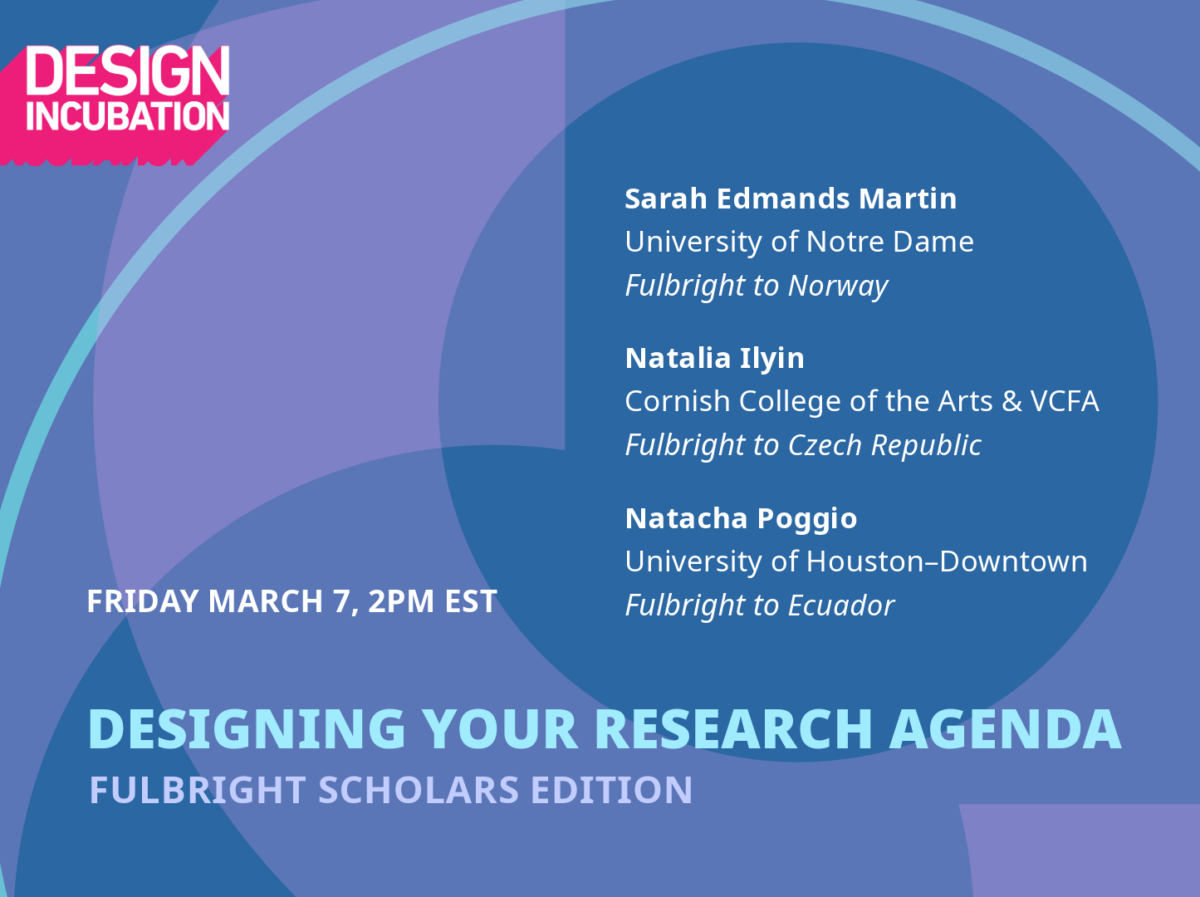
Designing Your Research Agenda (DYRA) 4.2

Fulbright Scholar Edition

Designing Your Research Agenda (DYRA) 4.2
Friday, March 7, 2025
2:00PM EST
Virtual Event

Designing Your Research Agenda (DYRA) is a panel discussion and open forum for design scholars and researchers to discuss aspects of their research agendas. We aim to open a dialog regarding the challenges of discovering one’s design research inquiry. DYRA is a design research webinar series.

This event focuses on Fulbright scholars in our Communication Design community. 

Panelists

Sarah Edmands Martin
Assistant Professor
University of Notre Dame

Natalia Ilyin 
Professor
Cornish College of the Arts and VCFA

Natacha Poggio
Associate Professor
University of Houston–Downtown

Some of the questions we will discuss with panelists include:
  • How did you determine your research agenda (high-level timeline of your career/trajectory)?
  • If you were going to position your work within a category, would you say your research addresses: design theory, design history, design practice, design research (traditional graphic design, speculative design, UX, UI, typography, AR, VR, creative computing, design solutions, etc.), design pedagogy, or something else?
  • What led you to pursue a Fulbright? 
  • What are some highlights from your Fulbright experience?
  • How has the Fulbright affected your creative/research trajectory?

Moderators

Jessica Barness
Kent State University

Heather Snyder Quinn
DePaul University

Biographies

Sarah Edmands Martin

Sarah Edmands Martin is Assistant Professor of Visual Communication Design at the University of Notre Dame where her practice unfolds at the intersections of speculative design, digital storytelling, and media aesthetics. She has received fellowships that include a 2024 Fulbright, a 2023 Design Writing Fellowship at Chicago’s Writing Space, and a 2021–22 Research Fellowship at the Institute for Digital Arts + Humanities. She has published in books and journals such as CounterText, Ethics in Design and Communication: New Critical Perspectives, Digital Transformation in Design: Processes and Practices, and AIGA’s Eye on Design. Her current book projects include Beautiful Bureaucracy: A Design Brief for Civic Life (MIT Press, 2025) and Otherworldly Games: An Atlas of Playable Realities. Her design work has been recognized and published by PRINT, Graphis, the Paris Design Awards, London International Creative, and the Creative Communication Awards. Her industry-facing work spans clients from Citibank to AMC’s The Walking Dead.

Fulbright Scholar to the Center for Digital Narrative, University of Bergen in Bergen, Norway.

Natalia Ilyin 

Natalia Ilyin teaches design history and criticism, design for social activism, and transition design at Cornish College of the Arts in Seattle, Washington. She and her former co-teacher Liz Patterson created the Parallel Narratives curriculum and published the Parallel Narratives anthology. These are extensive annotated historical bibliographies created by third-year undergraduate students on topics not covered in the contemporary canon of design history. A second volume is in production. Natalia is also Founding Faculty for the MFA in Graphic Design at Vermont College of Fine Arts, where she advises candidates in histories, criticism, and critical writing. She has taught at Rhode Island School of Design, Yale University, The Cooper Union and the University of Washington, and has acted as Critic for the MFA in Graphic Design at Yale University and at Rhode Island School of Design. Her most recent book, Writing for the Design Mind, is available from Bloomsbury Publishing. Her new book will be available in 2027 from the same publisher, should no new thing arise.

Fulbright Scholar to the Brno University of Technology Architecture Program in Czech Republic. 

Natacha Poggio

Natacha Poggio is an Associate Professor of Design at the University of Houston-Downtown, inspiring socially responsible citizens through design. In 2008, she founded Design Global Change, a collaborative focused on planet-centered solutions for global health, environmental, and social justice issues, impacting communities across Latin America, Africa, and Asia. A three-time recipient of Sappi’s Ideas that Matter award, she has secured over $76,000 in funding to support design for social good. In 2022, she was awarded a prestigious Fulbright U.S. Scholarship for a marine conservation project in Ecuador. A 2013 TEDx speaker and advocate for social impact design, she lectures internationally, judges competitions, and volunteers with the Winterhouse Institute Council. She holds an M.F.A. in Experience Design from the University of Texas at Austin and a B.F.A. in Graphic Design from the University of Buenos Aires. Originally from Argentina, Natacha considers herself a global citizen.

Fulbright Scholar to the Universidad de las Artes del Ecuador, in Guayaquil, Ecuador.

Gender, Transgression, and Ritual Torah Preparation

The highly scripted ritual performances, material processes, and acts of mediation that characterize the Torah scribing process.

Leslie Atzmon
Professor
Eastern Michigan University

According to the editors, Sami Sjöberg, Mikko Keskinen, Arja Karhumaa, the volume The Experimental Book Object considers how “historical and contemporary experimentation… has challenged what books are and could be from the perspectives of materiality [and] mediation.” Separating holy artifacts from mundane objects is one the most crucial mediations within most cultures—and it typically involves design. This mediation of materials commonly takes place through an elaborate series of ritual performances, some of which end up with a freshly designed sacred object.

In my chapter for The Experimental Book Object, “Gender, Transgression, and Ritual Torah Preparation,” I focus on the creation of a kosher Torah scroll. I am particularly interested in the highly scripted ritual performances, material processes, and acts of mediation that characterize the Torah scribing process.

This rule-bound undertaking—which involves interactions among the mundane materials used to make a kosher Torah scroll, the bodily and cognitive actions of its scribe, and the environment in which it is created—transforms a set of quotidian materials into a singular holy book object. Because the creating parameters are so strict, one could argue that a kosher Torah is not an experimental book. But I maintain that it is.

Making a kosher Torah scroll that is fit for ritual use is traditionally believed to be prohibited for women. I argue that this is due to women being considered contaminated two weeks out of every month due to menstruation. In this chapter, I use The Women’s Torah Project (2010)—which produced the first Torah written and embellished by an international community of women—as a test case for the role that gender or the gendered body might play in creating an experimental book.

I have long been fascinated by how designers use embodied thinking and making processes to transform raw materials into functioning objects. I have also been fascinated by the processes for making objects that are ostensibly imbued with holiness, such as a kosher Torah scroll. Exploring the relationship between these parallel processes taught me something about design and embodiment. Considering the role that bodily contamination plays in the Jewish bias against female Torah scribes, and realizing that the Torah scribing script is inherently ungendered, gave me new insights into how critical embodiment is to making processes. It also revealed that embodied making or ritual can be exclusive—or inclusive.

Writing this chapter also tested my response to the question “what makes an experimental book?” In The Open Book Project (2014) (https://infinitemiledetroit.com/The_Open_Book_Project.html), Ryan Molloy and I argue that experimental books challenge the definition of what a book can be, and that those who make experimental books interrogate aspects of book-ness. By this definition a Torah scroll is not an experimental book. In her Afterword for The Experimental Book Object, Johanna Drucker writes: “Leslie Atzmon’s discussion of the Women’s Torah Project…offers a significant insight into the way an act as basic as participation in the scribal production of a sacred text can be profoundly transgressive” (Drucker 2024, 306). By understanding making as an embodied process that involves the interplay of the scribe, materials, and environment, I argue that the transgressive act of a female Torah scribe challenges the making process and does interrogate book-ness. In this way, a Torah scribed by one woman or a group of women is indeed an experimental book.

Excerpt

Leslie Atzmon, “Gender, Transgression, and Ritual Torah Preparation” in The Experimental Book Object: Materiality, Media, Design, Sami Sjöberg, Mikko Keskinen, Arja Karhumaa, eds., London: Routledge, Copyright (2024), 216-217. Reproduced by permission of Taylor & Francis Group. 

The guidelines for the Hebrew letter beit … illustrate the meticulous process to be used for drawing each letter, as well as the critical traditional relationships between each letterform and the other letters (Hebrew letter names are in italic):

Beit: One should take care that the part which protrudes behind is square, so that it will not resemble khaf. If it resembles khaf, it is invalid, and if it is unclear, one shows it to a child (as explained in siman 6). Ideally the right-hand side of the roof has a little prickle pointing to the right and the left-hand side has a little prickle pointing upwards. According to the kabbalah [mysticism, or tradition] it has a thick heel at the bottom so that it resembles a dalet in the throat of a vav; if so, it must be squared at the top to resemble dalet, and have a substantial heel at the bottom which would be the head of the vav. Its height and width should both be three nib-widths, and the gap in the middle should be one nib-width wide (Darkhei Moshe) (Keset Ha Sofer as quoted in Taylor Friedman).

Each letter has specific detailed scribing rules like these ones for beit. Each letter must also have a certain amount of white parchment showing around it. The white spaces within and between letters are analogous to the white fire of the primordial Torah discussed in the previous section, and this letterspacing is integral to a Torah being considered kosher.

This project was the 2024 Design Incubation Educators Awards winning recipient in the category of Scholarship: Publication.

Biography

A designer and design historian, Leslie Atzmon writes on both experimental books and design and science.

In 2014, she edited The Open Book Project book, featuring a critical Introduction by Atzmon, a related exhibition catalogue, essays on the book, and an experimental book design workshop section. Currently she investigates the intersections between design and science.

In 2016, Atzmon was in the UK on a Fulbright fellowship at Central Saint Martins, UAL doing research on Darwin and design thinking.

In 2019/2020, she curated the exhibition Design and Science, which ran at Eastern Michigan’s University Gallery and The Esther Klein Gallery/Science Center in Philadelphia. Atzmon also edited a collection entitled Design and Science (Bloomsbury 2023). This collection examines overlap between design and science through visual metaphor and modeling; biomimicry and biodesign; makers and users; and data manifestation. Atzmon is working on a biodesign textbook with Professor Diana Nicholas of Drexel University.

Mashq Conference 2022 on Arabic Type and Typography 

Seasoned pioneers in Arabic typography to emerging younger practitioners and academicians.

Yara Khoury Nammour
Assistant Professor
American University of Beirut, Lebanon

Khajag Apelian
Lecturer
American University of Beirut, Lebanon

Mashq 2022 conference was held on October 20–21, 2022 at the American University of Beirut [AUB]. It was the first event dedicated entirely to Arabic type and typography. Organized by AUB’s Arabic Type Unit, a research body committed to advancing Arabic type and typography, the conference marked a groundbreaking milestone in the Arab region.

AUB has long been at the forefront of design education. More than thirty years ago, it pioneered the first graphic design program in the Arab world and was the first to integrate the graphic use of Arabic script into its core curriculum. Building on this legacy, the Arabic Type Unit was established in 2018. Naturally, Mashq 2022 served as an extension of these efforts that provides a platform to explore the historical evolution, current practices, and future directions of Arabic typography in the region.

The organizers made sure that the event spotlighted regional expertise that has long been overlooked, with more than 80% of the speakers being of Arab origin while talks by non-Arab speakers were curated to focus exclusively on Arabic type and typography. The team also made sure to design and develop a dedicated conference bilingual website [www.mashqconference.org], with a strong emphasis on Arabic, further reflected the conference’s dedication to its cultural and linguistic roots. All conference talks were made freely available on the Arabic Type Unit’s dedicated YouTube channel [www.youtube.com/@ATU_org], to extend the event’s reach to a global audience. A summarized video is here: https://www.youtube.com/watch?v=gcNUw5HOgH4&t=17s

Attendees and Participating Institutions

Mashq 2022 succeeded in attracting over 400 attendees, including students (62%), professionals (38%), and professors (13%). Participants mostly came from Lebanese universities such as the Lebanese American University, Notre Dame University, Middle East University, Lebanese University, and Académie Libanaise des Beaux-Arts. International attendees included those from Egypt, Turkey, Iraq, and the United Arab Emirates.

Speakers and Sessions

The conference featured presentations from 15 distinguished speakers, with a diverse spectrum, from seasoned pioneers in Arabic typography to emerging younger practitioners and academicians. This mix fostered a rich exchange of perspectives, blending deep-rooted expertise with fresh, innovative approaches to Arabic type design and visual communication.

Among the speakers, Kameel Hawa’s presentation, “The Spring of Arabic Type,” showcased his innovative efforts to rejuvenate Arabic script through type design and calligraphy, reflecting on its potential for both tradition and modernity. Lara Assouad discussed the graphic visual expression of language and its alphabet, offering insights into how typographic design can shape visual communication. Hatem Imam analyzed the relationship between cultural production and graphic arts, proposing methods to bridge the gap between these two domains. While Onür Yazıcıgil explored the history of Ottoman naskh and its spread beyond the borders of Istanbul in order to contextualize the influence of these typefaces on Turkish and Arabic printing and publishing in Beirut and Cairo. Naïma Ben Ayed also presented collaborative new research that aims to expand Arabic type design pedagogy, emphasizing the importance of ‘self-organized knowledge’ under the School of Commons.

Exhibitions and Workshops

The conference hosted two exhibitions: 100 Best Arabic Posters which celebrated contemporary Arabic poster design of 2021-2022, while the Granshan Type Design Competition Winners exhibition highlighted award-winning Arabic typefaces from 2019 and 2021/2022.

Complementing the exhibitions, workshops were also planned to provide participants with hands-on learning opportunities. Azza Alameddine guided attendees through the complexities of harmonizing Arabic and Latin scripts in logo design during her workshop, “Arabic/Latin Logo Matchmaking.” Georg Seifert introduced participants to the creation of Arabic fonts using Glyphs software in his workshop, “Introduction to Glyphs.”

Diversity and Inclusion

The organizers made it a priority to amplify diverse voices within the Arabic typography community. They took special care to give a platform to the older generation of Arabic typographers and designers, many of whom had not previously been afforded the opportunity to share their work on such a prominent stage. This effort ensured their invaluable contributions and experiences were recognized, preserving their legacy while inspiring a new generation of practitioners.

Additionally, the speaker lineup reflected a wide range of experiences and expertise, spanning seasoned pioneers to emerging practitioners and academicians. This intentional curation fostered an inclusive dialogue that bridged generations and enriched the discussions with diverse perspectives.

Sponsors and Support

Sponsors contributed a total of $12,000 from different entities in the profession and the educational sector. Their contributions were essential to the success of the event. Key sponsors included:

  • Gold Sponsor: Commercial Type
  • Silver Sponsors: Glyphs and TypeTogether
  • Brass Sponsors: Rosetta Type, ISType, Koein, and Morcos Key

Impact and Reflection

Mashq 2022 challenged the dominance of Eurocentric design paradigms by fostering a space where Arabic typography and regional practices took center stage. It offered a compelling alternative to the often homogenized global design landscape. The conference highlighted the possibilities of moving beyond standardized, Westernized approaches in design education and practice, encouraging attendees to rethink the role of cultural identity as an intrinsic element in the creative process rather than a background influence.
Through it all, Mashq demonstrated how design can transcend corporate functionality to serve as a medium for personal narratives, cultural preservation, and regional storytelling. It explored the potential for a design philosophy rooted in local visual culture.

This project was the 2024 Design Incubation Educators Awards runner up recipient in the category of Service.

Biography

Yara Khoury Nammour — Assistant Professor of Graphic Design, Arabic Type Unit, AUB

Yara is a graphic and type designer, author and educator. She is an assistant professor of graphic design at the American University of Beirut and an independent designer since 2017 after a long-standing career of 20 years as design director at Al Mohtaraf design house. Her work is published in several international books and has authored a book titled ‘Nasri Khattar: A Modernist Typotect’ from Khatt Books. She heads the Arabic Type Research Unit and co-organizes the biennial Mashq conference on Arabic typography at AUB.

Khajag Apelian — Part-time Lecturer of Graphic Design, AUB

Khajag is a lettering artist, type and graphic designer. Khajag has developed typefaces in various scripts, including Arabic, Armenian, and Latin. He designed Arek, a typeface that was awarded the Grand Prize at Granshan 2010 Type Design Competition, and was among the winners of Letter.2, the 2nd international type design competition organized by the Association
Typographique Internationale. He currently operates under the name “debakir” Armenian for “printed type”. He …. and co-organizes the biennial Mashq conference on Arabic typography at AUB.

Mitigating Youth Violence: The Futuring Project: Audacious Narratives & Enduring Voices 

An arts enrichment program aimed at addressing youth violence in South Bend, IN.

Neeta Verma
Independent Scholar
Associate Professor (retired)

University of Notre Dame

“The Futuring Project: Audacious Narratives & Enduring Voices” is the design, and implementation of an arts enrichment program aimed at addressing youth violence in South Bend, IN. The program was implemented at a detention facility serving at-risk youth aged 14-22 who had been exposed to violence. It combined art and design instruction with the goal of empowering these youth to take ownership of their stories, inspiring them to be catalysts for change in their communities.

The arts enrichment program provided much-needed engagement, equipping participants with valuable, translatable skills in art, design, and technology. Youth worked with software like Photoshop, InDesign, Illustrator, and GarageBand. The curriculum covered various disciplines, including drawing, painting, music composition, digital design, choreography, collage, and mask-making. This creative process served not only as a skill-building exercise but also as a form of healing and therapy, fostering self-expression, self-reflection, and personal growth.

In collaboration with law enforcement, city agencies, grassroots organizations, and community leaders, the program created structured workshops that sustained creative engagement while promoting articulation, self-expression, and technical skill development. This gave the youth unique tools to help them succeed as they re-enter society with fresh perspectives for a brighter future.

The project on youth violence started in June, 2020 and concluded in June, 2024 of which the arts enrichment program ran for a period of 18 months from January, 2022 through July, 2023.

PROJECT RESEARCH

The design of the arts enrichment program was informed by a combination of data, literature reviews, and field research:

1. Data: A comparative analysis was conducted using statistical data from South Bend, three similar cities, and two larger cities to understand the problem of youth violence.

2. Literature Reviews: Research focused on positive youth development, especially in youth psychology. The potential of creative expression as therapeutic intervention was explored within cognitive and behavioral psychology.

3. Field Research: Interviews and focus groups were conducted to understand perceived causes of youth violence. We also collected data on socio-economic indicators, law enforcement, and geographic/environmental factors.

4. Analysis & Synthesis: Key findings included a lack of structure, predictability, and enrichment among at-risk youth. Additionally, there was a significant correlation between single-parent households and increased exposure to violence. These insights led to the development of the arts enrichment programming titled, “The Futuring Project: Audacious Narratives and Enduring Voices.”

FUNDING

The project was funded by four grants awarded by the Jessie Ball DuPont Fund, Community Foundation of St. Joseph County, City of South Bend, and the Center for Social Concerns at the University of Notre Dame.

The project would not have been possible without the support of the following institutions. Collaborators for the project include The Jessie Ball duPont Foundation; the Community Foundation of St. Joseph County; the City of South Bend, and the Center for Social Concerns at the University of Notre Dame (UND), Office of Research (UND), Office of Procurement (UND), Arts and Letters Computing Office (UND), the Center for Social Science Research (UND), Department of Development (UND), Robinson Community Learning Center (UND), Notre Dame Psychological Services Center, ND Studios and Teaching & Learning Technologies, DePaul Academy; Venues, Parks, & Arts, City of South Bend; Charles Black Community Center; Goodwill Industries; Office of Innovation & Technology, City of South Bend; South Bend Police Department; Center for the Homeless; Mamas Against Violence; Connect 2 Be the Change; River Bend Quilting Guild, Midwest Photographics.

To my collaborators: Connie Mick, Senior Associate Director Center for Social Concerns; Ike Shipman, Program Director, DePaul Academy; Denise Linn Riedl, Chief Innovation Officer, Office of the Mayor; Maurice Scott, Director of Community Initiatives, Office of the Mayor, Aaron Perri, Executive Director of Venues Parks & Arts; Jordan Gathers, Deputy Director of Venues, Parks, and Arts; Lisa Shaffer, Executive Director, South Bend Museum of Art; Krista Hoefle, Senior Curator, South Bend Museum of Art; Cynthia Taylor, Director, Charles Black Community Center; Laresha Johnson, Manager, Charles Black Community Center.

THE ARTS ENRICHMENT PROGRAM

The arts enrichment program was structured around modules that covered various creative disciplines. These modules included drawing (charcoal, pencil, and pastels), painting, music composition (using GarageBand), digital design (Adobe Photoshop), collage, poster design (Adobe InDesign/Illustrator), and mask-making.

The semester was divided into 12-week units, with each module running for 2-hour sessions. The program served approximately 22 students each week, with attendance ranging from 17 to 24 participants. The first session of each semester was dedicated to introducing the program, getting to know the participants, and setting expectations. As the semester progressed, participants explored their interests and selected modules that aligned with their projects. At the end of each module, participants presented their work to peers.

COMMUNITY AFFILIATIONS & PARTNERSHIPS

The workshop was designed to run within an institution, The DePaul Academy, that is part of the Juvenile Justice Center in South Bend. The institution is a private secure program serving male youth between the ages of 14 and 22 with a history of delinquent behaviors, mild mental health issues, abuse, neglect, and trauma needs, as well as students who did not thrive in less restrictive settings. The institution’s program offers an academy model residential treatment that promotes diverse social and educational interactions essential to the competency development of students. Audacious Narratives and Enduring Voices, was offered as an arts enrichment program to youth at this facility on a semester system basis. The design project was launched in February of 2022 and was completed in May of 2024.

RESPONSE to the ARTS ENRICHMENT PROGRAM

The program achieved high attendance, with over 45 students served throughout its duration. Participants consistently demonstrated deep engagement, often exceeding expectations in their creative outputs. One confidential evaluation noted, “Ms. Neeta has brought something extremely positive into the institution. Watching the young men engage in something they love has been truly inspiring. Her ability to maintain order and her fearlessness are greatly appreciated by both the boys and staff.”

The workshops fostered a safe, creative environment that encouraged self-reflection, self-expression, and critical thinking. This was evident in the vibrant and imaginative work produced by the youth. This expanded their portfolios to include both the work and proficiencies that served as a validation in their capabilities as these students reassimilated in the community and applied for placement opportunities and jobs.

In August 2023, the project was featured in the Audacious Narratives & Enduring Voices exhibit at the South Bend Museum of Art, running from September 22 to November 12, 2023. The youth participated in the opening reception on November 3, where they had the opportunity to discuss their work with the community and share their creative journey.

This project was the 2024 Design Incubation Educators Awards runner up recipient in the category of Service.

Biography

Neeta Verma situates herself within the porous discipline of Visual Communication Design whose work explores design as a tool for social equity. Her research focuses on systemic social issues examined through the lens of power and privilege. It expands the canon of the discipline to include pluriversal shifts within design discourse. She earned her MFA from Yale University. She served as an Associate Professor of Visual Communication Design at the University of Notre Dame. She is the recipient of the Nehru-Fulbright Fellowship. Awards include the SEGD 2024 Educator Award, 365: AIGA Year in Design Award, Design Incubation Teaching Award, Core77 Award for Social Impact, A’Design Awards, International Design Award, and Rev. William A. Toohey Award for Social Justice. She has presented her research at national and international conferences. She serves on the SEGD Academic Taskforce and is a member of the Pluriversal Working Group of the Future of Design Education.

The People’s Graphic Design Archive

A crowdsourced digital archive of inclusive graphic design history.

Louise Sandhaus
Professor
California Institute of the Arts

Mary Banas
Lecturer
Tufts University

Brockett Horne
Lecturer
Boston University

Alan Caballero Lazare
Assistant Professor
George Mason University

Briar Levit
Associate Professor
Portland State University

Alberto Rigau
Designer
Studio Interlínea

Morgan Searcy
Art Director

Morgan Searcy

Bobby Joe Smith III
Special Faculty
California Institute of the Arts

The People’s Graphic Design Archive is a crowdsourced digital archive of inclusive graphic design history. The project was first realized in 2020 as a prototype built in the off-the-shelf wiki software Notion; in September 2022, the permanent custom platform was launched. The motivation for PGDA was a belief that much of graphic design history was going unrecognized because it didn’t fit into the established canon or understanding of graphic design. Lack of preservation was also due to few archives for preserving graphic design; thus, much material ended up in dumpsters. Offering a virtual graphic design archive provided a means of preserving a record of this material. It allowed anyone interested to contribute, consume, and discuss what they argue is relevant and vital. The outcome reflects a wide range of cultures and interests — an expansive, democratized, decentered reflection of history. Contributions by individuals or teams can be a single image, a link to an existing archive, documents, interviews, essays, a small collection, or an entire research project. Formats include jpegs, pdfs, tiffs, and audio and video formats.

A Growing, Unique Resource

Visibility of the PGDA takes place through social media and participation in educator events and conferences, contributing to the Archive’s steady growth and knowledge of it as a valuable resource. Today, it boasts over 12,000 items in the collection and users from across the globe. Contributed material includes Roshanak Keyghobadi’s extensive research and collection of Iranian graphic design and designers, which includes a special sub-collection of women graphic designers— of particular value and relevancy given the recent Women, Life, Freedom revolutionary movement. The collection also includes extensive activist material, such as Geoff Kaplan’s thousands of hi-resolution images documenting alternative press from archives across the United States; Daneille Aubert’s research on cooperative printing in Detroit; and many short-form research projects by students all over the world, including The University of Florida, Massachusetts College of Art, CalArts, and George Washington University.

Add-a-Thons

Add-a-thons are events that allow groups to work collectively to add material of common interest to the Archive. These gatherings have included themes such as Latinx Design, Indigenous Design, and Southeast Asian design. Anyone can host an online Add-a-Thon event. During these live and lively 90-minute sessions, with the PGDA team on hand, attendees research and upload material to the Archive. One recent example is the Radical Scholarship Add-a-thons held by Jessica Barness and Amy Papaelias resulting in a multitude of materials that show the visual forms that scholarship has taken when trying to reflect alternatives to status quo scholarly journals.

Blog

Contributions to our blog enhance our understanding of the value of PGDA to different communities and offer critical perspectives. Posts range from curating a collection to highlighting a particular contributor to short essays offering critical perspectives on graphic design history. These include the recent posting by Choctaw-Apache designer and educator Sebastian Ebarb, unraveling the thread between typography and Native American beadwork. A post by Tanvi Sharma offered her favorite items from the Archive and a unique story about her family’s collections of stamps from Ghana. Among the reflective essays are Susan Yelavich’s Value(s) Added: Amplifying The PGDA, in which she asks us to contemplate work on what makes something preservation-worthy, inviting the community to share their finds and, most significantly, their reasoning for adding items to PGDA.

Value for Educators

Although many who are curious about design, often looking for inspiration, delight in the PGDA, the largest user group is educators, who use PGDA extensively in the classroom for a variety of purposes. The site encourages students to become producers of historical narratives rather than just consumers of history, gives those teaching design history an expansive repository of examples of work made from different cultures in different periods, and even provides resources for creative projects. Examples of how the Archive is used in the classroom include:

An archive-to-archive project for University of Georgia faculty Julie Spivey, who integrated archive-based learning for teaching typography. Students would identify material from archives in their school library that those interested in graphic design would find of interest, then document these works, giving consideration to the tagging and data that provided relevancy through the work’s graphic form.

Animating The Archive. For a Kinetic Typography course at Boston University, students are asked to animate a favorite item from The Archive. Guided by faculty members Mary Yang and Brockett Horne, students offered an analysis of the grid, typography, and imagery from their selections to create storyboards that were developed into looping animations.

Analyzing Local Graphic Design History with the PGDA. For Christina Singer’s undergraduate Design Research class, students at UNC Charlotte investigated local graphic design history and researched ways of making social movements and graphic design history to contextualize their artifacts in local and graphic design history. Over 185 items, the stories about them were added to the PGDA.

Actively changing the narrative of graphic design history. For Robert Finkel’s Graphic Design History course, students collected artifacts that they thought merited inclusion into the historical canon and added those to the PGDA. At the end of the project, the teams were challenged to identify a unified theme and narrative for their collection.

This project was the 2024 Design Incubation Educators Awards winner recipient in the category of Service.

Biography

Mary Banas’s independent creative practice YES IS MORE includes research, teaching, and design. Mary develops conceptual and informed designs for brands, institutions, and people. She collaborates with artist Breanne Trammell as BMTMB where they embody “friendship as practice” and mine archives and contemporary collections to create new ephemera that responds to the existential crisis of contemporary American life. She has been a resident for Design Inquiry and led design workshops at OTIS College of Art & Design (Los Angeles, CA), and the Berkeley Art Museum + Pacific Film Archive (Berkeley, CA). Banas received her BFA from University of Connecticut and her MFA from Rhode Island School of Design. She currently teaches TYPE AS IMAGE in the undergraduate program at the School of the Museum of Fine Arts at Tufts University and serves as a working board member of the People’s Graphic Design Archive.

Brockett Horne, co director, is a designer, educator, and writer. She serves on the faculty at Boston University, where she teaches studio and theory courses. Her creative work encourages audiences to question their own ways of consuming design. Clients include the Baltimore Museum of Art, Johns Hopkins University, Decentering Whiteness working group, and Harvard University. She has won multiple design awards and presents her work internationally. She is Co-Director of The Peoples Graphic Design Archive, a crowd-sourced online platform that enables new and expanded stories about graphic design history. This experimental project asks each of us to write history instead of reserving narratives for only those with special training or access to exclusive tools. She holds a BFA from Carnegie Mellon University, an MFA from Rhode Island School of Design, and an MA from the Bard Graduate Center.

Alan Caballero LaZare is a Colombian American designer, artist, and educator. His work is focused on community engagement and reimagining design history pedagogy to be more inclusive, plural, and empowering for a new generation of design students. Alan is an Assistant Professor of Graphic Design at George Mason University where he teaches Graphic Design History and Visual Communication Theory + Practice. His essay, “The Road to Flores de María,” was recently published in SHIFT{ED}, Dialogue: Proceedings of the AIGA Design Educators Community Conferences. It illustrates how he used design to collaborate with community leaders in a remote village in Colombia, near where his family has lived for generations, to crowdsource medicine, toys, and clothing for local schoolchildren. Alan began his career as a graphic designer with Michael Graves. He is a recipient of the Writing Space 2024 Design Writing Fellowship and also serves as a board member of the People’s Graphic Design Archive. He received a BFA from Pratt Institute and an MFA from Rutgers University.


Briar Levit, co-director, is an Associate Professor of Graphic Design at Portland State University. Levit spent her early career in publishing as Art Director of the magazine, Bitch: Feminist Response to Pop Culture, as well as an independent book designer. In 2017, Levit released the feature-length documentary Graphic Means: A History of Graphic Design Production, which follows design production from manual to digital methods and looks at both the social and formal implications this transition had for the graphic design discipline. In 2021, Princeton Architectural Press published Levit’s edited volume of essays, Baseline Shift: Untold Stories of Women in Design History. In 2018, Levit joined Louise Sandhaus’ journey to realize The People’s Graphic Design Archive. The Archive is a crowd-sourced virtual archive that aims to allow for new and expanded stories about graphic design history.

Louise Sandhaus, co-director emerita, is the founder and Co-Director Emerita of The People’s Graphic Design Archive, a pioneering crowd-sourced platform dedicated to diversifying and preserving graphic design history, and is faculty at California Institute of the Arts (CalArts). She penned and designed the lauded book Earthquakes, Mudslides, Fires, and Riots: California and Graphic Design 1936-1986 (2014), which won the Palm d’Argent at the International Art Book and Film Festival (FILAF). With Kat Catmur, she co-authored A Colorful Life: Gere Kavanaugh, Designer (2019), published by Princeton Architectural Press. Louise’s contributions to the field extend to her roles as a board member of Letterform Archive and a former board member of the American Institute of Graphic Arts (AIGA), where she also chaired the Design Educators Community steering committee. In 2022, she was honored with the AIGA Medal for her exceptional impact on the design community.

Alberto Rigau was born and raised in Puerto Rico, Alberto is a seasoned designer based in San Juan. With nearly two decades in the field, his versatile practice spans many design projects, including branding, publications, exhibits, wayfinding systems, and environmental graphics. This work enables him to engage with initiatives that seek to advance and impact the design discipline. Alberto is a passionate advocate for design education and community involvement. As a Board Member of Puerto Rico’s Casa del Libro, he promoted the collection’s use for academic research. As Co-Chair of AIGA’s Design Educators Community, he collaborated with educators nationwide to create programs and resources supporting academic research and design teaching. Locally, he serves on the steering committee of the Design Dinners community, where he works to strengthen Puerto Rico’s design scene by fostering new connections. Recently, he joined the core team of the People’s Graphic Design Archive, where he aims to support and build specialized design communities. Beyond his studio practice and volunteer endeavors, Alberto has taught graphic design at several universities in both Puerto Rico and the United States.

Morgan Searcy, co-director, is a creative lead, researcher, and strategist with a background in graphic design and progressive politics. Morgan’s work balances nonprofit and commercial sectors. Her creative practice focuses on finding sustainable and practical solutions that center design. She supported design and creative strategy for the NY State Democrats and the DNC in 2024; political campaigns: Warren for President and Jon Ossoff for Senate in 2020; and has served as Brand and Creative Director at Rock the Vote. In 2023, she launched The Politics Project, an initiative supporting research that uplifts Gen Z and bipoc voices in progressive politics. Morgan has recently led creatives with Instrument and collaborated with Wieden+Kennedy. She is a Co-Director of The People’s Graphic Design Archive, where she collaborates to promote equitable collection of histories.

Bobby Joe Smith III is a Black and Indigenous graphic designer and media artist living on the unceded ancestral lands of the Tongva, Tataviam, Serrano, Kizh, and Chumash peoples in Los Angeles, California. His creative practice is a poetic discourse on the utilization of art and design to further anti-colonial movements and achieve decolonial outcomes. He studied graphic design at the Maryland Institute College of Art (Post-Bacc) and the Rhode Island School of Design (MFA), and received an MFA in Media Art from the University of California—Los Angeles.