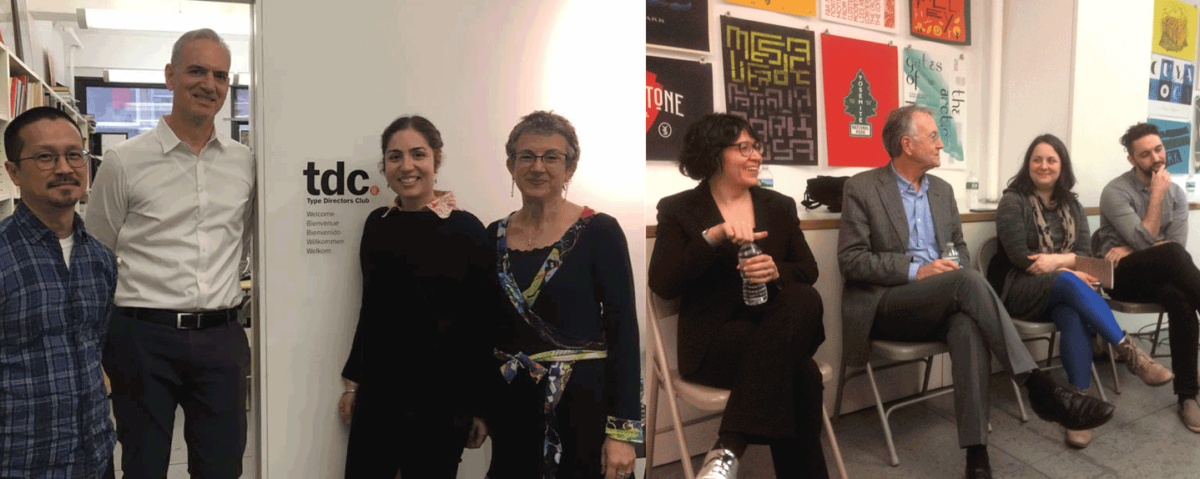
Read Amy Papaelias’ delightful synopsis of the panel discussion on Teaching Typography. Amy is Assistant Professor of Graphic Design at SUNY New Paltz and was one of the distinguished panelists at this past Saturday’s event at the Type Director’s Club.
Educators will discuss innovations, challenges and best practices for teaching typography.
As a mainstay of design, typography is a corner stone of most degree programs in visual communication design. Still questions abound. How and where typography is taught is as varied as its use in design applications. We invite you to join fellow educators in a conversation which will focus on how, where and when we teach typography. Our panelists will explore the role of typography in the continuum of design education and identify areas where traditional programs experience shortcomings and challenges. We will ask what fundamental skills should be taught and whether the way we are teaching typography needs to change in a screen-based world? Finally, we will ask the audience to participate in identifying specific skill sets and methodologies which should be part of type-centric design curriculum in the 21st Century.
The conversation will be moderated by Doug Clouse, President of TDC and Principal at The Graphics Office and Liz DeLuna, Associate Professor of Design at St. John’s University.
Type Directors Club
347 West 36th Street
Suite 603
New York, NY 10018
Saturday, April 1, 2017
2pm–5pm
Moderators
Liz DeLuna Associate Professor of Design St. John’s University
Doug Clouse President, Type Directors Club Principal, The Graphics Office
Panelists
Thomas Jockin Founder of TypeThursday Adjunct Professor Queen’s College, CUNY and Fashion Institute of Technology, SUNY
Amy Papaelias Assistant Professor Graphic Design SUNY New Paltz Co-founder of Alphabettes.org
John Gambell Senior Critic Yale School of Art Yale University Printer
Juliette Cezzar Designer, Writer Assistant Professor Communication Design Parsons School of Design, The New School
Educators discuss Graphic Design Programs at the Type Directors Club, Saturday, November 12, 2016. 2pm–5pm.
What challenges and obstacles do graphic design programs encounter today as they work to balance the multitude of critical thinking, and conceptual and technical skills needed to help students grow into thoughtful, adept and culturally aware design practitioners? How do programs housed in liberal arts institutions differ from those in art schools? We invite you to join educators in a conversation on the teaching of design in institutions with varied pedagogies and student communities.
Moderators
Liz Deluna Associate Professor of Design St. John’s University
Mark Zurolo Associate Professor of Design University of Connecticut
Panelists
Robin Landa Distinguished Professor Robert Busch School of Design Michael Graves College Kean University
Allan Espiritu Associate Professor Graphic Design Graphic Design Program Director Rutgers University
Dan Wong Associate Professor Communication Design New York City College of Technology, CUNY
Nick Rock Assistant Professor Graphic Design Boston University
Jessica Wexler Assistant Professor Graphic Design Purchase College, SUNY
Kelly Walters Assistant Professor Graphic Design University of Connecticut
Event Details
Sponsored by AIGA/NY
Hosted by Type Directors Club
Saturday, November 12, 2016
2pm–5pm
Type Directors Club
347 West 36th Street, Suite 603
New York, NY 10018
Suzanne Dell’Orto
Adjunct Lecturer
Fine & Performing Arts
Baruch College, CUNY
“Eat Your Vegetables: Sneaking in Conceptual Thinking during Technical Instruction” is an experiential progression of graphic design projects that helps to introduce and refine the technical skills essential to professional practice. More important, it overlays other 21st century skills, adding pedagogical depth to the skill-building through an implicit layer of meaning-making, critical thinking, and abstract and symbolic thinking.
My introductory graphic design class is mandated to build the skills to communicate ideas and cover the essence of branding (a highly competitive game of attention-getting, recognition and trust), and the class is enriched by the addition of a critical thinking element. Students imagine, conceptualize, then filter and form allegiances to a random “theme word” assigned at the beginning of the semester. The challenge of deepening the development of this key word threads through 15 weeks of instruction, intersecting critical thinking with learning technical skills. This approach also allows the mimicking of a real-life designer/client relationship, using the theme word as a surrogate client. Students also learn and use tools for thinking in the curricular sequence, some borrowed from other domains such as the writing process of “word mapping”.
Attendees will learn, in this illustrated lecture, that the complexities of contemporary professional practice and the competitive global business context demand a critical and creative approach to foundational coursework––well-prepared hands, eyes, and minds.
Karen M. Cardozo, M.Ed., PhD Assistant Professor of Interdisciplinary Studies Massachusetts College of Liberal Arts
Some undergraduate institutions offer an interdisciplinary or special major where students integrate their interests and passions to design their own programs of study. In Finding Your Way in a Wild New World (2013), this method is recommended to everyone by social scientist and life coach Martha Beck. Arguing that social structures (including those related to work) are changing faster than conventional education or strategic planning processes can keep pace, Beck suggests that we can best navigate this rapidly shifting landscape by following our instincts and using all five senses in a more fluid, situationally responsive way. This dovetails with Daniel Pink’s thesis in A Whole New Mind (2006) that we have entered a Conceptual Age in which the most successful enterprises will be “high touch” (providing face to face or interactive services that cannot be outsourced) and/or “high concept” (tapping the creative, visual capacities of the right brain in addition to the analytic, verbal capacities of the left brain that are most elicited by educational systems). Barbara Sher (2006) agrees, adding that integrative or interdisciplinary orientations of the polymath types she calls “scanners” will be particularly in demand. Design communication serves as an ideal nexus for all of these insights.
Inspired by Stanford’s Design your Stanford and Design Your Life courses, this presentation argues that 21st century pedagogy should relinquish an outmoded “information age” attachment to content coverage in favor of more self-reflexive learning in which students apply open-ended and iterative design principles to fully maximize their own curiosity, inclinations and opportunities—in college and beyond. As a concrete case study, we’ll look at MCLA’s Interdisciplinary Studies (IDST) program as helpful “design your major” intervention, and present a scaled-up counterpart in life design from one IDST World of Work course, whose final research project requires students to design their lives in two alternate universes: one, the life they think they are planning and the other a path that might unfold from a different point of departure and in response to unpredicted setbacks, risks taken, or plain dumb chance. The resulting insights reveal that while the future is unpredictable, the value of design thinking as a method for navigating the unknown is quite clear.
Irina Lee Design Director, Bureau Blank Adjunct Lecturer, School of Visual Arts Adjunct Lecturer, Department of Visual Communications: Art + Graphic Design SUNY Farmingdale
Portfolio preparation can be a friendly approach to learning time management, identifying personal career goals, and transitioning from a student to a professional practice.
“Live Interviews + Networking Night” was born out of the necessity to focus and motivate the graphic design seniors. Over the course of 6 weeks, the work leading up to the “big night” provides a real-world setting for students to research the design industry, identify personal career goals, iterate, self-initiate the necessary portfolio work, articulate their work through written case studies, seek out help and feedback from design professionals, and learn to make their own decisions. Instead of the traditional teacher/student reviews, students seek reviews from industry professionals and supplement their work with group reviews and self evaluations.
Through this process, students gain confidence in their work, become stronger writers, improve collaboration and group facilitation skills, and learn how to build their networks. The talk will include students’ work, teaching methods, and tips for anyone interested in incorporating a similar model into their upper-level design courses.
Yue Chen Art Director Office of Visual Communication New York City College of Technology, CUNY
Design critic Ralph Caplan wrote: “Learning how to write is not the same as being a writer.” The same principle holds true when it comes to design, and yet this simple truth is often forgotten in the classroom. While students are expected to learn how to design, many have failed to realize that technique alone does not automatically make them designers—attitude and work ethnic are just as important. In this presentation, I will discuss a few real-life lessons I developed to help students become more aware of the choices they make as designers, and how those choices can, for better or worse, affect their own lives and the well-being of society.