White Plains Storefront Project: Art In Vacant Spaces

Teaching Award Runner-up

Warren Lehrer
Professor
School of Art+Design, Purchase College, SUNY
Founding Faculty Member, SVA (School of Visual Arts) Designer as Author Graduate Program”

For two years in a row, the White Plains BID (Business Improvement District) asked me and my Community Design class at Purchase College, SUNY to “improve the visual appearance of vacant storefronts in downtown White Plains and thereby enhance the ambiance and pedestrian experience in the downtown business district.”

Community Design is a senior level graphic design class that serves the campus and non-profit communities while providing students with “real” projects that interrogate ideas of community, civic engagement, and an expanded role of the designer. The class functions as a design studio that works on multiple projects of different kinds, scales and media with a variety of clients/collaborators. In the fall of 2015, the Storefront project was one of 11 projects. In 2016, it was one of 6.

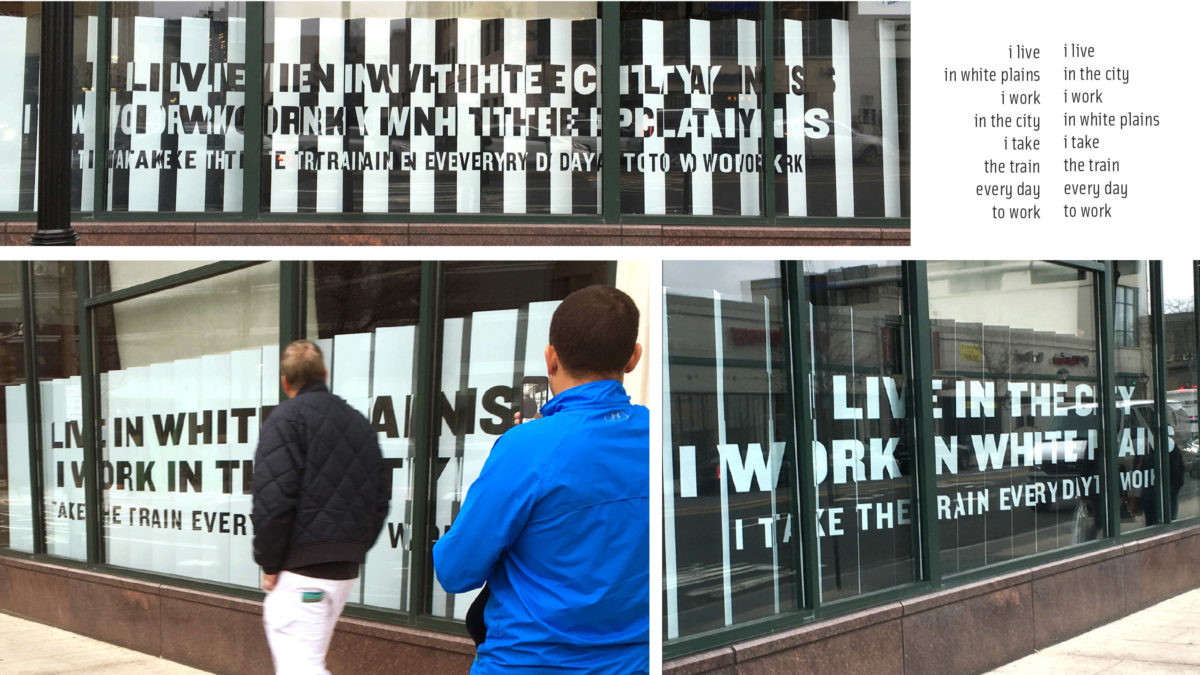
In year one of the Storefront project, the students and I reframed “the brief” to go beyond “aesthetic enhancement” of the vacant storefronts, by creating works of visual poetry that reflect the conditions of downtown White Plains and the people who inhabit it. As the class had ten other projects on its plate that semester, and the course is not a writing course (I also teach a elective writing course for designers), we brought in Judith Sloan to write poetry for the project. (Judith is my partner in EarSay, a non-profit arts organization dedicated to uncovering and portraying stories of the uncelebrated.) After researching White Plains and interviewing residents, commuters, historians and city officials, Judith wrote five poems that left room for visual interpretation by students.

Each student in the Storefront team did their own primary and secondary research on nearby White Plains and selected a poem or poems they were interested in. From the 20% commercial vacancy stock, students picked storefronts they thought most suitable for their selected poem(s) and began visualizing them within the frame of the storefront using typography as well as shape, color, texture, image, sequence, metaphor. The student’s interpretive “performance” of a text into a space was influenced by the store’s configuration, number of windows, and proximity to other landmarks (train station, bookstore, other vacant spaces, etc). Invariably, the design student’s re-composition of the poem necessitated consultation with the poet, sometimes culminating in collaborative re-writes. This fluid collaboration/negotiation between designer and writer, the whole creative team and the BID/property owners, and with materials and vendors—helped catapult the project beyond a normal class assignment or traditional designer/client relationship. The resulting transformation of a blighted area into an activated public space fusing poetry and art was an enlarging and successful experience for everyone involved. The windows stimulated conversation, enchantment and change in the community. Half the stores utilized in year one have since rented, the commercial vacancy rate is down to 17%, and the White Plains BID approached me to do the project again—with an expanded budget—for a second and now third year. In year two of the project, we expanded the media beyond printed vinyls and lenticulars, to include laser cutting, digital monitors and projections.

LehrerWhite Plains Storefront Project

Warren Lehrer is a designer, writer, and educator known as a pioneer of visual literature and design authorship. Awards include: Center for Book Arts Honoree, the Brendan Gill Prize, the Innovative Use of Archives Award, three AIGA Book Awards, a Media That Matters Award. Grants/fellowships include: NEA, NYSCA, NYFA, Rockefeller, Ford, Greenwall Foundations. Collections include: MoMA, the Getty Museum, Georges Pompidou Centre, Tate Gallery. With Judith Sloan, Lehrer co-founded EarSay, an arts organization dedicated to portraying lives of the uncelebrated. Lehrer is also a playwright, performer, and frequent lecturer and keynote speaker. He is a full professor at Purchase College, SUNY, and a founding faculty member of the Designer as Author grad program at SVA. His recent illuminated novel, A LIFE IN BOOKS, has received nine awards, including the International Book Award for Best New Fiction, the IPPY Outstanding Book of the Year Award, and a Print Magazine Design Award.

Recipient of recognition in the Design Incubation Communication Design Awards 2017.
An Archive: The National Museum of African American History and Culture

Kelly Walters
Assistant Professor of Design
Art + Art History Department
University of Connecticut

In social media platforms such as Instagram, Twitter and Facebook, the animated gif is used as a means to convey ideas, actions or beliefs to our friends or followers. When we want to convey our emotions more emphatically via text message or social post, the emoji is replaced with another form, the reaction gif. Unlike the static emoji face, a reaction gif can convey a faster depiction of the specific body gesture or facial expression one is trying to transmit digitally.

In close observation of my social account and of those that I follow, reaction gifs featuring black people are extremely high. There a countless social accounts today that are dedicated to featuring black reaction gifs as its main source of content. As TeenVogue author Lauren Michelle Jackson states in her article, We Need to Talk About Digital Blackface in Reaction GIFs, “Images of black people, more than anyone else, are primed to go viral and circulate widely online — in trauma, in death, and in memes. Reaction GIFs are an uneasy reminder of the way our presence is extra visible in life, every day, in ways that get us profiled, harassed, mocked, beaten, and killed.”

I am interested in how black reaction gifs are made, viewed and disseminated into social media platforms. I’d like to gain a better understanding of their source origin, through the identification of the films, television shows, music videos and news outlets the clips are extracted from. Through this analysis and documentation, I hope to highlight the lineage of black reaction gifs to a more expansive history of similar body gestures, facial expressions or speech patterns found in images that date back to the early 19th century. I hope to compare the images and sounds found in contemporary black reaction gifs, to artifacts found in the Film, Music, Photography and Civil Rights collections of the National Museum of African American History and Culture.

The following parameters will guide this research:

  1. Examine how black and non-black audiences consume, share or distribute black reaction gifs online.
  2. Identify which black gestures are captured.
  3. Study the differences between black male and female representation in reaction gifs while also comparing age and soci-economic class systems.
  4. Identify different patterns of speech conveyed within the reaction gifs.
  5. Identify the events or causes that make black reaction gifs necessary.

This research was presented at the Design Incubation Colloquium 4.0: SUNY New Paltz on September 9, 2017.

Graphic Design for Science

Gokhan Ersan
Assistant Professor
Department of Art & Design

SUNY Binghamton 

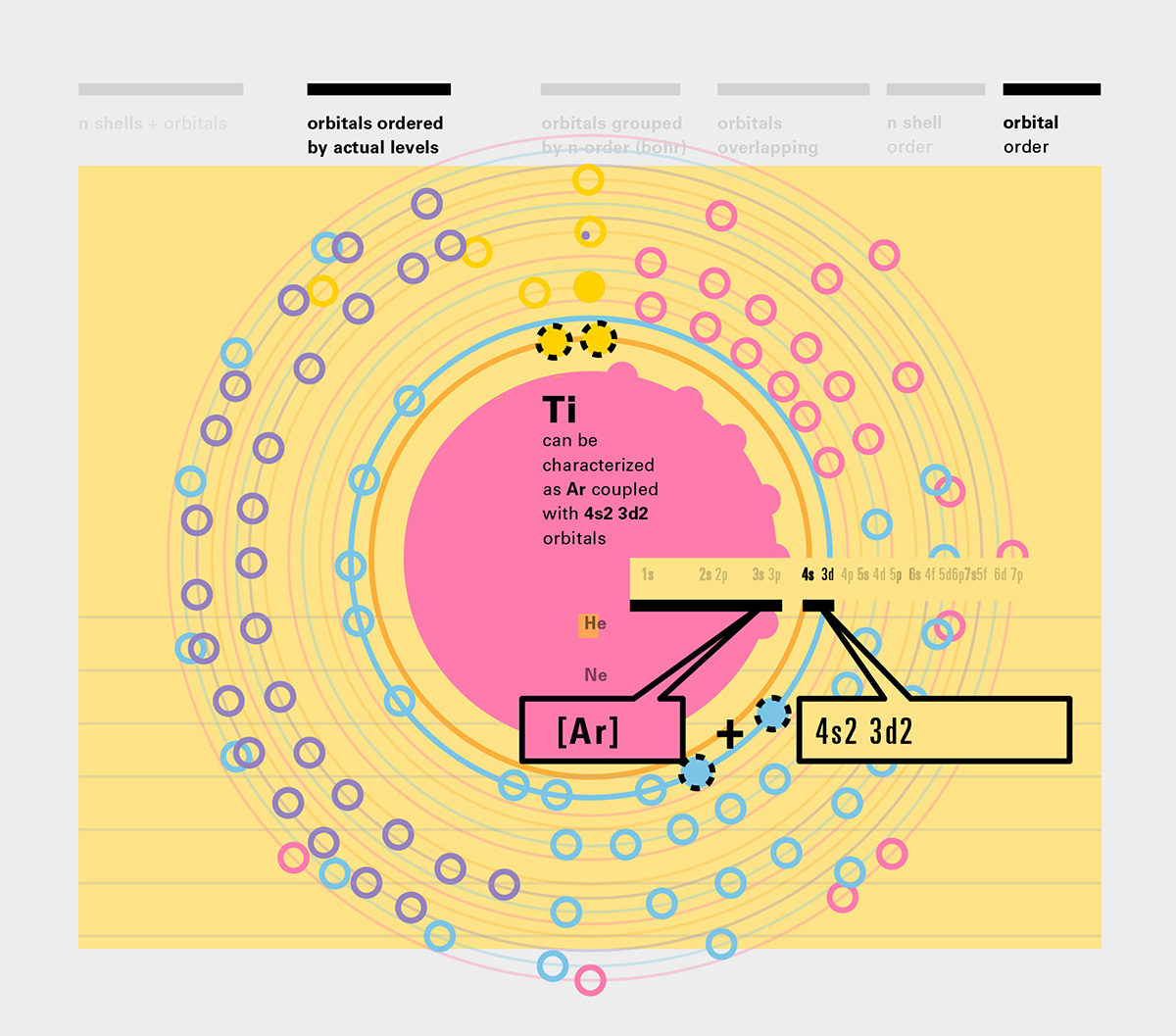
The history of science embodies both a development of ideas as well as notations and images that report and represent those ideas. My research involves utilizing modern visual art’s visual notation to give voice to contemporary researchers across the domains of engineering, natural sciences, and the humanities.

Walking the audience through a few historical examples of knowledge representation (Kepler, Dalton, Faraday) and recent collaborations with natural scientists (“Image of Science,” “Material Matters” research grants) I want to demonstrate the ways in which chemistry and material science concepts can be made concrete for broad audiences by experimenting with the visual primitives of visual arts to encode complex physical phenomena in a humane manner.

This design research begins with establishing a healthy communication stream between content-providing scientists and knowledge-visualizing graphic designer, promising to open up a fruitful venue for contemporary designers.

This research was presented at the Design Incubation Colloquium 4.0: SUNY New Paltz on September 9, 2017.

Be Good to Me: How Advertising Students Made San Jose Think Twice About Illegal Dumping

John Delacruz
Professor of Advertising
School of Journalism and Mass Communications
San Jose State University

Creativity is a powerful driver for brand communications. Entertaining and engaging, we tell the world stories across media channels that encourage consumption and allow brands a central role in shaping identities, communities and history. The skills learnt by students on creative programs can be a force for good. As educators in the field of advertising and other creative industries we should be guiding our students to make ethically minded decisions, not just to continue the cycle of consumption of which we, as communicators, are integral spokes.

In this case study they learn the importance of empathy and how this becomes a strength in the communications process, they learn to respond to a real life client and a real life target group. They also learn about issues that impact the community, the environment, and become better informed citizens. Our students have grown up with social currency, they are a sharing generation, global citizens, media aware and ethically minded. They are already switched on to alternative futures and therefore open to guidance on how to use their creativity for good.

This case study will focus on one specific example of service learning from the advertising program at San Jose State University. Our client was the City of San Jose’s Environmental Services Division in collaboration with CommUniverCity. The brief was to inform citizens of San Jose about illegal dumping. Our students crafted a campaign that spoke of the relationships between our everyday stuff and ourselves, reminding us to treat our treasures with respect when the time comes to let them go. They worked in an agency team and learnt about issues affecting urban neighborhoods and the environment. The program offered them experience reflecting the world of work and the world around them, civic responsibility and storytelling. They have hopefully become informed, engaged and aware citizens as well as effective and creative communicators.

This research was presented at the Design Incubation Colloquium 4.1: San Jose State on Saturday, Sept 30, 2017.

Basic Web Design as Foundation of Publication Design

Bruno Ribeiro
Assistant Professor of Graphic Design
Department of Art and Design
California Polytechnic State University

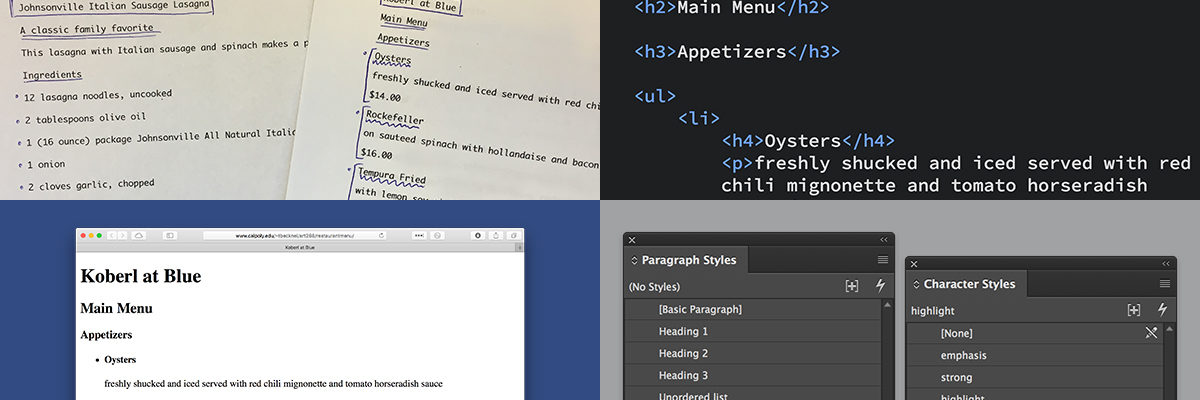
When introduced to the design of print publications, students often struggle with type hierarchy and sometimes they lack appreciation for simplicity. Learning HTML and its tagging system, however, can help them in both matters.

After taking their first web class, students tend to have a better understanding of systematic typography and make more conscious decision about typographical design. Through the logical language of HTML and the tagging system, students clearly see the supporting structure of type hierarchy. Pedagogically, it helps educators guide students to make better choices. Because web design is completely new to most of the students, it’s an opportunity to frame its structure as an approach on how to properly treat type hierarchy and consistency. Even the default style for HTML documents, with no formatting of any kind, provides a clear correlation between content hierarchy and visual hierarchy. Therefore, an early web design class improves students’ understanding of systematic formatting a wide range media. Web design can also promote an appreciation for simplicity in design. Every non-designer knows how to (often badly) format a printed page in their text processor of choice. Design students, then, tend to overly design to differentiate their work from what non-designers do. Simple design on the web, however, already brings a sense of accomplishment to the student who is able to make something they built from scratch available online. Even utterly simple designs are more tangible as a learned skill.

Web design should not be seen only as a skill that students need to learn. It is an effective means to teach the principles of systematic typography and visual hierarchy. The earlier students learn these concepts, better are the chances they will have of fully integrating them into their creative practice.

This research was presented at the Design Incubation Colloquium 4.1: San Jose State on Saturday, Sept 30, 2017.

Bridging the Business Design Gap

Martin Dominguez
Adjunct Professor
St. John’s University, Fordham University

Service design is an emerging field that operates at the intersection of human-centered design, user-experience design and business execution. Despite two decades of academic and practical work in the field (see Service Design Network, https://www.service-design-network.org/), service design has only recently emerged as a field of interest in the United States. Catalyzed by firms like IDEO and Fjord and design programs at Stanford and SCAD, interest in the field is gaining momentum among business decision makers.  As a result, new opportunities for graduating design students and experienced designers in related fields are emerging in both the public and private sectors. Growing the service design industry in the US and abroad, however, requires more than simply preparing the next generation of designers. Bridging the gap between designers/design thinking and the business community is also necessary in order to improve communication between designers and those who employ them.

The purpose of this presentation is to examine how engaging business students in the fundamentals of design might benefit design students and practitioners. Specifically, we explore how helping business see how design can be used to innovate and address complex market and organizational challenges might open new opportunities for designers in the future. Two service design-centered business courses (graduate and undergraduate) at two Universities in New York City provide a framework for understanding how best to educate business students in the fundamentals of design thinking and service design. Insights for design educators and practitioners including three fundamental principles that have emerged from this participatory action research. Areas for future research and pedagogy are also discussed.

This research was presented at the Design Incubation Colloquium 4.0: SUNY New Paltz on September 9, 2017.

When the Process is the Product: Pollock, Gehry and the Illusion of Randomness

Craig Konyk, AIA
Assistant Professor
School of Public Architecture
Michael Graves College
Kean University

This paper explores the role of randomness in the design process using two examples for the field of art and architecture as illustrative examples: Jackson Pollock and Frank Gehry.  Both Pollock’s and Gehry’s work rely on the revelation of the process as the product.

Jackson Pollock is one of those art world figures that is frequently derided by the average person with a dismissive, “My kid could paint that.” Abstract Expressionism (the combination of the term “abstract” with “expressionism”, two vastly different artistic movements of the 20th century) defined a certain “automatism” of the process of the paint’s actual application, even defining Pollock in a certain sense as the “idiot savant” of the post-war American art scene; child’s play indeed.

Frank Gehry’s study models of torn paper and crumpled foil elicit similar decrees of child-like facileness from the same quarters.  But for all their apparent improvisation, a closer study reveals quite a different narrative.  Contemporary critics of the time, when not dismissing the work outright, were compelled to suggest edits and/or additions, the implication being that the works were somehow “disharmonious” in their present state and in need of adjustment.  But when the process is one that defies easy visual “completed-ness” in the traditional sense, the artist/architect maintains the final arbitration of that “completed-ness”.

The acknowledged acceptance of Polock’s and Gehry’s work as serious endeavors allows a certain liberation for experiment in design, outside of the pragmatics of functionality.  It is not to say that we now all have to “do a Gehry” in order to be “artists”, but we are now in a position to argue for more difference in approach, rather than any narrowly focused expectation of what a design project should look like.  In that respect, as designers, we now have the freedom to allow the process to be revealed and use randomness as a strategy, which enhance and elevate all design investigations.

This research was presented at the Design Incubation Colloquium 4.1: San Jose State on Saturday, Sept 30, 2017.

Towards an Understanding of Cinema’s Impact on Design Education

Jason Tselentis
Associate Professor Of Design
College Of Visual And Performing Arts
Winthrop University

In the classroom, design students who view documentary films such as Gary Hustwit’s “Helvetica” (2007), Douglas Wilson’s “Linotype” (2012), and Briar Levit’s “Graphic Means” learn about designers, the tools they use (or used), and the meaning behind their creations. Film viewings and class discussions offer perspectives for students to recognize the significance (or lack of significance) a designer and/or their design has in yesterday’s and today’s culture.

To understand and appreciate designers and their work in those films and others has merit, exposing students to relevant issues and influences. But what can design students learn from not only watching such documentaries, but also investigating the methods and principles used for creating them? In cinematic arts and filmmaking degree and certificate programs, film studies deliver a framework to appreciate and understand cinematic creations. It’s visual literacy for cinema, teaching film students to read and analyze movies in preparation for making their own movies.

Film studies and filmmaking could also enhance a design student’s skill set. How would identifying a researchable documentary topic teach students about design history and design research, as well as storytelling? Studying film is also a platform for criticism. What could design students learn from fictional cinematic works, investigating the ways designers have been represented as antagonists, protagonists, or mere set dressing? What would design students say about the stereotypical designer, as (sometimes negatively) represented in movies and on television?

“Towards an Understanding of Cinema’s Impact on Design Education” will present a motion picture and film study platform  for design education that includes documentary films and more. It aims to demonstrate how a class (or classes) could shape design students into more well-rounded creatives, perhaps the next generation of filmmakers. And it proposes ways to mold them into capable and responsible critics or historians.

This research was presented at the Design Incubation Colloquium 4.0: SUNY New Paltz on September 9, 2017.

The 45th City: Visualizing and Experiencing Fake News

Jonathan Hanahan
Assistant Professor, Communication Design
Sam Fox School of Design & Visual Arts
Washington University in St. Louis

Fake news is a problem created by designers. It is a problem of aesthetics, not simply content or substance. Attempts to clarify the way information from any source is rendered in the walled gardens of our social media platforms—where reportedly 62% of American adults get news information—have homogenized the visual representation of all content, reliable or not.

This presentation discusses an ongoing research project—titled The 45th City—which investigates the role that design plays in the current fake news epidemic, epitomized by the recent election of the 45th President of the United States. The project explores speculative ways of visualizing both reliable and unreliable news websites through the physicalization of code into 3D artifacts. It inquires on a real world implication of the legitimization of such entities and encourages audiences to occupy, investigate, and contemplate their relationship to digital infrastructure beyond the thin veneer of their devices.

This series of large scale 3D artifacts along with corresponding digital renderings will be on view at The Luminary in St. Louis, MO in September 2017 and the pinkcomma gallery in Boston, MA in early 2018.

This research was presented at the Design Incubation Colloquium 4.1: San Jose State on Saturday, Sept 30, 2017.

Rethinking the Capstone in a Graphic Design BFA Program

Regina Gardner Milan
Lecturer
Department of Art & Design
University of Massachusetts Lowell

Evolving the BFA capstone project to develop professional competencies for emerging designers.

Encouraging students to develop projects that address their competencies and those that they need to develop. A year-long course sequence encouraging extensive creative exploration while working within developed constraints that are specific to each student. These constraints are developed through a reflective process of research and critical analysis of their skill sets and portfolio. They then apply these skills and making to a defined set of projects.

Projects are developed across complex design systems encouraging personal design thinking and and challenging student’s skillsets. Projects include both analog and digital solutions including app design, web design, interactive installations and motion graphics.  Faculty encourage growth mind-set and conceptual development of projects that help define a student’s aesthetic and aspirations for their post-college practice.

Developed two years ago, this new capstone has proven successful in encouraging critical design thinking, content development, and putting students in the strongest possible position for entering their professional design practice. Students graduate with a strong social media presence, robust resumes and expanded portfolios.

This research was presented at the Design Incubation Colloquium 4.0: SUNY New Paltz on September 9, 2017.