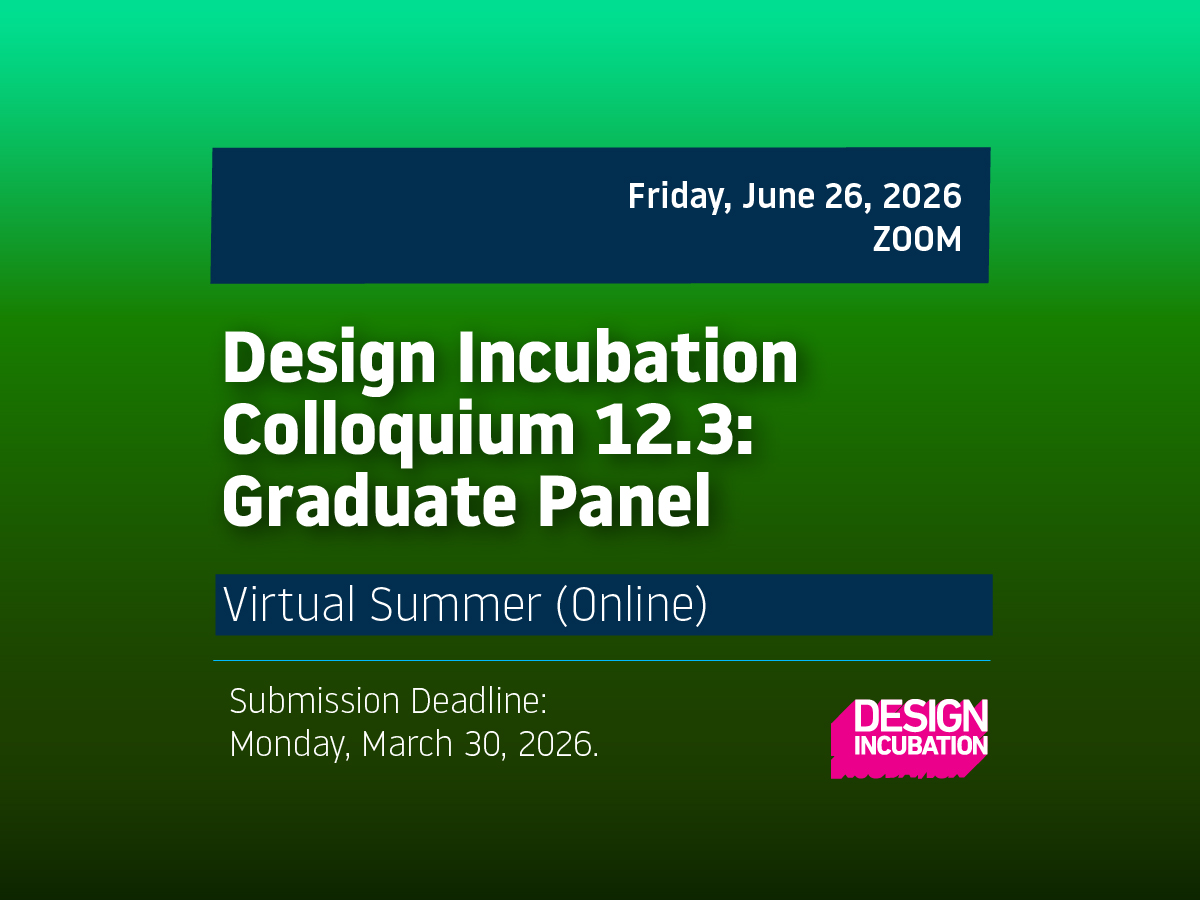
Event date: Friday, June 26, 2026 Format: Virtual/Online Location: ZOOM
We invite current and recent communication design graduate students to submit abstracts of their design research, creative investigations, and productions. The work can cover a broad range of topics, including but not limited to graphic design, typography, branding, illustration, photography, videos, motion graphics, advertising campaigns, websites, UX/UI designs, animations, and other visually communicated design products and solutions. The work should have been completed within the past 3 years. This is a virtual online event format. Abstracts can be submitted online now for peer review.
There is a $10 conference fee required per research abstract submission for non-members. Please submit only one abstract per colloquia. The conference fee is waived for active annual members. Find out more about our annual memberships.
Researchers will videotape their 6-minute presentations which will published online in advance of the colloquium. The video recording is due by Friday, May 22, 2026. We encourage all attendees to watch the videos in advance of the moderated discussion.
Event date: Friday, June 26, 2026 Format: Virtual/Online Location: ZOOM
We invite designers—practitioners, creators, and educators—to submit abstracts of design research, creative investigations, and productions. This is a virtual online event format. Abstracts can be submitted online now for peer review.
There is a $10 conference fee required per research abstract submission for non-members. Please submit only one abstract per colloquia. The conference fee is waived for active annual members. Find out more about our annual memberships.
Researchers will videotape their 6-minute presentations which will published online in advance of the colloquium. The video recording is due by Friday, May 22, 2026. We encourage all attendees to watch the videos in advance of the moderated discussion.
A panel discussion by design scholars about their research journeys.
Designing Your Research Agenda (DYRA) 5.1 Friday, April 17, 2026 1:00PM EST Virtual Event
Designing Your Research Agenda (DYRA) is a panel discussion and open forum for design scholars and researchers to discuss aspects of their research agendas. We aim to open a dialogue regarding the challenges of discovering one’s design research inquiry. DYRA is a design research webinar series.
Presentations plus an open Q+A and informal discussion.
Some of the questions we are asking our panelists include:
How did you determine your research agenda (high level timeline of your career/trajectory)
How do you define research and why do you think it matters/for society, the field, yourself?
How do your department and institution define and support the work you do?
How would you describe/categorize your department and institution?
If you were going to position your work within a category, would you say your research addresses: design theory, design history, design practice, design research (traditional graphic design, speculative design, UXUI, typography, AR, VR, creative computing, design solutions, etc.), design pedagogy, or something else?
What barriers (if any) exist at your institution or in the field for creating and disseminating your research?
This event brings together academics from various stages in their careers and from different types of institutions. We hope that by sharing experiences, we can support others on their journeys.
Lesley-Ann Noel Dean of the Faculty of Design OCAD University
Lesley‑Ann Noel, PhD, is a design researcher, educator, and Dean of the Faculty of Design at OCAD University. Her research centers on equity-focused, community-led design, drawing from critical race theory, decolonial practices, and participatory methodologies. She investigates how positionality, lived experience, and local knowledge shape design inquiry—and how design researchers can cultivate agendas that are responsible, relational, and grounded in context. Her work includes developing reflective tools such as The Designer’s Critical Alphabet and the Positionality Wheel, which support designers in articulating values, motivations, and epistemological commitments within their research programs. Across her global practice in the Caribbean, Brazil, the U.S., and Canada, she champions pluriversality, social change, and the expansion of who gets to produce design knowledge. She is the author of Design Social Change and co-editor of The Black Experience in Design.
Robert Harland Reader in Urban Graphic Heritage Loughborough University
Rob holds a PhD in Architecture (Social Sciences) from the School of Architecture and Built Environment at the University of Nottingham (2011) and an undergraduate degree in Information Graphics from Trent Polytechnic, Nottingham (1986). His transdisciplinary research explores urban heritage through the lens of graphic design, under the guise of urban graphic heritage.
He co-leads a team who launched the TOWN Observatory in 2025 and was subsequently invited to join the UN-Habitat Global Urban Observatory steering committee. In the same year he became deputy lead for Loughborough University’s UNESCO Chair in Storytelling Education for Sustainability, having joined the university’s renowned Storytelling Academy.
Known also for his interest in graphic design studies, he has led several funded projects with NGOs in Australia, Brazil, China, South Africa and United Kingdom. Recent collaborators include United Kingdom National Commission for UNESCO, Nelson Mandela Foundation, David Roche Gallery, and Loughborough Library Local Studies Volunteer Group.
Kelly Salchow MacArthur Professor Michigan State University
Kelly Salchow MacArthur is a Professor of Graphic Design at Michigan State University, and currently an Honorary Visiting Researcher at University College Cork (Ireland). She received her MFA in Graphic Design with Honors from the Rhode Island School of Design (RISD), and BS in Graphic Design Magna Cum Laude from the University of Cincinnati College of Design, Architecture, Art and Planning. Before joining the faculty at MSU, she taught at Kansas City Art Institute, RISD and The College of New Jersey.
Kelly’s design practice and creative research focus on environmental awareness, advocacy and action. Her work has been disseminated internationally through exhibition, design award, conference, and publication, and is included in several permanent collections. She is President Emerita of the international design organization, United Designs Alliance and AIGA Detroit. She is a 2-time Olympic rower, a 2-time Olympian Artist, and a Member of the IOC’s Culture and Olympic Heritage Commission.
Design Incubation will host the College Art Association (CAA) conference business meeting at the Hilton Chicago and on Zoom on Thursday, February 19th from 1:00–2:00 pm CST. There is no cost to attend this meeting.
In this session, we’ll present A Decade of Keywords in Communication Design Research, a project that analyzes over ten years of Design Incubation colloquium submissions to reflect on the themes, methods, and questions shaping the field. We will share results of the keyword analysis and how it leads to topic ideas for a Design Incubation book series. We will present the book series ideas and ask participants to contribute by providing feedback, sharing research interests, and discussing the project goals. This session is open to designers, researchers, educators, and practitioners interested in contributing to this project and book publication.
Design Incubation is a volunteer academic organization whose focus and mission is the facilitation of research and scholarship in communication design. Our aim is to foster discussion and collaboration among academics and industry professionals. We are a resource for those working and studying within the field.
Welcoming Dr. Leslie Atzmon as Director of Design History and Theory
Starting this January 2026, we welcome Dr. Leslie Atzmon as Director of Design History and Theory. Atzmon has been participating with our team for several months. She is currently on the jury of the 2025 Design Incubation Educators Awards, as well as other initiatives we have under development.
Leslie Atzmon is a designer and design historian who teaches at Eastern Michigan University. She co-edited the collections Encountering Things: Design and Theories of Things (Bloomsbury 2017) and The Graphic Design Reader (Bloomsbury 2019). Atzmon and colleague Ryan Molloy were awarded a National Endowment for the Arts (NEA) ArtWorks grant from 2012-2014 to support experimental book design workshops and the creation and production of The Open Book Project book. Atzmon has a new collection, entitled Visual Ecologies of Placemaking, edited with Pamela Stewart (forthcoming Bloomsbury 2026).
Atzmon’s current work mainly investigates the intersections between design and science, with a focus on biodesign. In 2016, Atzmon was a Fulbright fellow at Central Saint Martins UAL, UK doing research on Darwin and design thinking. This led to the essay, “Intelligible Design: The Origin and Visualization of Species,” in the journal Communication Design (2016). In 2019/2020, she curated the exhibition Design and Science, which ran at Eastern Michigan’s University Gallery and The Esther Klein Gallery/Science Center in Philadelphia. She also edited a related collection entitled Design and Science (Bloomsbury 2023). Atzmon is currently working on a biodesign textbook, entitled Biodesign in Context (forthcoming Lived Spaces 2027), with Professor Diana Nicholas of Drexel University.
Training students to treat generative models as tools and as systems of meaning-making.
Lingyi Kong Adjunct Professor Parsons School of Design
The underlying logic of generative AI—structured prompts, output predictability, and system feedback—is not unlike the foundations of critical design education: both rely on linguistic construction, syntactic control, and traceable iterations. This project explores that shared grammar as a pedagogical entry point, training students to treat generative models not just as tools, but as systems of meaning-making.
The framework introduces a “backward design” pedagogy in which students begin with AI outputs and work backward to decode the system’s structural assumptions. They analyze how prompt phrasing affects visual/linguistic output, how cultural bias surfaces in training data, and how interface design foregrounds certain logics while obscuring others. This method draws on theories of language, semiotics, and critical interface design to guide students through comparative mappings between AI-generated outputs and traditional design structures (e.g., grids, typographic rhythm, narrative sequencing).
Crucially, students are not passive recipients of AI assistance. They use AI as a reflective instrument to reframe and critique existing design workflows—extracting embedded design grammars, stress-testing stylistic assumptions, and making strategic use of the model’s generative excess. Students build speculative tools, experimental interfaces, and annotated systems that visualize not just results but the underlying decision tree behind them.
Through this process, students achieve more than tool fluency—they cultivate a critical authorship grounded in system thinking, capable of navigating the noise of generative output with informed judgment. The outcomes show that once AI is treated as an epistemological partner rather than a shortcut, students are empowered to articulate design decisions with greater clarity, ethics, and intentionality.
Design methodology and outcomes for two projects—a group exhibition and a large-scale installation.
Megan Irwin Assistant Professor Washington University in St. Louis
As the climate crisis accelerates, designers are faced with pressing questions concerning how design contributes to awareness and action. Typography—bridging language and visual form—offers a unique capacity to make environmental issues tangible. This presentation examines how experimental typographic practice—through material processes, formal disruption, and spatial installation—can move beyond representation to translate the urgency and complexity of our ecological moment.
This presentation features design methodology and outcomes for two projects: Climate for Change and Tipping Point. Climate for Change, a group exhibition addressing the current environmental emergency, employed an expressive typographic language across the exhibition design. Physical manipulations with water and melted letterforms worked alongside digital experiments to distort and dissolve type—evoking themes of fragility and urgency. The typography disintegrates and then rebuilds, carrying an additional message of change, restoration, and hope.
Tipping Point, a large-scale typographic installation, evolved from research on ecological thresholds. The typography spans a grid of 25 panels, each representing a vulnerable environmental system. As viewers engage with the work, panels flip and disrupt the typography, triggering a transformative cascade of events from the wall to the floor. This participatory experience invites action and reflection upon this ecological instability.
Together, these projects demonstrate typography’s power to engage the public with urgent climate issues. By synthesizing language and visual form, designers can mediate between scientific discourse and public understanding—offering frameworks for reflection, engagement, and collective action.
Poetic logs, imagined histories, diary entries, or hybrids about nightlife experiences that never happened.
Nika Simovich Fisher Assistant Professor Parsons / The New School for Design
Invisible Nightlife Review is a speculative writing and publishing project I taught at The New School, developed in collaboration with Dirt, an experimental media company.
The project asked students to treat fiction as a design tool. Inspired by Italo Calvino’s Invisible Cities, students created 800-word essays in the form of poetic logs, imagined histories, diary entries, or hybrids about nightlife experiences that never happened. The goal wasn’t to document nightlife, but to explore how people move through visibility, intimacy, and risk after dark, and how fiction can surface emotional truths that are hard to express in literal terms.
The project culminated in a public anthology on Dirt, giving selected students professional bylines and the chance to work with editor Daisy Alioto. I served as co-editor and designed the anthology’s microsite. Some stories were adapted into interactive formats—Google Maps as narrative or an audio based experience—extending the themes of disorientation, memory, and blurred realities.
In 2025, when generative tools are speeding everything up and flattening creative voice, speculative writing slows things down. It gives students a way to make something memorable and their own, while contributing humanities based research outside of the classroom.
Builing upon Ethics, Theory, Methods, Profession, Technology, and Visual Trends layers, each operating on distinctive temporal cycles of change.
Jarrett Fuller Assistant Professor NC State University
This presentation examines applying Stewart Brand’s “Shearing Layers” as a theoretical framework for restructuring graphic design education amid contemporary challenges. With technological disruptions including artificial intelligence and broader sociopolitical instabilities, design educators must develop curricula preparing students for sustainable career trajectories in uncertain futures, not merely immediate employment.
The proposal adapts Brand’s architectural model—originally conceptualized by Frank Duffy to describe buildings as systems with components evolving at different rates—to establish a multi-layered pedagogical structure. Just as buildings comprise Site, Structure, Skin, Services, Space Plan, and Stuff, this curriculum framework is built upon Ethics, Theory, Methods, Profession, Technology, and Visual Trends layers, each operating on distinctive temporal cycles of change.
The framework fundamentally inverts traditional design education by positioning theoretical seminars as the stable core around which experimental, responsive studio courses orbit. This restructuring enables programs to maintain philosophical and methodological continuity while simultaneously accommodating emerging technologies and shifting professional demands—addressing what Drucker and McVarish (2013) identified as “the perpetual crisis of design education.”
While not yet implemented, this speculative framework provides design educators with a conceptual tool for navigating curricular decisions in contexts of persistent change. The proposal contributes to design pedagogy discourse by offering a theoretical model that reconciles paradoxical demands for both stability and adaptability in curriculum development.
These structures prepare designers to address complex societal challenges with both historical perspective and future-oriented skills, enabling educational programs to respond dynamically to rapid disciplinary evolution while maintaining foundational integrity.