How Do Design Research Journals Evaluate the Quality of Submitted Articles?

“Ask the Expert” is a series looking at various considerations and practices related to design research, scholarship, publication, and other academic topics.

We invited Design and Culture’s Principal Reviews Editor, Maggie Taft, to respond to questions about different aspects of journal publishing. This is the first of a series from Taft, an independent scholar and Director of Writing Space, a community-based writing center for artists and designers.

Question: How do design research journals evaluate the quality of submitted articles?

Answer:

I think of this question as a two-parter: how do journals go through the process of evaluating submissions and what criteria do they commonly use at different stages in that process?

After an author submits a journal article, it moves through many people’s hands before the author hears back with the journal’s decision. Typically, a Managing Editor, who’s in charge of the journal’s day-to-day coordination and administrative work, is the first to review. The Managing Editor confirms that the article abides by the submission standards and style guidelines evaluating, for instance, that the piece meets the journal’s length specifications and that the topic corresponds with the journal’s. (You might be surprised how often that’s not the case!) Next, the journal’s Editor-in-Chief—that’s the person in charge of the journal’s vision—reviews the piece to confirm that it aligns with the journal’s mission and that, broadly speaking, it follows academic publishing standards. For instance, does it include research with citations? If the Managing Editor and the Editor-in-Chief think it looks good, then they pass it on to one of the journal’s Associate Editors. Associate Editors, sometimes called Editorial Board Members, are specialists in various fields who collectively contribute to a journal’s scope in expertise, perspective, and geographic reach. They oversee the next phase of the review process, during which an article receives more thorough attention and feedback from peer reviewers. Typically, peer reviewers do not hold positions on the journal; you won’t find their names on the masthead. Rather, they’re specialists in the article’s subject area and thus are particularly well-positioned to evaluate its argument, methodology, and contribution to the field.

Different journals configure the peer review process differently, and most use either a double-blind or single-blind review process. Double-blind peer review, which is typically the most highly regarded within academia, means that the reviewers will not know who the author is and the author will not know who the peer reviewers are. Single-blind peer review means that the author does not know who the reviewer is but the reviewer does know who the author is.

When a journal sends out an article for peer review, reviewers are typically asked to evaluate a piece using a questionnaire. Every journal has its own version of this questionnaire—unfortunately, they don’t often make them public—but most ask reviewers to assess some or all of the following features—

Scope: How does the article fit within the journal’s purview?

Impact: What is the significance of this article for its field of study? How does it contribute to research on its topic? How and in what ways does it build on existing literature?

Audience: Who is this article’s primary audience? (For instance, practitioners? Design historians? Design studies researchers?)

Argumentation: What is the article’s central claim? Is it clearly presented and well-supported with adequate evidence? Does any part of the paper need to be expanded to make the argument convincing? Is the approach methodologically sound and appropriate for the subject at hand?

Accuracy: Are there any factual errors in the paper? Is anything misrepresented?

Form: Is the writing and its style clear? Is the paper sensibly organized? Are all citations provided and complete? Are images of high quality and adequately captioned?

As you prepare an article, you may find that answers to the above questions feel self-evident. But it’s important to confirm that they are also apparent on the page. To evaluate if they are, I recommend stepping out of our role as author and trying to approach your text as a reader. Reread your article and try to answer the above questions using only the information provided by the text. For instance, does the text name its intended audience? Can you highlight a sentence that states the article’s central claim? If so, is this in a place where a reader could easily find it, such as the introduction, or is it buried in the paper’s middle?

Approaching your text as though you are a reader can provide new insights into how effectively the text presents your article’s argument, methodology, and contribution to the field. These are the key things that your article’s first readers—the managing editor, editor-in-chief, and peer reviewers at the journal where you’re submitting—will be looking for.

Maggie Taft, PhD
Founding Director
Writing Space
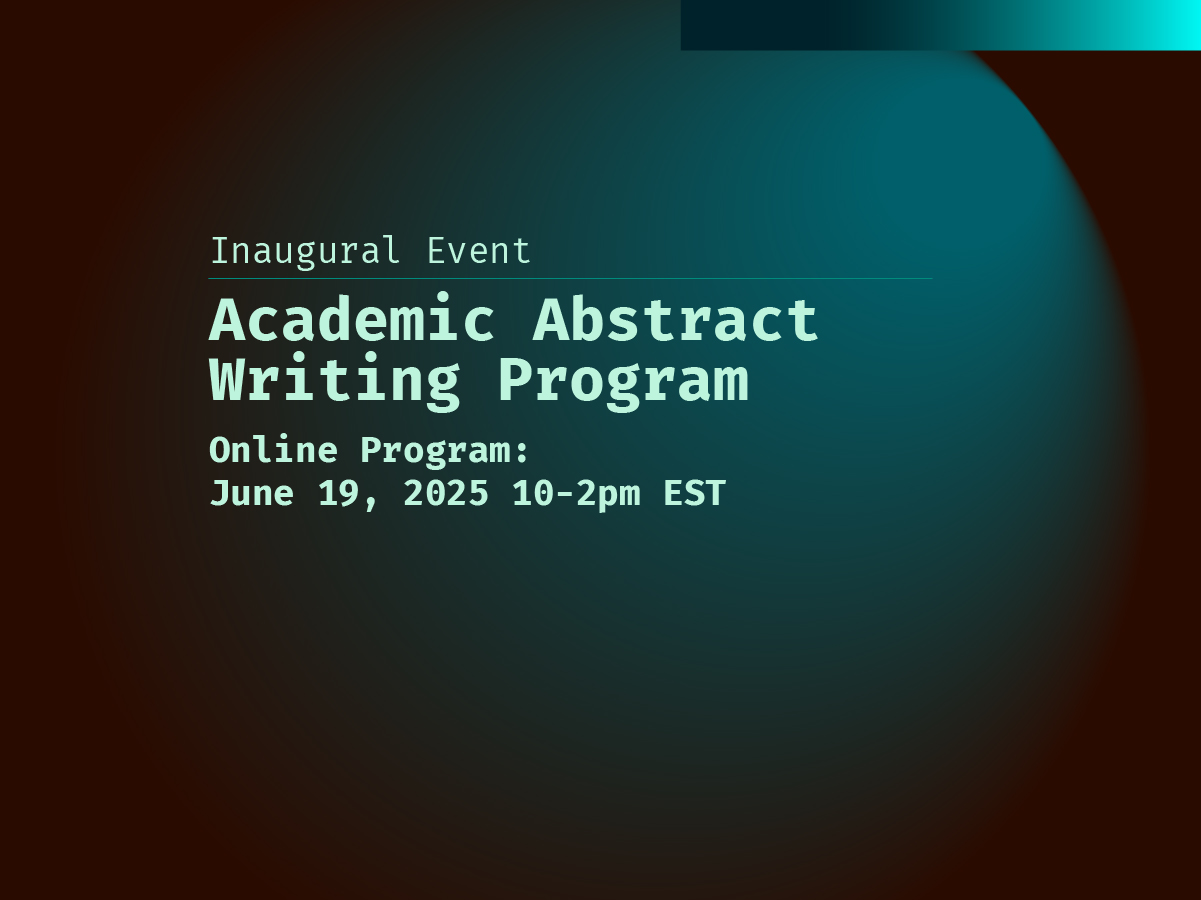
Academic Abstract Writing Program

Thursday, June 19, 2025
10:00am – 2:00pm EDT

The online Academic Abstract Writing Program at Design Incubation offers a series of activities that will help design researchers to craft a written synopsis of their research. The outcome(s) will be a concisely written document typically expected of academic publication venues. This includes conferences, journals, grant applications, publishers, and academic organizations.

The program is designed along two tracks:

  1. The first track is for design faculty who are new to academia and want a program that will help them to navigate the academic publication arena.
  2. The second track is aimed at design faculty who have established their research agenda and activities, and would like to explore ways to broaden their scope of publication opportunities.

We are excited to announce Leslie Atzmon, Eastern Michigan University, Jess Barness, Kent State University and Dan Wong, CityTech, CUNY will be facilitating and moderating the various activities.

Agenda

Time (EDT)Activity
10:00am-11:15amPresentation on Abstracts.
Dan Wong, Jess Barness.
Abstracts Reviewed. Breakout rooms with Mentors.
Atzmon, Barness, Wong.
11:15am-12:15pmFellows Abstract Workshop
12:15-1:00pmLunch Break
1:00pm- 2:00pmAbstracts—Repurposing Research. Leslie Atzmon.
Group Consultation with Mentors. Atzmon, Barness, Wong.

Fellows

Katie Blazek
Assistant Professor
University of Illinois- Urbana Champaign

Grace Hamilton
Assistant Professor
CUNY, Baruch College

Brooke Hull
Assistant Professor
Pennsylvania State University

Megan Asbeck
Assistant Professor
SUNY Brockport

Ruichao Jiang
Artist/Designer

Minoo Marasi
Graduate Student
University of Illinois Chicago

Golnoush Behmanesh
Assistant Professor
University of Mississippi

Tips for Design Scholars Looking to Publish in a Design Research Journal

“Ask the Expert” is a series looking at various considerations and practices related to design research, scholarship, publication, and other academic topics.

We invited Design and Culture’s Principal Reviews Editor, Maggie Taft, to respond to questions about different aspects of journal publishing. This is the first of a series from Taft, an independent scholar and Director of Writing Space, a community-based writing center for artists and designers.

Question: What is your top tip for scholars and designers interested in publishing in a design research journal?

Answer: Read.

We often think of reading as a parallel activity to writing. (Consider the elementary school trifecta “reading, writing and arithmetic,” which seems to position reading and writing as separate enterprises.) Yet when it comes to academic writing, reading is essential in so many ways.

The most familiar way to connect reading with academic writing is in the form of research. You read existing scholarship on your topic so that you can reference and draw upon previous findings and build a bibliography that demonstrates your knowledge of the field. Reading for research is essential.

But reading supports academic writing in at least three other crucial ways–

  • Reading will strengthen your methodology.

The more you read, the more you’ll learn about different ways to structure an academic argument and mobilize evidence in support of that argument. You’ll encounter some authors who highlight their subjectivity as a researcher and others who minimize it. You’ll find some authors who interpret case studies and others who analyze data sets. By reading widely and keeping track of the texts you find most compelling, you can identify the kinds of arguments you want to make and get ideas about how to use your research to make them.

My colleague Liat Berdugo recommends prospective article authors identify “sample journal articles”. These need not be articles that address the same topic as yours, but rather articles that make the types of arguments and interventions you hope to make. Having a good example of the kind of writing you wish to do will make it easier to figure out how to put together your article.

  • Reading will help you to identify how your work fits into the conversations that are happening in your field.

Academic arguments offer new ways of understanding, new paths of inquiry, and/or new recommendations for practice. These interventions are meaningful insofar as they respond to existing conventions. What is your work responding to? What is it seeking to change or rethink? To do meaningful work, you need to know what other people in your field are paying attention to and talking about so that you can explain to them the connection between their concerns and yours. Keeping up with ongoing scholarship in your field by reading will allow you insight into the kinds of work people are doing right now and what they’re paying attention to. This will, in turn, allow you to connect your specific area of research to broader patterns in the field, whether your ambition is to shift or refocus these conversations or to develop them in new directions or through new approaches.

  • Reading will help you identify the journals that are the best fit for your article.

There are many international journals that publish design scholarship but that doesn’t mean every one of them will be a good fit for your design research article. Every journal has a different historical focus, thematic emphasis, and methodological bent. Familiarize yourself with different journals’ respective missions (available on journal websites) and read the scholarship they’ve been publishing recently so that you can evaluate which is most likely to publish your work.

During my five years as the Managing Editor of Design and Culture, I think we rejected 50% of the articles we received not because they were bad scholarship but because they simply did a different kind of work than that which the journal sought to highlight. Some submissions deployed a scientific approach whereas the journal favored a humanistic one. Others focused on architecture, which at that time fell outside of the journal’s purview. Read the journals in your field so that you can both target your article submission to the ones most likely to publish your work AND target your article to that journal’s constituents. For instance, if you’re publishing research on graphic design education in a design history journal (like The Journal of Design History) you might frame your argument a bit differently than if you were to publish the research in a design education journal (like International Journal of Designs for Learning).

Ultimately, it is easy to think of reading as extraneous to the publishing process. You’re busy. There are so many urgent personal and professional matters vying for your attention. It can be difficult and even feel indulgent to dedicate time to reading, a task that typically rewards slowness. But for all the reasons described above, reading is not extraneous to writing for journals (and to writing more broadly). It is fundamental to it.

Maggie Taft, PhD
Founding Director
Writing Space

Design Incubation Writing Groups

Two groups, based on scheduling preferences and project type, are open to academics, researchers, and writers working in the field of communication design.

Design Incubation is pleased to announce a Writing Group program for the 2020–21 academic year.

Scholarly writing is an integral part of many design faculty’s research agenda. As designers and writers, we know it can be daunting to sit down in front of a blank screen. Participating in a writing group provides structure, support and feedback. It’s also a way to build accountability into your writing practice.

For a writing group to work, it requires a serious, regular commitment from each member. For this inaugural program, Design Incubation will assemble two groups based on scheduling preferences and project type. Details on the structure and varying levels of commitment for each of the two groups are outlined below. Groups are open to academics, researchers, and writers working in the field of communication design. We will give preference to full-time faculty. (At this time we are not accepting graduate students.) The cost is $55 for the year. Ten spots are available for the 2020/21 academic year.

Each group will have a participant who is the designated Coordinator, responsible for light administrative work, including scheduling meetings; maintaining group accountability goals; and communicating with the Writing Group program DI Chairs to provide updates on group progress and ongoing feedback on the program. Design Incubation will recognize the Coordinators on their website and the position can be used to demonstrate service to an organization at a national level.

Applications will be considered immediately upon submission and they can be submitted through August 5th, 2020 (Due to an overwhelming response, we have closed applications early). Design Incubation will provide official letters of acceptance to allow attendees to request funding from their institutions.

2020–21 Pilot Launch Groups

Each group will set a regular day and time to meet throughout the semester. A fixed meeting time reinforces the notion that your writing practice takes priority and promotes accountability.

Weekly Writing Accountability 

Best for: Faculty, writers, or researchers looking for accountability to establish a writing practice.

Description: The weekly accountability Writing Group will provide a support network for establishing a regular writing practice and help group members set and achieve goals related to writing and/or research. In addition to participating in weekly video conference meetings, members will be responsible for presenting a writing/research plan, maintaining a writing log, and completing readings related to writing. 

1-hour video conference call every week from August 2020–May 2021

Responsibilities:

  • Create a research/writing plan that details your project(s) and timeline(s)
  • Maintain a writing log including dates, times, and activity
  • Complete group-related assignments that may include readings, podcast episodes, or writing exercises

Bi-Weekly Writing Accountability 

Best for: Faculty, writers, or researchers looking for accountability to establish a writing practice but who cannot accommodate weekly meetings.

Description: The bi-weekly accountability Writing Group will provide a support network for establishing a regular writing practice and help group members set and achieve goals related to writing and/or research. In addition to participating in bi-weekly video conference meetings, members will be responsible for presenting a writing/research plan, maintaining a writing log, and completing readings related to writing. 

1-hour video conference call every other week from August 2020–May 2021

Responsibilities:

  • Create a research/writing plan that details your project(s) and timeline(s)
  • Maintain a writing log including dates, times, and activity
  • Complete group-related assignments that may include readings, podcast episodes, or writing exercises

Proviso: If you don’t show up for three meetings in a row, you may be dropped from the group. 

Design Incubation Fellowship 2019

January 10-12, 2019. New York City. A three-day workshop facilitating academic writing and publishing for designers.

The 2019 Design Incubation Fellowship Workshop will be presented by Maggie Taft, Managing Editor of the journal Design and Culture. Events include sessions with Elizabeth Guffey, Professor of Art and Design at SUNY Purchase and author of Posters: A Global History and Retro: The Culture of Revival; Louise Baird-Smith, Commissioning Editor – Design and Photography Bloomsbury Visual Arts; Robin Landa, Distinguished Professor, Kean University; and Brian James, Assistant Professor St. John’s University and as well as guest appearances by a number of authors and publishers. Aaris Sherin is director of the Design Incubation Fellowship program.

2019 Design Incubation Fellowship

January 10 –12, 2019
St. John’s University’s Manhattan campus

Schedule

Day 1—Thursday, January 10th

Introductions with Hosts
9:30am–10:00am

Dan Wong, Co-founder of Design Incubation and Liz DeLuna, Co-chair Design Incubation.

What, Why and How We Write
10am–12:30am
Lunch break
12:30pm–1:30pm
Writing for Journals: Workshop Session
1:30pm–5:30pm

Maggie Taft
Reviews Editor and former Managing Editor
Design and Culture

Day 2—Friday, January 11th

Book Publishing with Bloomsbury Publishing
9:15am–10:00am 

Louise Baird-Smith
Commissioning Editor – Design and Photography Bloomsbury Visual Arts

Break Out Session / Working Groups
10:00am–12:30pm

Facilitated by Maggie Taft, Robin Landa, and Elizabeth Guffey. Participants will work on drafts of their writing in small groups.

Lunch break
12:30pm–1:30pm
Reviews Writing
1:30pm –2:30pm

Brian James
Assistant Professor
St. John’s University

Break Out Session / Working Groups
2:30pm –5:30pm 

Facilitated by Maggie Taft, Robin Landa, and Elizabeth Guffey

Day 3—Saturday January 12th

Break Out Session / Working Groups
9:00am–12:30pm 

Facilitated by Maggie Taft, Robin Landa and Elizabeth Guffey.

Lunch break
12:30pm–1:30pm
Presentations
1:30pm–2:30pm

Robin Landa
Distinguished Professor
Kean University
Author of over twenty books including Nimble: Creative Thinking in the Digital Age.

Elizabeth Guffey
Professor State University of New York
(SUNY) at Purchase
Author of Posters: A Global Perspective, and Retro: The Culture of Revival and founding editor of Design and Culture.

Sharing Session / Wrap Up
3:00pm–5:00pm
Group Dinner (Optional)
6:00pm–8:00pm

Please note: This schedule is tentative and is subject to change.

2019 Design Incubation Fellows

Noopur Agarwal
Assistant Professor
The University of San Francisco

Leon Butler
Lecturer
Dublin Institute of Technology

Anneke Coppoolse
Assistant Professor
The Hong Kong Polytechnic University

Jeanne Criscola
Assistant Professor
Central Connecticut State University

Juan Carlos Rodriguez Rivera
Visiting Faculty
California College of the Arts

Rezan Gassas
Assistant Professor
Imam Abdulrahman Bin Faisal University

Dave Gottwald
Assistant Professor
University of Idaho

Lisa Hammershaimb
Curriculum Designer, Full Time Instructor
Independence University

Christine Hauck
Design Director and Independent Arts Educator

Szilvia Kadas
Assistant Professor
SUNY Cortland

Amy Papaelias
Associate Professor
SUNY New Paltz

Kathy Mueller
Assistant Professor 
Temple University 

Kelly Murdoch-Kitt
Assistant Professor
University of Michigan

Holly Tienken
Assistant Professor
Kutztown University

Greg Turner-Rahman
Associate Professor
University of Idaho

Local Lunch and Coffee Spots

Starbucks
13-25 Astor Pl, New York, NY 10003

Pret A Manger
1 Astor Pl, New York, NY 10003

Le Petite Parisien – Sandwiches / Baguettes
32 E 7th St
New York, NY 10003

Mamoun’s Falafel – Middle Eastern
30 St Marks Pl
New York, NY 10003

V-Spot – Vegan / with Gluten Free options
12 Saint Marks Pl
New York, NY 10003

Bluestone Lane (coffee shop)
51 Astor Pl, New York, NY 10003
(just downstairs in the same building as SJU)

Chopt Creative Salad Co.
51 Astor Pl, New York, NY 10003
(just downstairs in the same building as SJU)

Many tasty Ramen and Sushi places on St. Marks between 2nd and 3rd Ave.

Design Incubation Fellowship 2018: Call for Applications

Design Incubation is currently accepting applications for the January 2018 Fellowship and Workshop Sessions. The application deadline is September 1, 2017.

Application Process

Design Incubation welcomes online applications for the January 2018 Fellowship and Workshop Session. Applications are being accepted June 1, 2017–September 1, 2017.

The upcoming 2018 Design Incubation Fellowship will be held January 11–13, 2018 at the Manhattan campus of St. John’s University, 51 Astor Place, New York, NY 10003.

Applicants are required to provide contact information, title/current rank, institutional affiliation, a CV, and a 200-word biography. Candidates also need to indicate for which of the 2 tracks they are applying. (see Fellowship Program Format.)

Preference will be given to full-time faculty currently employed by accredited colleges or universities. Adjuncts and independent scholars are also encouraged to apply.

There is no fee to apply for the Design Incubation Fellowship. However upon acceptance there is a $200 fee for the 3-day workshop and all Fellows must be available to participate in person at the Design Incubation Fellowship workshops. A formal letter of acceptance will be provided so attendees can apply for travel funds from their home institutions and pay the workshop fee to reserve their place.

FELLOWSHIP PROGRAM FORMAT

Design Incubation Fellows commit to working on a research project for six months. The Fellowship begins with a three-day workshop (see below) where participants learn about different modes of publishing and writing strategies. During the six months following the Workshop, Fellows pledge to continue to work on their projects during which time they receive feedback and group checkin’s. The 2018 Design Incubation Fellowship Workshop will take place at St. John’s University’s Manhattan Campus on January 11-13, 2018. All Fellows are required to participate in the Fellowship Workshop.

Design Incubation Fellowship 2018

January 11–13, 2018. New York City. A three-day workshop facilitating academic writing and publishing for designers.

The mission of Design Incubation is to support and facilitate the development of research in the field of communication design. The organization works with academics and practitioners to create scholarly discourse and publications focused on creative projects, critical analysis, historical perspectives, technological advances and other topics relevant to design studies.

Visit the Fellowship Program Format page for details on the fellowship and program format.

Applications accepted: June 1, 2017 – September 1, 2017. Visit the Fellowship Application page for details to apply.

2017 Design Incubation Fellowship
January 11 –13, 2018
St. John’s University’s Manhattan campus

PROGRAM AGENDA 

The 2018 Design Incubation Fellowship Workshop will include sessions with Maggie Taft, Managing Editor of the journal Design and Culture as well as guest appearances by a number of authors and publishers. Aaris Sherin is director of the Design Incubation Fellowship program. Sherin is a Professor of Graphic Design at St. John’s University in New York and author of a number of books including her most recent titles Elaine Lustig Cohen: Modernism Reimagined and Sustainable Thinking: Ethical Approaches to Design and Design Management. (See below for schedule.)

Day 1

Thursday, January 11th

Introductions with Hosts
9:00am–12:30pm

Dan Wong, Co-founder of Design Incubation
Liz Deluna, Co-chair Design Incubation
Robin Landa, Co-Chair Design Incubation

Structuring Scholarship

Aaris Sherin
Director of Fellowships at Design Incubation

Lunch break (see recommendations)
12:30pm–1:30pm
Writing for Journals: Workshop Session
1:30pm–5:30pm

Maggie Taft
Managing Editor, Design and Culture

Day 2

Friday January 12th

Book Publishing with Bloomsbury Publishing
9:15am–10:00am

Louise Baird-Smith
Commissioning Editor – Design and Photography Bloomsbury Visual Arts

Break Out Session / Working Groups
10:00am–12:30pm

Facilitated by Maggie Taft, Robin Landa, Aaris Sherin, and Elizabeth Guffey. Participants will work on drafts of their writing in small groups.

Lunch break
12:30pm–1:30pm (see recommendations)
Writing Process and Feedback
1:30pm –2:30pm

Andrew Shea
Author of Design for Social Change
Principal of design studio, MANY

Break Out Session / Working Groups
2:30pm –5:30pm

Facilitated by Maggie Taft, Robin Landa, Aaris Sherin and Elizabeth Guffey

Day 3

Saturday January 13th

Break Out Session / Working Groups
9:00am–12:30pm

Facilitated by Maggie Taft, Robin Landa, Aaris Sherin, and Elizabeth Guffey

Lunch break
12:30pm–1:30pm (see recommendations)
Presentations
1:30pm–2:30pm

Robin Landa
Distinguished Professor Kean University
Author over twenty books including
Nimble: Creative Thinking in the Digital Age

Elizabeth Guffey
Professor State University of New York
(SUNY) at Purchase
Author of Posters: A Global Perspective, and Retro: The Culture of Revival Founding Editor of Design and Culture

Sharing Session / Wrap Up
3:00pm–5:00pm
Group Dinner (Optional)
6:00pm–8:00pm

Please note: This schedule is tentative and is subject to change.

2018 Senior Fellow

Maria Rogal
Professor
School of Art + Art History
Graphic Design Program & Affiliate Faculty
Center for Latin American Studies
University of Florida

2018 Fellows

Camila Afanador-Llach
Assistant Professor
Department of Visual Arts and Art History
Florida Atlantic University

Denise Anderson
Assistant Professor
Robert Busch School of Design
Michael Graves College
Kean University

Liat Berdugo
Assistant Professor
University of San Francisco

Anne Berry
Assistant Professor
Cleveland State University

David Hardy
Assistant Professor
James Madison University

Jessica Jacobs
Assistant Professor
Columbia College Chicago

Cynthia Lawson
Associate Professor
Integrated Design
The New School

Christine Lhowe
Instructor
Seton Hall University

Courtney Marchese
Assistant Professor
Quinnipiac University

Daniel McCafferty
Assistant Professor
University of Manitoba

Grace Moon
Adjunct Professor
CUNY Queens College

Sarah Rutherford
Assistant Professor
Cleveland State University

Misty Thomas-Trout
Assistant Professor
University of Dayton

Karen Zimmermann
Professor
University of Arizona

Local Lunch and Coffee Spots

Starbucks
13-25 Astor Pl, New York, NY 10003

Pret A Manger
1 Astor Pl, New York, NY 10003

Le Petite Parisien – Sandwiches / Baguettes
32 E 7th St
New York, NY 10003

Mamoun’s Falafel – Middle Eastern
30 St Marks Pl
New York, NY 10003

V-Spot – Vegan / with Gluten Free options
12 Saint Marks Pl
New York, NY 10003

Bluestone Lane (coffee shop)
51 Astor Pl, New York, NY 10003
(just downstairs in the same building as SJU)

Chopt Creative Salad Co.
51 Astor Pl, New York, NY 10003
(just downstairs in the same building as SJU)

Many tasty Ramen and Sushi places on St. Marks between 2nd and 3rd Ave.

Design Incubation Fellowship Program

January 12, 15, 19, 2015
11am-1pm
St. John’s University
Manhattan Campus
101 Astor Place
New York, NY 10003

This is Design Incubation’s inaugural Fellowship Program. To find out more information and to apply, please visit the Fellowship Program section, review the format of the workshops, and the fellowship application process.