
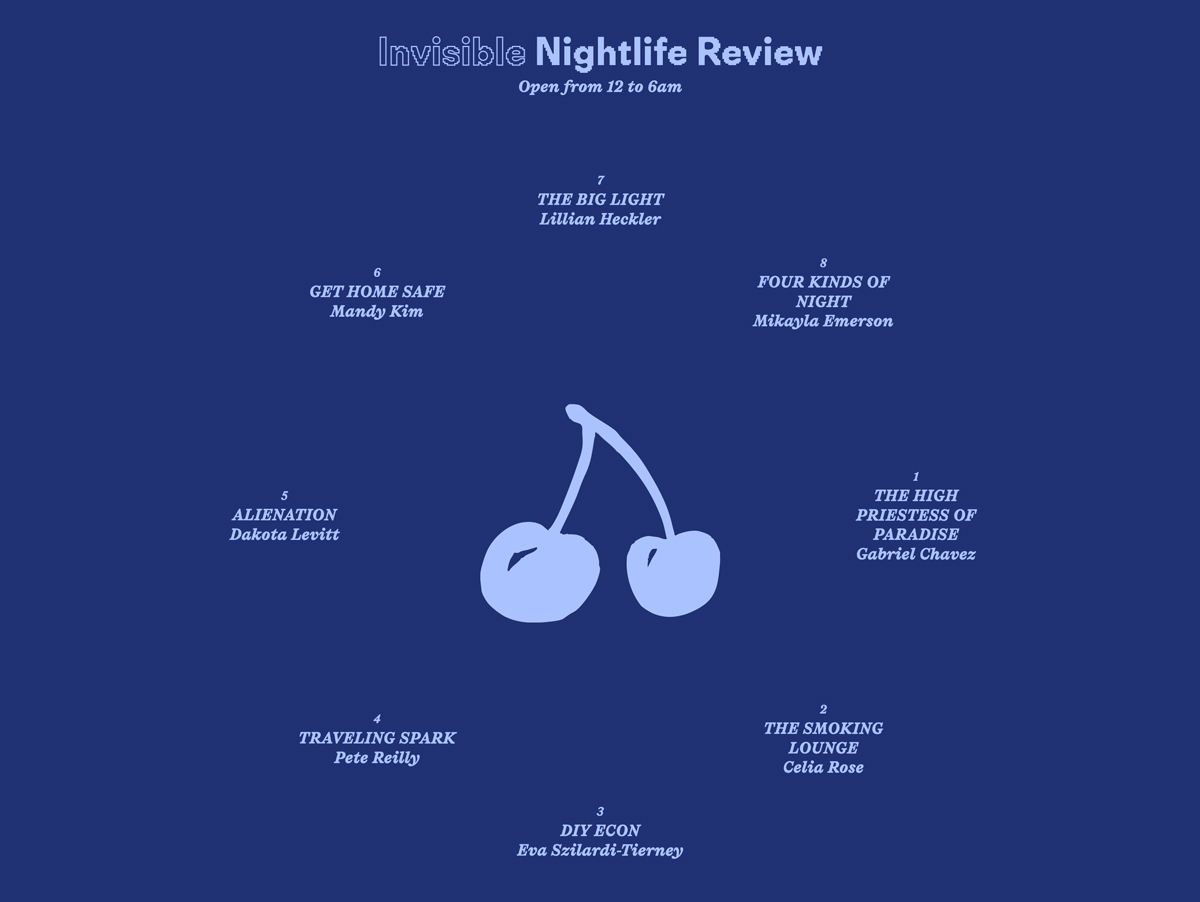
Invisible Nightlife Review: Teaching Fiction as Design Practice

Poetic logs, imagined histories, diary entries, or hybrids about nightlife experiences that never happened.

Nika Simovich Fisher
Assistant Professor
Parsons / The New School for Design

Invisible Nightlife Review is a speculative writing and publishing project I taught at The New School, developed in collaboration with Dirt, an experimental media company.

The project asked students to treat fiction as a design tool. Inspired by Italo Calvino’s Invisible Cities, students created 800-word essays in the form of poetic logs, imagined histories, diary entries, or hybrids about nightlife experiences that never happened. The goal wasn’t to document nightlife, but to explore how people move through visibility, intimacy, and risk after dark, and how fiction can surface emotional truths that are hard to express in literal terms.

The project culminated in a public anthology on Dirt, giving selected students professional bylines and the chance to work with editor Daisy Alioto. I served as co-editor and designed the anthology’s microsite. Some stories were adapted into interactive formats—Google Maps as narrative or an audio based experience—extending the themes of disorientation, memory, and blurred realities.

In 2025, when generative tools are speeding everything up and flattening creative voice, speculative writing slows things down. It gives students a way to make something memorable and their own, while contributing humanities based research outside of the classroom.

This design research is presented at Design Incubation Colloquium 12.2: Annual CAA Conference 2026 (In-person only) on Thursday, February 19, 2026.
Design as Performance

A. Marcel
Graduate student
Vermont College of Fine Arts

“The ideal subject of totalitarian rule is not the convinced Nazi or the convinced Communist, but people for whom the distinction between fact and fiction (i.e., the reality of experience) and the distinction between true and false (i.e., the standards of thought) no longer exist.”

Hannah Arendt

The Origins of Totalitarianism

We currently face a phenomenological question: In a hyperreal, post-truth world, how do we orient toward the real and toward freedom?

This abstract argues that the antidote to disorientation occurs through the embodied praxis of performativity. My research contributes to continued dialogue in media and political theory, as well as performance studies. Performativity is a growing and major new paradigm for the arts in the 21st century. Much like the way conceptual art brought the visual arts out of an object-oriented realm and into a method event based realm in the 1960s, performance has a similar capacity for socio-economic critique via multi-modal, experimental forms of semiotic expression.

This thesis argues that performance orients us toward the real through a creation of the Foucauldian concept of heterotopic space. Performance becomes an index for the real as an index of a 4D world, a spatial dimension we can’t see in a 3D world, but can experience through time-based media or events. Performance thus becomes a method of queering of space and time—and ultimately our relationship to mimesis. This index runs counter to the concept of the single narrative that is the heart of the hyperreal and the simulacra of fascism. The locus for liberatory practice centers in heterotopic spaces and, in turn, the inclusion of multiple narratives—for all of us, as we are always both spectator and participant, audience and actor.

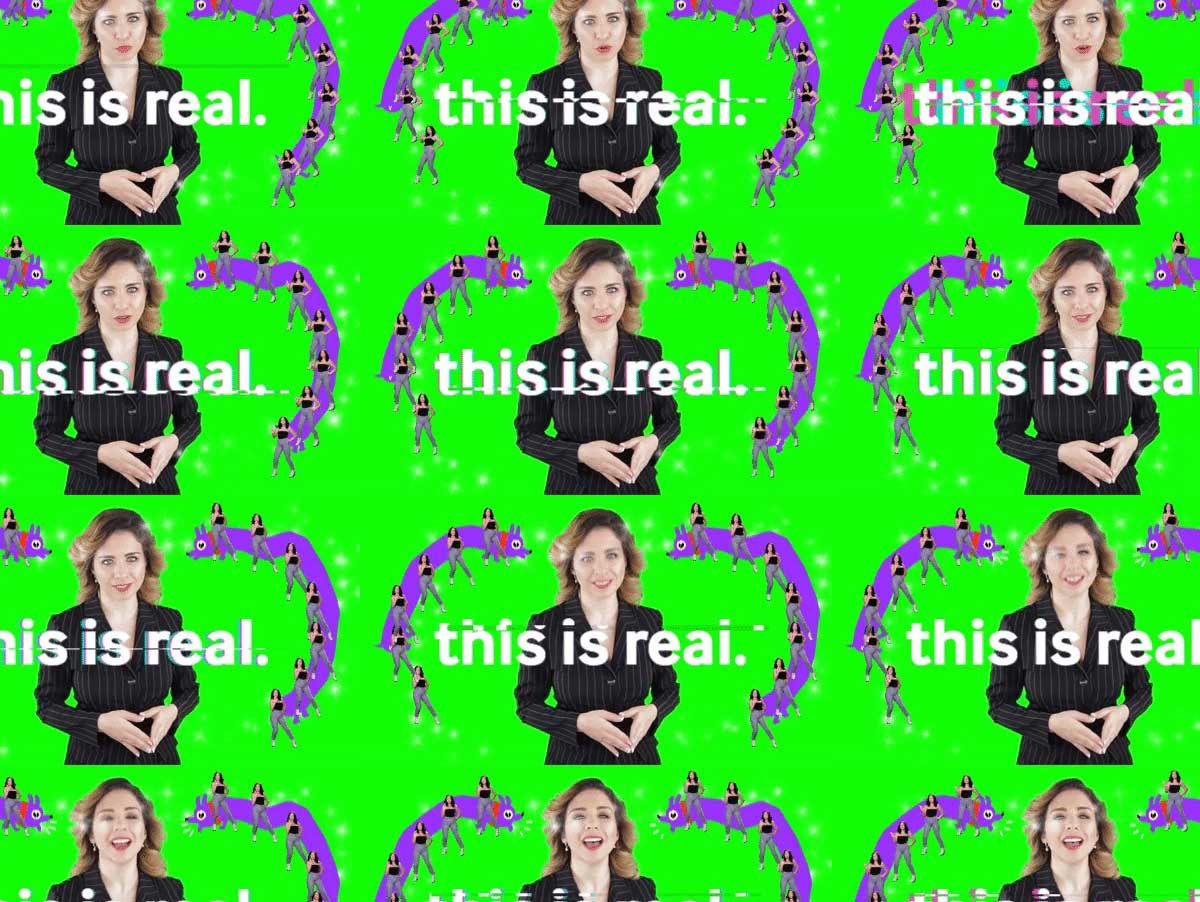
Using fiction as method, I explore this hypothesis through the writing of a play called Hot Dogs 24/7. My theory imagines a tripartite world set within a hypercube, or a tesseract. Hot Dogs 24/7 is a sci-fi retelling of Plato’s Allegory of the Cave. The text is then realized into the visual via video installation. Recursively moving between the micro and the macro, my intention is that my work is doing what I am saying; it is performing. Ultimately, the connection to the physical body, as material and sensory, is the piece driving this all. To conclude, this thesis calls for the formal recognition and exploration of performative design as a subset of graphic design.

This research was presented at the Design Incubation Colloquium 5.1: DePaul University on October 27, 2018.