Mis/Understanding: Reframing Language Barriers and Miscommunication Through InteractiveDesign

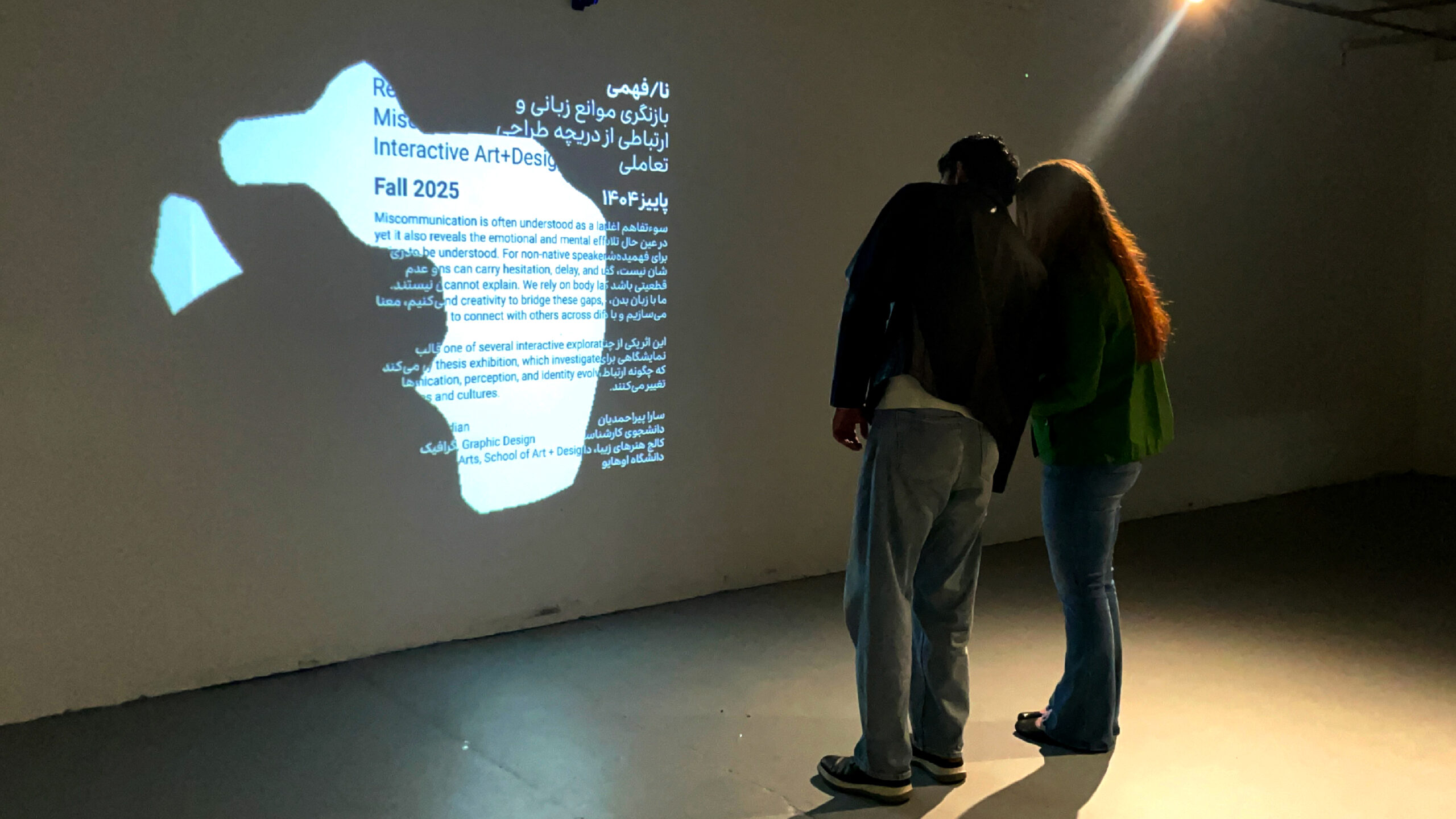
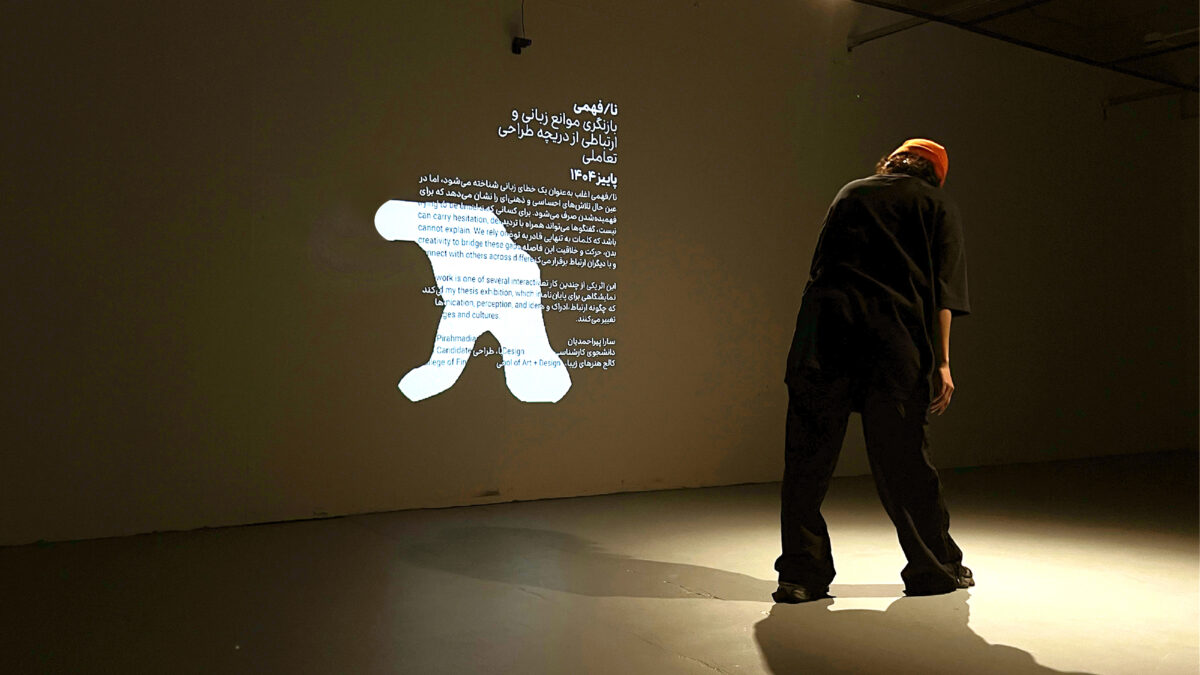
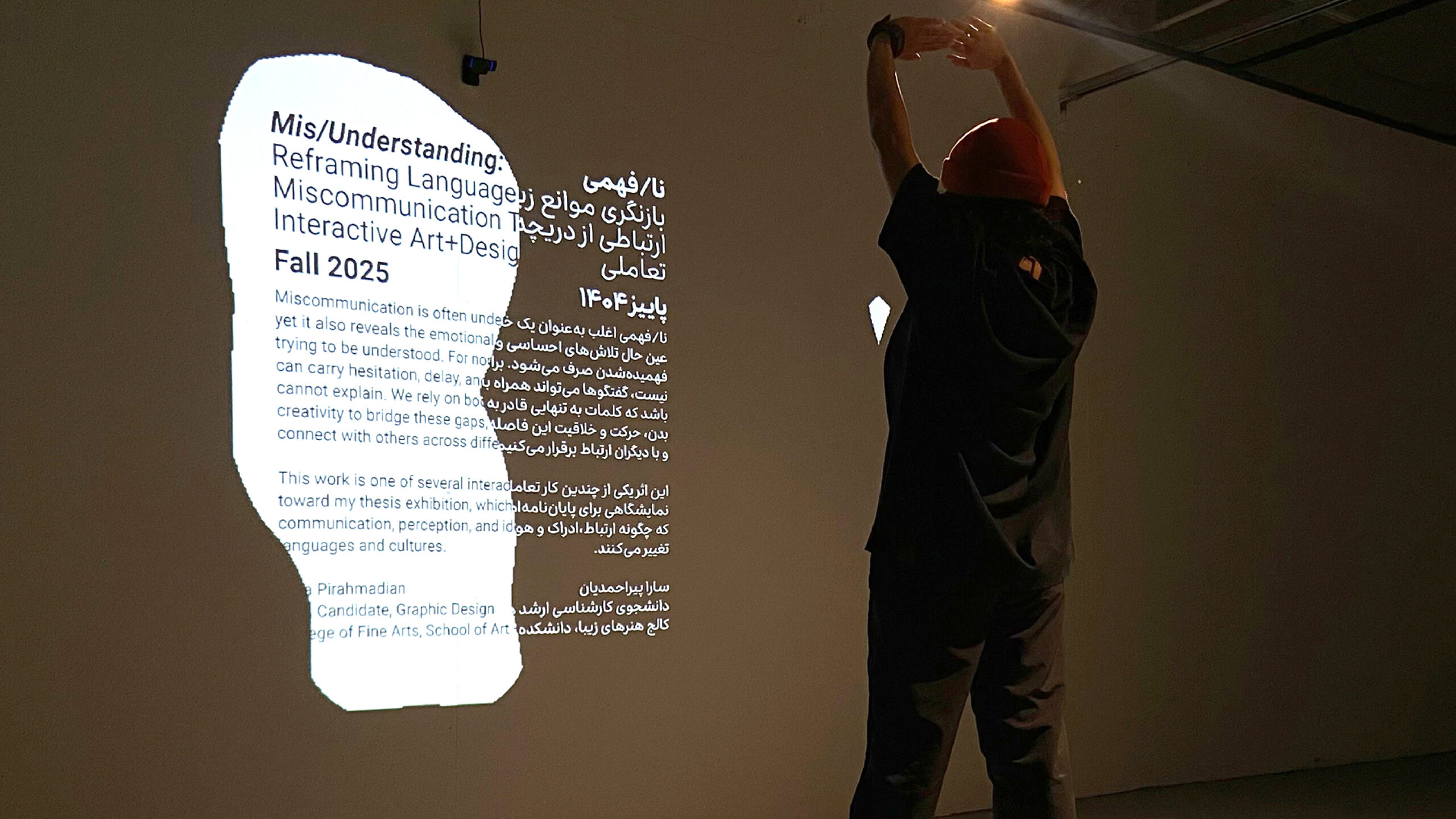
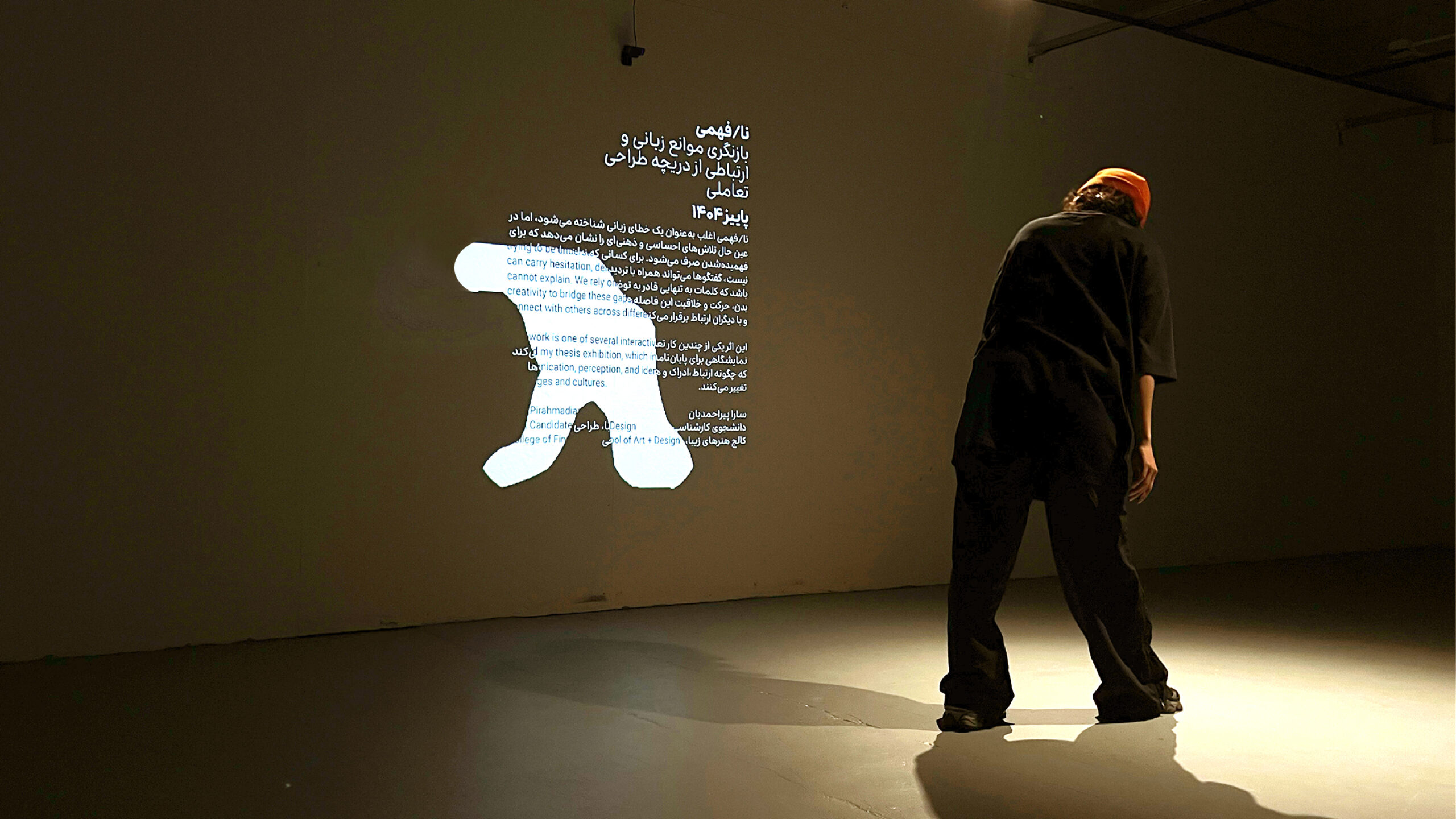
An interactive installation that invites you to move and reveal layers of meaning as participants.

Najmeh Pirahmadian
Graduate student
Ohio University

Miscommunication is often studied in linguistics and psychology as a technical challenge of understanding, yet such perspectives overlook the emotional and cognitive labor carried by non-native speakers. Language barriers create hesitation, delay, and dissonance that are difficult to express through description alone. This research addresses that gap by using interactive design to reveal the invisible labor of miscommunication, reframing it from a private struggle into a shared experiential phenomenon.

The project employed an exploratory, practice-based design research methodology that combined projection mapping, creative coding, and responsive technologies to construct environments where meaning is deliberately unstable. Works include wall text where English words gradually appear over Persian letters through the viewer’s body movement, echoing the struggle of non-native speakers who must often rely on body language to make themselves understood; a dual-microphone system that distorts or delays speech; motion-activated pieces that fragment words or faces in real time; and looping animations that represent anxiety, fear of misunderstanding, and the pressure to perform fluently.
This research resonates with works such as Cildo Meireles’s Babel, which sonifies linguistic confusion; Paige (Xinling)’s Speak in Bloom, visualizing fragile digital speech; and Shuang Wu’s A Poetic Space, reinterpreting poetry beyond translation. Like these, Mis/Understanding transforms linguistic distance into shared, sensory experience.

Initial outcomes show that participants experienced stress and disorientation, suggesting the installations successfully replicate the hesitation and cognitive load of bilingual communication and make the invisible labor of miscommunication tangible.

This research contributes to communication design scholarship by reframing miscommunication as both a design problem and an opportunity: a space where interactivity and relational aesthetics generate new forms of encounter. It demonstrates how practice-based design can function as research, moving beyond representation toward experiential knowledge-making and offering transferable methods for future studies of accessibility, identity, and cross-cultural communication.

This design research is presented at Design Incubation Colloquium 12.1: Virtual Online on Friday, November 14, 2025.
Design + Computation + Performance + __________

An innovative software tool enabling users to create dynamic, immersive media environments.

James Grady
Assistant Professor
Boston University

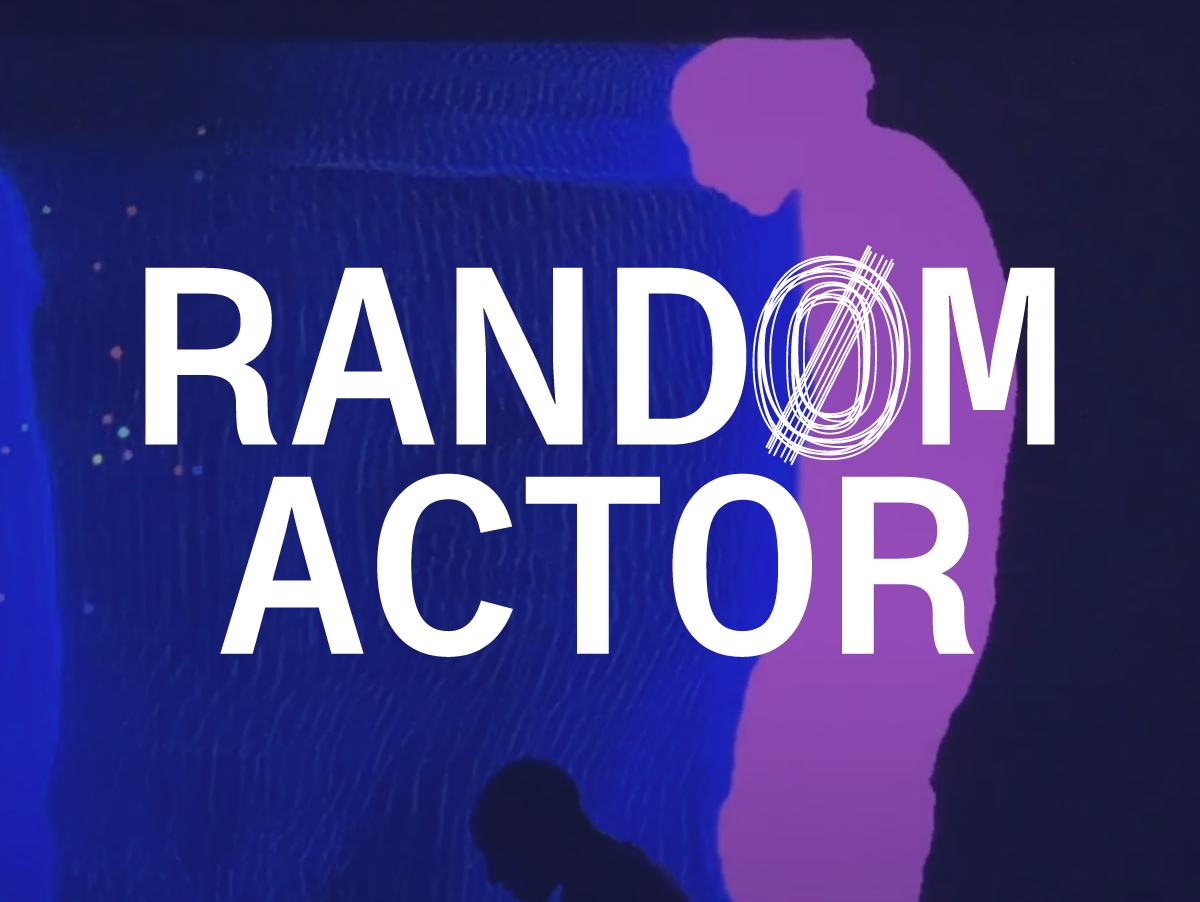
Random Actor is an innovative software tool initiated by James Grady, Assistant Professor of Graphic Design, and Clay Hopper, Senior Lecturer of Directing at Boston University’s College of Fine Arts. This solution connects computation and human performance, enabling users, including theatrical designers, artists, and more, to create dynamic, immersive media environments without extensive coding expertise. By incorporating computational vision, projection mapping, MIDI control, and machine learning into a user-friendly interface, Random Actor democratizes interactive design, making it accessible to a wide range of industries from theater to corporate events and gaming therapy models.

Building on tools like Processing, OpenFrameworks, TouchDesigner, and Unity, which integrate projection mapping, interactive generative graphics, and computational vision, this new tool addresses the challenges of traditional scenic and visual design. These existing tools often require coding knowledge, which can limit accessibility for non-coders. Random Actor bridges this gap by providing an intuitive, user-friendly interface that enables designers and performers to leverage advanced techniques without needing to learn how to code, thus expanding creative expression and adaptability in real-time visual storytelling.

In staging a previous play within an immersive, fully projected-media environment, we found traditional rehearsal methods to be insufficient for achieving the desired aesthetic goals. The excessive time spent adjusting or writing code during rehearsal led to the development of a software application capable of changing the values of any given generative algorithm in real time, without requiring coding knowledge.

We hypothesize that this kind of generative interactive technology could have far-reaching implications for how we construe visual narrative, story structure, and design principles, and how they manifest in physical space as extensions of the human body, speech, sign, and music. Our goal is to develop a new design vocabulary that merges the interior psychology of the performer with the physical environment, expanding the boundaries of Aristotelian narrative structure while affirming their deep relevance to the human experience.

Random Actor aims to bridge the gap between technology, creativity, and research. It expands on a continuum where technology empowers artistic expression. Based on our recent testing during a live play and multiple workshops, our findings suggest a bright future for such tools, indicating they could be further refined and integrated into broader artistic and educational practices, potentially transforming the landscape of design and performance art.

This design research is presented at Design Incubation Colloquium 11.1: Boston University on Friday, October 25, 2024.