Alison Place
Assistant Professor
University of Arkansas
Additional contributors: Jennifer Armbrust, Dina Benbrahim, Madeline Avram Blount, Elizabeth Byrd, Benedetta Crippa, Alexandra Crosby, Laura Devendorf, Rachael Dietkus, Ashley K. Eberhart, Griselda Flesler, Aimi Hamraie, Gaby Hernández, Alexis Hope, Jeff Kasper, Ellen Kellogg, Aasawari Kulkarni, Eden Laurin, Una Lee, Andrew Mallinson, Claudia Marina, Victor G. Martinez, Lauren Lee McCarthy, Margaret Middleton, Maryam Mustafa, Becky Nasadowski, Maya Ober, Nina Paim, Elizabeth Pérez, Heather Snyder Quinn, Cami Rincón, Jenn Roberts, Velvet A. Johnson Ross, In-ah Shin, Marie Louise Juul Søndergaard, Ayako Takase, Attia Taylor, Rebecca Tegtmeyer, Aggie Toppins, Ilaria Vanni, Joana Varon, Manon Vergerio, Mandy Harris Williams, Sarah Williams.
Published in September of 2023 by MIT Press, Feminist Designer: On the Personal and the Political in Design is a book that explores emerging feminist practices in design. Place wrote this book, primarily, for her students, in whom she observed strong passion for addressing feminist issues through design with little understanding of the histories and power structures that undergird them. The writing and concepts in the book are intended to be accessible for a wide audience, not just an academic one. Her own writing makes up about one-third of the book, while the rest is comprised of contributions from other designers. Contributors were solicited through an open call for proposals or by direct invitation, with a significant effort made to assemble a diverse array of identities, background, disciplines and perspectives. Each contributor was paid an honorarium, funded by an advance from the publisher.
Book Blurb
Feminist Designer brings together a constellation of voices and perspectives to examine the intersection of design and feminist theory. For decades, the feminist refrain within design has hinged on the representation and inclusion of women in the field. This collection, however, is a call to move beyond this narrow application. Feminist design is not just about who does design—it is about how we do design and why. Feminist frameworks for design activism are now more relevant than ever, as they emphasize collaborative processes that aim to disrupt and dismantle power hierarchies while centering feminist ways of knowing and doing.
The first book in nearly three decades to address such practices in design, Feminist Designer contains essays, case studies, and dialogues by 43 contributors from 16 different countries. Place engages a wide variety of design disciplines, from graphic design to disability design to algorithmic design, and explores key feminist themes, such as power, knowledge, care, plurality, liberation, and community. Through diverse, sometimes conflicting, intersectional perspectives, this book contributes new design methods informed by a multiplicity of feminisms that confront design’s patriarchal origins while ushering in new pathways for making critical and meaningful change.
Book Design
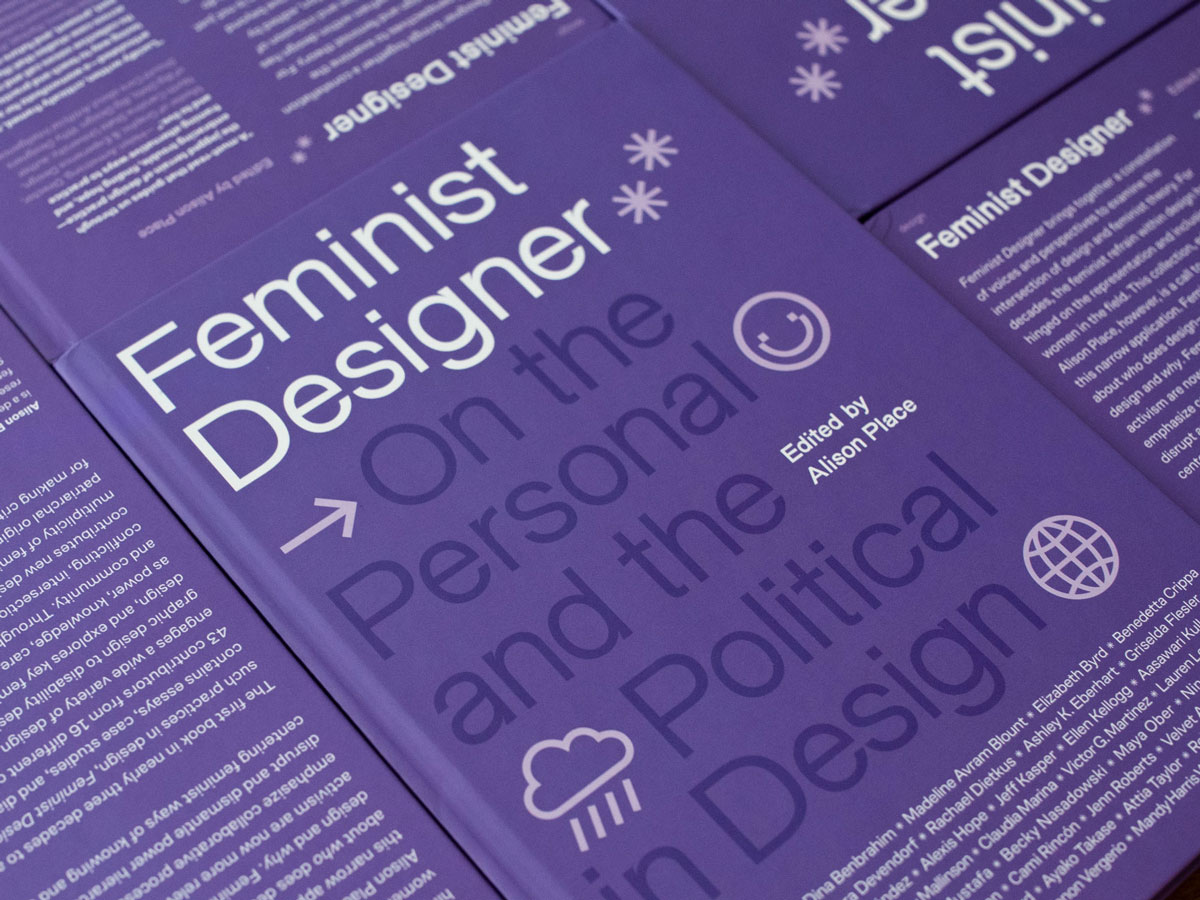
In addition to writing the book, she also designed it, which was a feminist project in itself. The three typefaces used are Bastardo Grotesk (Giulia Boggio), Cofo Sans (Contrast Type Foundry), and Fraunces (Phaedra Charles)—all created by designers who identify as women, non-binary or trans. The typography on the cover makes a loud statement with the title and subtitle in large, bold type with a spot varnish, echoing an unwavering chant of feminist protest. The addition of emoji-style glyphs on each line speak to the snarky ambivalence felt by an emerging generation of feminists. The purple hues merge the historical purple of the 20th century suffragettes, with the effervescence of so-called Gen Z lavender. In the feminist spirit of citation, the name of every contributor in the book is featured on the cover in alphabetical order, giving credit where credit is due. The interior of the book is designed for accessible reading, plus ease of skimming; sections are short, with headlines, decks, and pull quotes like a magazine.
Outcomes
The book has received much positive recognition from the media, with excerpts published in Design Observer and Fast Company; several reviews in major outlets including the Boston Globe, Metropolis Magazine, and Madame Architect; and was named one of the best design books of 2023 by both Fast Company and the Architect’s Newspaper. Currently, there are seven journal reviews in progress expected to be published next year in top journals, including Design and Culture, Design Issues, and the Journal of Feminist Pedagogy. Place has been interviewed about the book on two podcasts, Scratching the Surface and The Deep Dive, and invited to speak at DePaul University in Chicago in 2024. Though it has only been four months since the book was published, she is excited to see the conversations about feminist design that have been initiated, and she look forward to expanding and amplifying those in the months to come.
This project was the 2023 Design Incubation Educators Awards winner recipient in the category of Scholarship: Publication.
Alison Place is a designer, educator and researcher who works at the intersection of feminism and design to create spaces for critical making and radical speculation. She is the author of Feminist Designer: On the Personal and the Political in Design published by MIT Press in 2023. She is an assistant professor of graphic design at the University of Arkansas School of Art, where she also serves as the director of the graphic design program. She has held several leadership roles in the design community, including two terms on the AIGA Design Educators Community National Steering Committee, and has earned multiple national awards for her scholarship and creative work. Previously, she worked for more than ten years as a creative director and designer for nonprofit and higher education institutions. She earned an M.F.A. in experience design from Miami University of Ohio, as well as degrees in graphic design and journalism from the University of Cincinnati College of Design, Architecture, Art and Planning.
Like this:
Like Loading...