
Type as Cultural Bridge: An Interactive Fusion of Iranian and American Design

How typography and interactive media can bridge Iranian cultural heritage and contemporary American aesthetics.

Narges Sedaghat
Graduate student
East Carolina University

In an increasingly globalized and diasporic world, the negotiation of cultural identity has become a central concern in design. Scholars such as Homi Bhabha and Stuart Hall have theorized identity not as a fixed essence but as a fluid process shaped by historical and aesthetic negotiations. Visual culture, particularly typography, can play a critical role in reinterpreting heritage within new cultural frameworks. This project explores how typography and interactive media can bridge Iranian cultural heritage and contemporary American aesthetics, contributing to broader conversations around hybridity, migration, and representation.

The project unfolds in two interrelated phases. The first phase focuses on type design as a medium for cultural storytelling. A full English A-to-Z typeface was developed, inspired by ancient Persian motifs, particularly the Achaemenid lotus. This typeface merges traditional Iranian elements with modern typographic forms, reframing Iranian identity not as fixed or nostalgic, but hybrid and dynamic, aligned with Bhabha’s concept of the third space that conceptualizes identity as a process shaped by hybridity and negotiation.

The second phase of the project centers on participation and interactivity. It takes the form of a web-based experience built with p5.js, where users type their names using the custom font. This action triggers a system that algorithmically generates Iranian-inspired motifs. Users can download or print their designs as postcards, transforming the experience from passive viewing to active participation.

By creating a custom typeface, this project aims to bridge Iranian heritage and contemporary design. This typeface serves as a tool for cultural exchange, and by inviting user interaction, the project becomes a participatory platform. It illustrates how design can embody migration, hybridity, and transformation. Ultimately, this research positions visual design not only as a means of cultural preservation but as a forward-looking method for negotiating hybrid identities and fostering inclusive, multisensory storytelling.

This design research is presented at Design Incubation Colloquium 11.3: Virtual Summer on Friday, June 20, 2025.
Academic Marginality and Exclusion for Graphic Design Educators of the United States

Visual design education is rapidly shifting from Western and print-centric to diversifying with emerging technology and globalization

Yeohyun Ahn
Assistant Professor
University of Wisconsin-Madison

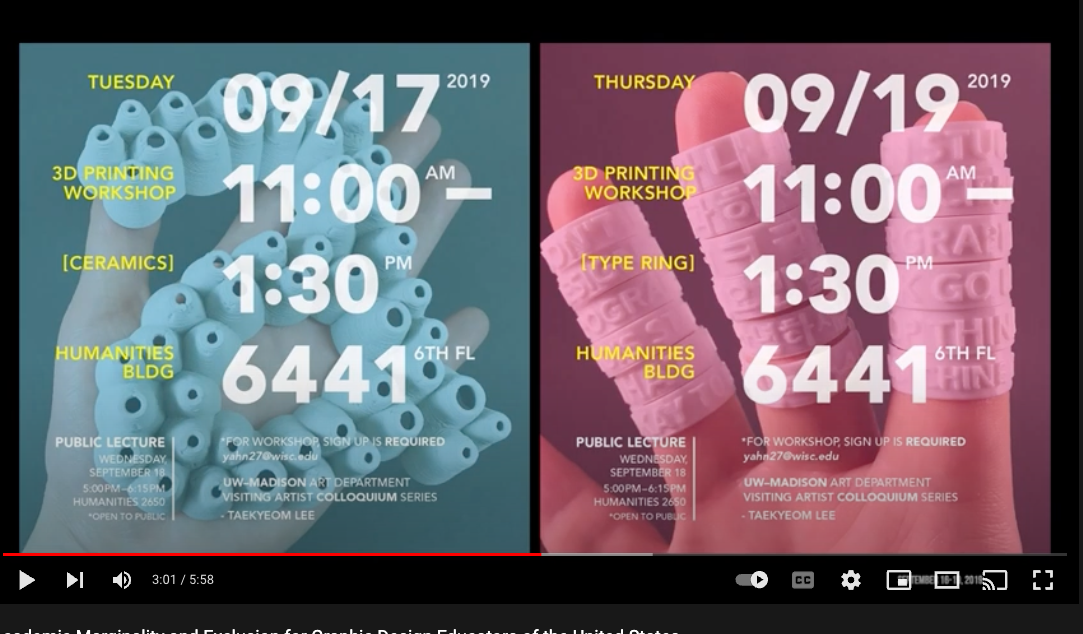
Graphic Design has been a predominantly white and European-centric academic area deeply rooted in Bauhaus, a German art school from 1919 to 1933, combining crafts and the fine arts to approach constructive and universal design for mass production. It has dominated modern graphic design for over 100 years. Now visual design education is rapidly shifting from Western and print-centric to diversifying with emerging technology and globalization. This research aims to create original and impactful exhibition design and research opportunities (symposium) for academically underrepresented and marginal graphic design educators in the United States. The study investigates the future of visual design education and research, crossing boundaries among creative coding, 3d printing, Guerrilla projection, speculative design, sound, data visualization, augmented reality with activism, and cultural identity impacted by globalization. It results in an original exhibition design that frames a newly curated exhibition. The curated exhibition invites sixteen outstanding visual design educators of the US who are highly regarded but academically undervalued and depreciated from conservative, homogenous, and print-centric professional graphic design communities. The design methodology, Design Thinking, is employed to create the user-friendly and inclusive interface design for the virtual reality gallery. The virtual exhibition brings global exposure and tap into an extensive network of academically underrepresented graphic design educators and underserved audiences. The exhibition visitors gain new in-person and immersive virtual experiences for evolving graphic design. It incubates new visual design perspectives being open-minded, alternative, diverse, and inclusive visual communication design education, practices, research, and communities of the US.

This research was presented at the Design Incubation Colloquium 8.2: Annual CAA Conference on Thursday, March 3, 2022.