
Elizabeth Resnick
Professor Emerita
Massachusetts College of Art and Design
In 1994, US designer, design educator, and historian Martha Scotford published an inspirational essay titled ‘Messy History vs. Neat History: Toward an Expanded View of Women in Graphic Design’ (Visible Language 28:4). In her introduction, she states: ‘For the contributions of women in graphic design to be discovered and understood, their different experiences and roles within the patriarchal and capitalist framework they share with men, and their choices and experiences within a female framework, must be acknowledged and explored. Neat history is conventional history: a focus on the mainstream activities and work of individual, usually male, designers. Messy history seeks to discover, study, and include the variety of alternative approaches and activities that are often part of women designers’ professional lives.’
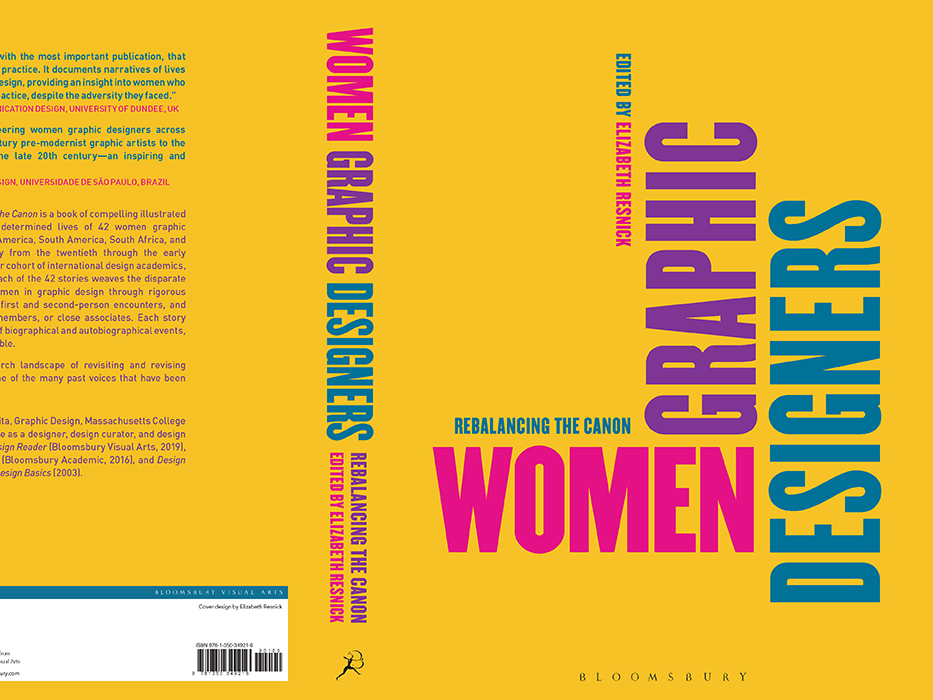
Women Graphic Designers: Rebalancing the Canon is a book of illustrated stories examining the resilient and determined lives of 44 women graphic designers — from Europe, Asia, North America, South America, South Africa, and Australia — who worked professionally during the twentieth through early twenty-first century. Written by a stellar cohort of international design academics, practitioners, and design historians, the book represents the current research landscape of revisioning graphic design history, in part due to the recognition that many past voices have been systematically excluded.
Currently, there is an urgent need to codify and decolonize the work and stories of multicultural women designers, making them more accessible to educators, practitioners, and students alike. Critical feminist and decolonial perspectives provide a richer, more multifaceted narrative of design history that acknowledges both the advances and limitations of female designers’ contributions. Embracing the converging paths forged through the multidisciplinary nature of design and its design practitioners, my presentation will illuminate certain stories selected for their diverse cultural experiences, perspectives, and approaches to design.
This design research is presented at Design Incubation Colloquium 12.1: Virtual Online on Friday, November 14, 2025.