
Kyla Paolucci
Assistant Professor
St. John’s University
Vic Rodriguez Tang
Assistant Professor
Texas State University
Motivation/Problem/Opportunity
Risograph printing is having a moment. As a technology-based duplication process—often compared to a hybrid of screen printing and photocopying—it is recognized for its vibrant colors, layered textures, and presence in independent publishing and community printshops. While Riso is often celebrated as a trendy or aesthetic tool within design and art contexts, its pedagogical potential remains underexplored. There is an opportunity to frame Riso as a low-stakes, accessible teaching method that fosters technical literacy, collaboration, and community connection. Risograph printing can serve as an entry point into creative-related careers for students with little to no prior experience in art or design technologies. By offering a process-oriented environment where curiosity is enough to begin, Riso broadens participation in creative practice and helps learners reimagine design through experimentation and collective making.
Thesis
This project argues that constraint-driven, prompt-based Risograph printing can function as a model for pedagogy by combining technical skill-building, collaborative practice, and community engagement while moving beyond trend-based or perfection-oriented applications.
Approach/Methodology
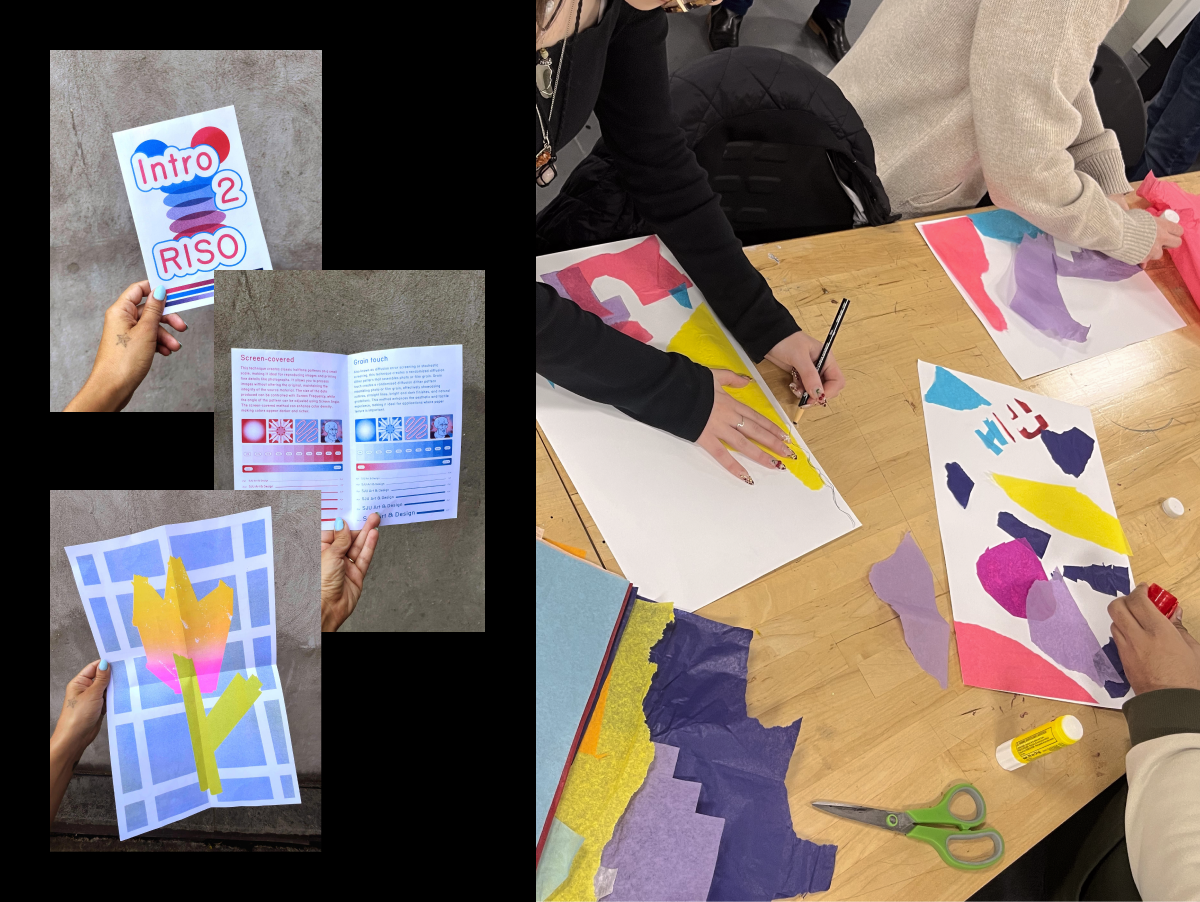
Two educators respond to the same prompts—printing on black paper, executing a four-color separation, or working exclusively on the flatbed—without sharing approaches in advance. The paired responses form a prompt-based archive including prints, prompts, and reflections on similarities, differences, and lessons learned. Over time, this archive evolves into a toolkit of adaptable prompts for classrooms and community workshops, framing Riso printing as both teaching and research practice.
Results/Outcomes/Analysis
Unlike short-term workshops, this project cultivates a sustained, evolving body of work that operates as both practice and pedagogy. Outcomes include collaborative prints, adaptable exercises, and a reflective zine compiling process documentation. The project demonstrates how structured experimentation can reduce gatekeeping, promote curiosity, and support equitable access to design education.
Conclusion
This project reframes Riso as a tool for approachable experimentation and shared authorship, showing how analog technologies can support creativity, inclusion, and critical reflection in design pedagogy.
This design research is presented at Design Incubation Colloquium 12.1: Virtual Online on Friday, November 14, 2025.