
Anastasiia Raina
Associate Professor
Rhode Island School of Design
Anastasiia Raina’s course Design in the Posthuman Age has been taught since 2018 and has become a platform for transdisciplinary exchange, bringing together graduate and undergraduate students from RISD and Brown University. The course has been consistently popular among students across art and design departments as well as Brown University majors.
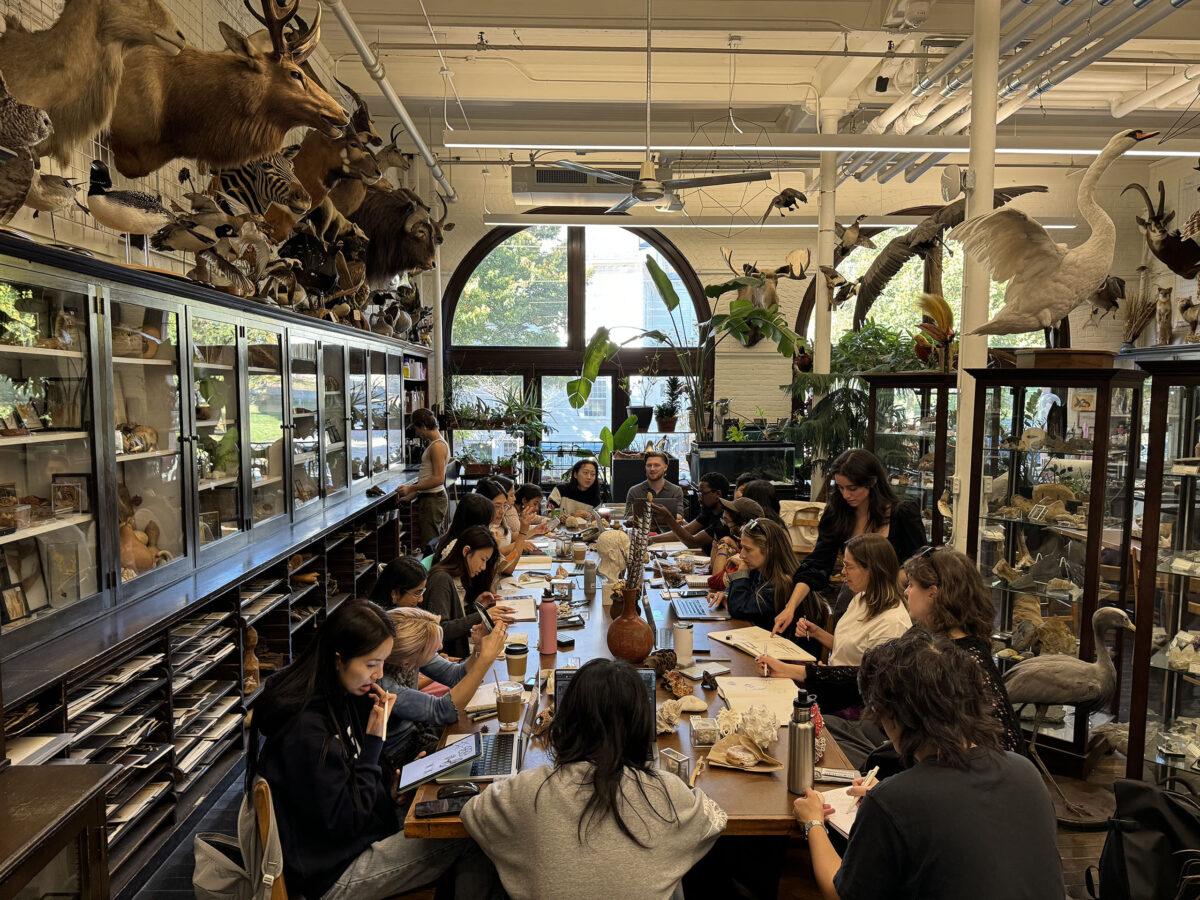
In the course, students develop in-depth knowledge of machine learning, data politics, emerging technology, and climate change, and critically examine the implications of these forces on the design field. The class also draws on RISD’s Nature Lab as a core resource, where students work with nature specimens, microscopy for close observation, visual research, and form making. Biomorphic Typography workshop invites students to look closely at the structures found in nature and translate them into typographic form; this assignment becomes a way to think with living systems.
What is most inspiring about this course is how it functions as a visual research lab— it balances a strong theoretical framework and rigorous making. New design methodologies emerge through the use of tools that both science and design have to offer. The course stays focused on the ethical dimensions of emerging technologies as they inscribe our social, educational, cultural, and biopolitical landscapes.
Learning outcomes include: expanding what constitutes design; surveying collaborations between art, design, biology, and other sciences; imagining new roles for designers in the age of AI and gene editing; gaining perspectives from non-human organisms and environments; challenging inherited aesthetic norms and formats; and developing bold experimental methods that value meaningful risk-taking and productive failure.
Contemporary graphic design is formed by two significant forces: machine vision and climate change. Emerging designers now enter a profession in which form and meaning are mediated by automated perception, including cameras, datasets, recognition models, platform ranking, and generative systems. Simultaneously, climate change redefines design responsibilities, reshaping materials and production, and how designers communicate climate change to the public.
Design In The Posthuman Age addresses both challenges through a defined methodology. Machine vision is approached as a design instrument. Students examine machine learning and datasets, construct reality, and explore how classification can generate bias and exclusion. Machine learning is introduced as a visual method, and students learn to build custom datasets and train models, moving beyond reliance on off-the-shelf models like Midjourney. This method changes students from passive users of artificial intelligence to designers capable of critically engaging with emerging technologies.
Climate change is addressed by introducing students to nature systems, environmental sensing, satellite imagery, scientific imaging, and the visualization of climate data in design processes. Students develop skills to translate complex environmental and biological information into visual systems that support climate action.
To develop a new visual language necessary to address these issues, students generate forms derived from natural specimens and employ processes such as crossover and mutation, using both analogue drawing and machine-learning. These formal systems are developed into typefaces, books, posters, motion pieces, and interactive works. This workflow engages observation, biological metaphor, and iterative design, which in turn, develops new visual methods for typography and visual identity that are living, dynamic, and adaptive.
The Design In The Posthuman Age course expands the definition of graphic design by incorporating data, code, and biomaterials into the visual method. It enables students to:
- create novel visual forms using scientific tools, nature specimens, and machine learning.
- articulate the ethical implications of emerging technology
- collaborate across disciplines, preparing students to address technical complexity and social responsibility.
https://eyeondesign.aiga.org/what-does-posthuman-design-actually-mean
https://www.risd.edu/news/stories/graphic-design-faculty-anastasiia-raina-on-posthumanism-and-design
Biography
Anastasiia Raina is a Ukrainian-born biodesigner, researcher, and Associate Professor at RISD. She holds an MFA in Graphic Design from the Yale School of Art. Anastasiia integrates living organisms, natural systems, and data into her practice, inspiring the audience to connect with science and the environment in transformative ways. Her research delves into the aesthetics of technologically mediated nature, machine vision, evolutionary biology, and biomaterials to create new methodologies that redefine design possibilities.
As an Associate Professor at the Rhode Island School of Design (RISD), Raina directs Nature-Culture-Sustainability Studies with over 170 students from 17 departments. Her work has been exhibited in New York, Los Angeles, Shanghai, and Seoul. Raina has also lectured and served as a critic at Yale University, Columbia University, Stanford University, Parsons, Pratt Institute, Otis College of Art and Design, the University of Southern California (USC), and the Maryland Institute College of Art (MICA). Additionally, Anastasiia consults international organizations and companies, including the Hyundai Motor Group where she worked a three-year project exploring the Future of Mobility and Sustainable Cities.
This project was the 2025 Design Incubation Educators Awards winning recipient in the category of Teaching.